Biden’s magic budget fools no one
It’s easy to get too excited about a president’s budget. OK, maybe not. But it’s certainly possible to read too much meaning into the fiscal plans issued by the White House. So it is with Joe Biden’s record-setting $5.8 trillion budget, published this week.
As Jonathan Bydlak writes for the site, the documents aren’t the law, and even in a functioning Washington, they are only the start of the budget process. In a dysfunctional Washington, they are good for little more than messaging. What is the message of Biden’s budget? “Its significance is limited to telling us what we already know: the administration wants to spend — a lot,” writes Bydlak.
The White House has spun this budget as a pivot to the center. And, at least in some corners, that spin seems to have worked. The New York Times reported that the budget was a continuation of a change of course set at the State of the Union, “where he reframed a domestic agenda that focused less on the sweeping aspirations of his first year in office and more on issues worrying swing-state Democrats ahead of the midterm elections.” There are, however, a few problems with this framing.
Biden may have presented his budget as an example of fiscal responsibility. But what use is a hypothetical balancing of the books when it depends on a politically doomed and likely unconstitutional proposal to tax the unrealized gains of wealthy Americans, as Biden’s proposed “billionaire’s tax” does? Perhaps more important is the not-so-sneaky exclusion of any Build Back Better-related spending. As Brien Riedl explains for the Dispatch, the White House has used what is known as a “magic asterisk” that carves out an expensive pledge from the president’s tax-and-spend plans. The scale of the dodge — $2.4 trillion against a total budget of $5.8 trillion — renders the budget exercise even more pointless than usual. Why put out a budget at all? Not that the BBB-free budget is an especially reassuring document. It amounts to a large increase in the scope and scale of the state, especially compared to pre-pandemic levels.
Biden’s economic policy has so far been characterized by magical thinking: a massive spending bill that costs nothing and the insistence that government spending has nothing to do with inflation, to cite two examples. Add this budget to the list. If the White House is to be believed, the package is both an overdue expansion in the role of the US state and a paragon of fiscal responsibility — and it includes a package of tax rises that won’t do any economic harm. Does Biden really think voters will fall for that?
*** Sign up to receive the DC Diary in your inbox on weekdays ***
Does Collins’s yes on KBJ signal a return to normalcy in Washington?
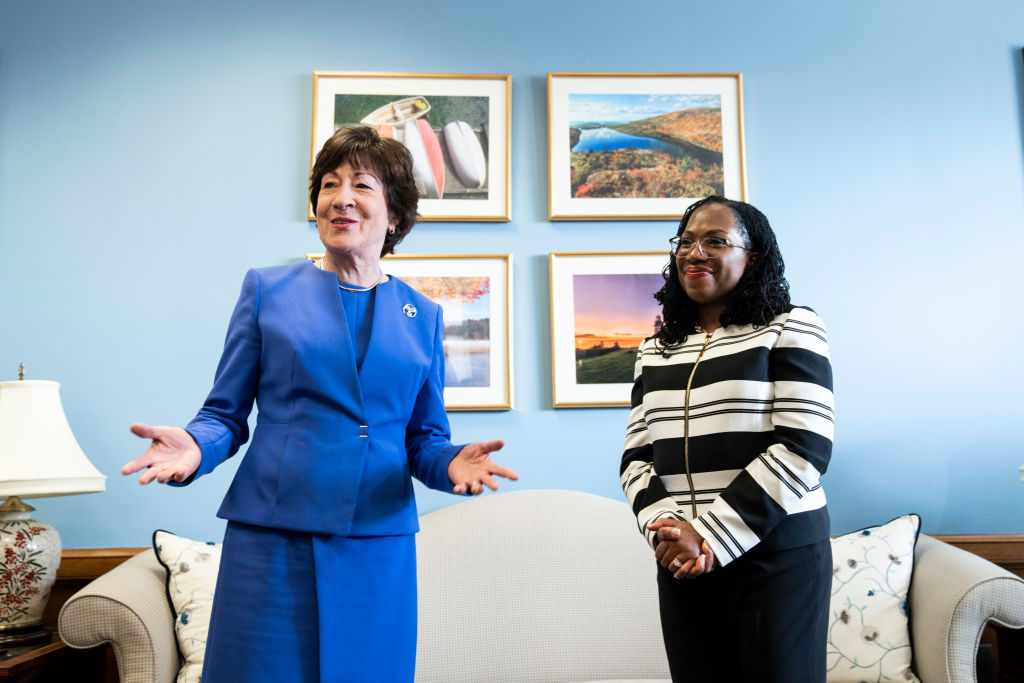
Maine senator Susan Collins has announced that she will vote to confirm Ketanji Brown Jackson’s Supreme Court nomination. The judge has been on a glide path to the top court ever since Joe Manchin indicated that he would back her at the end of last week. But Collins’s announcement means that KBJ’s confirmation will not be a straight party-line vote, giving the process a faint whiff of bipartisanship.
“In recent years, senators on both sides of the aisle have gotten away from what I perceive to be the appropriate process for evaluating judicial nominees,” said Collins. “In my view, the role under the Constitution assigned to the Senate is to look at the credentials, experience and qualifications of the nominee. It is not to assess whether a nominee reflects the individual ideology of a senator or would vote exactly as an individual senator would want.”
Will Jackson pick up any other Republican votes? Mitt Romney and Lisa Murkowski are two possible yeses, but so far neither has stated how they plan to vote.
Trump lowers expectations
Donald Trump may not be famous for expectation management, but that was the order of business in a cable TV interview yesterday. When he wasn’t busy calling for Vladimir Putin to release dirt on Joe Biden (an extraordinary thing to do given the geopolitical circumstances), the former president was tamping down the prospects of his chosen midterm candidates. “I endorse a lot of people that are long shots,” he told Real America’s Voice. “Hopefully David Perdue is going to win. These are not sure things. If I lose one along the way, which you have to, right, they’re going to say, ‘This was a humiliating experience.’”
Cawthorn gives McCarthy a cocaine-and-orgies headache
Barely a week goes by without North Carolina congressman Madison Cawthorn causing Kevin McCarthy embarrassment. Two weeks ago it was his characterization of Ukrainian president Volodymyr Zelensky as a “thug.” This week it’s claims about orgies and cocaine in Washington. Asked on a podcast how life in the nation’s capital compared to the nefarious goings on depicted in House of Cards, Cawthorn said it was more documentary than drama, adding that he had been invited to a sex party and seen a lawmaker do cocaine since arriving in DC last year. Asked about the twenty-six-year-old congressman’s claims, McCarthy adopted the tone of a stern parent and said that he would be speaking to Cawthorn. Scott Perry, House Freedom Caucus chair, pursued a riskier form of repudiation: “I think it is important, if you’re going to say something like that, to name some names,” he said.
What you should be reading today
Sohrab Ahmari: The flawed idealism that united the right
Julius Strauss: Has Putin finally handed over control to his generals?
Bill Kauffman: A eulogy for Democrats of yore
Samuel Goldman, the Week: Culture war in the magic kingdom
Yuval Levin, New York Times: Democrats and Republicans won’t stop committing political malpractice
Nora Kenney, City Journal: Columbus’s promise, and challenge
Poll watch
President Biden Job Approval
Approve: 41.0 percent
Disapprove: 53.3 percent
Net approval: -12.3 (RCP Average)
Florida Job Approvals
Governor Ron DeSantis: 59 percent
Senator Rick Scott: 55 percent
Senator Marco Rubio: 54 percent (Saint Leo)