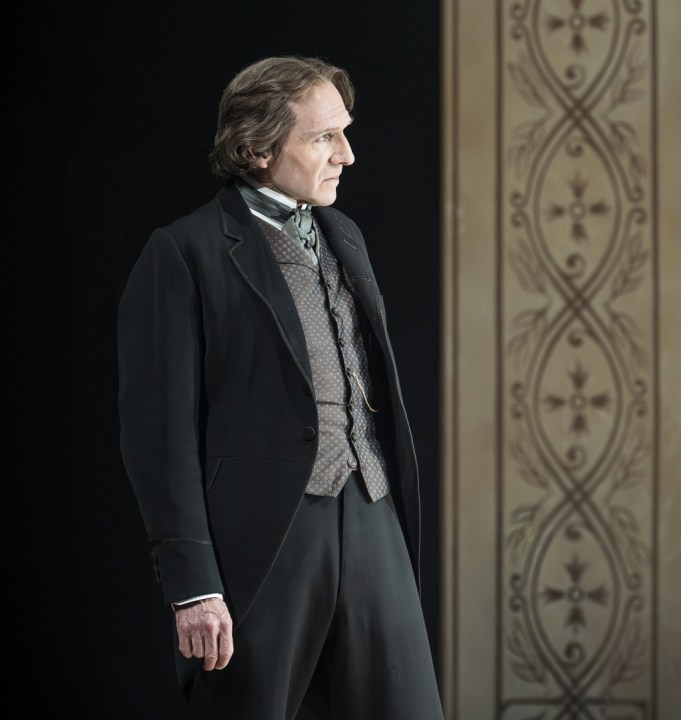


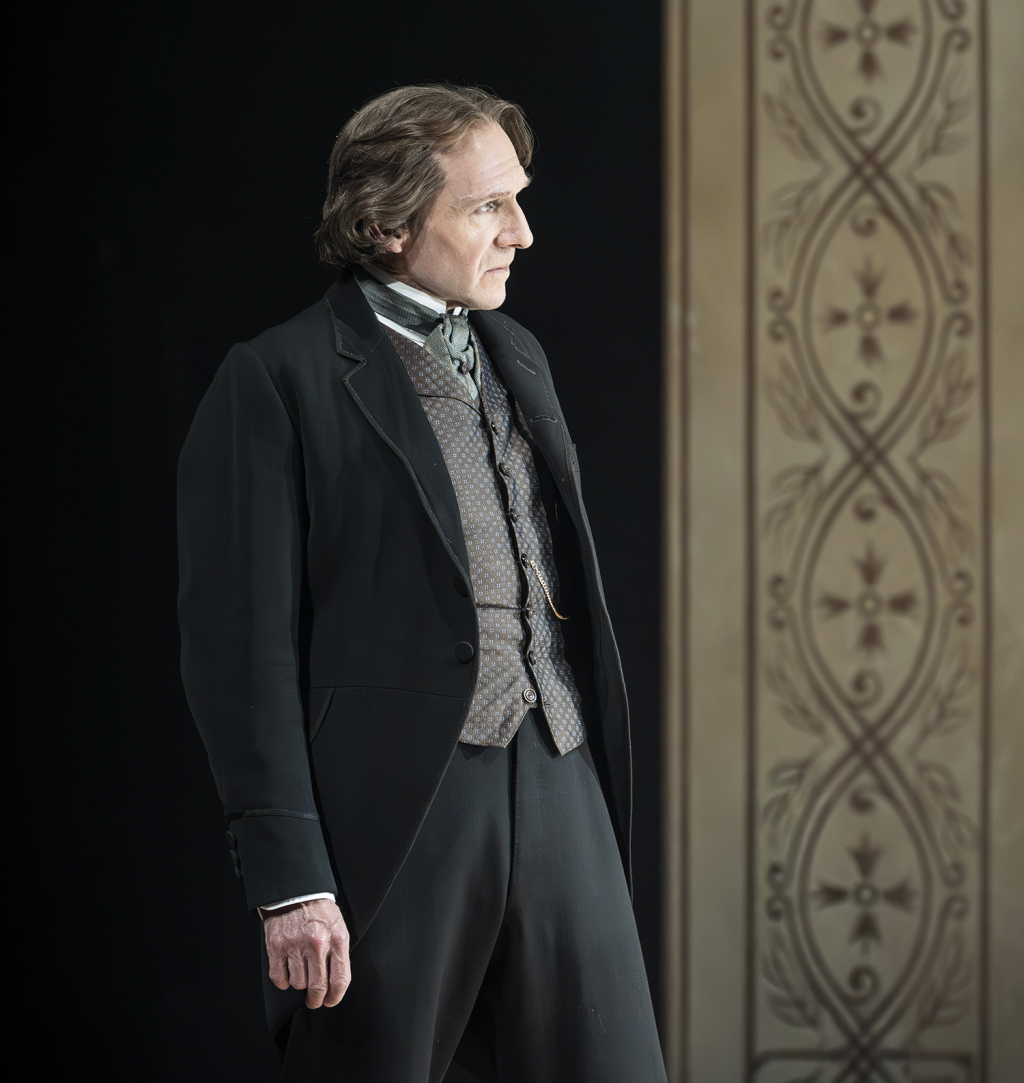
Grace Pervades by David Hare is a drama-documentary about the life and theatrical work of the great Victorian thesp, Sir Henry Irving. He was a morose and obsessive perfectionist whose style was considered dated even in the 19th century. Success arrived relatively late in life. He was making his way as a jobbing actor until he took the lead in an overheated French melodrama, The Bells, which turned him into a star in 1871.
Ralph Fiennes delivers a dour, mirthless and deliberately stiff performance as the cranky and unapproachable actor. In drawing rooms, he shifts his feet awkwardly as if trying to find a floorboard that doesn’t creak. On stage, his mannered performances are presented as absurdities, full of grimacing, eye-rolling, jaw grinding and head tossing. Irving’s personality catches fire only once – when he denounces playwrights such as Ibsen and Shaw whose work he despises because they confine their characters to suburban homes. He rages about his need for palaces, cathedrals and royal courts to bring his mythical heroes to life.
The staging by Bob Crowley, Peter Mumford and Fotini Dimou is miraculous
Tiring of Irving, Hare’s script moves to his on-stage colleague, and perhaps lover, Ellen Terry. He writes the role very politely and presents her as an angelic beauty who floats through life, charming audiences, earning fortunes, touring America, and seldom raising a peep of complaint. Miranda Raison is perfect but she doesn’t stamp herself on our memory.
Next we move to her illegitimate children, who used the surname Craig. Edith built a theatre in Kent where she staged subversive plays about violent suffragettes. Ruby Ashbourne Serkis, always excellent, plays her as an earnest and tiresome do-gooder. Her brother, Edwin Gordon Craig, was ruined in childhood by his mother who constantly declared that he was a genius. He believed her. No one else did. As a youth he joined Irving’s company but he alienated the cast by sermonising about his pretentious desire to set plays free from the limitations of actors, costumes and even scripts. During a rehearsal for Hamlet, they flung the young visionary from the battlements of Elsinore. But to modern ears his theories sound disturbingly familiar. He spoke of the ideal show as an incorporeal abstraction that exists in the producer’s mind and ‘never actually opens’. He was still alive in 1966 and his poppycock inspired the young Peter Brook. Jordan Metcalfe captures his brittle pomposity superbly. He’s the funniest thing on stage.
This is an informative and amusing comedy, a little arid in parts, which students of theatrical history will adore. As usual with Hare, the characters prefer to describe their feelings rather than to experience them in the raw. The staging by Bob Crowley, Peter Mumford and Fotini Dimou is miraculous: elegant costumes, subtle furnishings, exquisitely harmonised lighting and lovely ornamental backdrops. Everything they touch is magical. Awards galore should come their way.

The Price is an Arthur Miller play from 1967 when his talent was in decline. Estranged brothers, Victor and Walter, meet in their parents’ home and agree to flog the valuables to an elderly Jewish dealer. Victor is a depressed policeman, pushing 50, and married to a greedy wife who wants him to earn some hard cash. He’s offered a job by the sleek and prosperous Walter but Victor mistrusts his brother’s motives. The play takes a very long detour into the family’s past which is so complicated that you’d need a diagram to understand it.
The emotional terrain, familiar from Death of a Salesman, centres on an entrepreneur ruined by an economic slump. There are some weird extra details. The boys’ father may have lied and kept $4,000 in reserve which he should have invested in Victor’s college fees. So poor old Victor had to slum it as a cop rather than becoming a successful graduate. Does this add up? Not really. Nor does the scene in which the boys’ mother vomits over their father’s tuxedo. Too many of these scandals and secrets are revealed to us in flashback rather than unfolding in real time on stage.
Unwittingly, Miller has written a whodunit about the mendacious father but he doesn’t let the audience see the clues or look the chief culprit in the face. The father is absent from a story that he dominates. Very frustrating.
The cast make the show worth watching. John Hopkins is terrific as the generous, upright Walter who wants to heal the old wounds of his broken brother. And Henry Goodman is mesmerising as Gregory Solomon, the ageing Russian salesman who uses every trick he can muster to break down the defences of the cold and inflexible Victor. Goodman plays him as a semi-comical parody of a Jewish middleman and his exaggerated gestures and effusive patter are all part of the act. It’s a wonderful role, superbly played. And it feels entirely authentic.





Comments