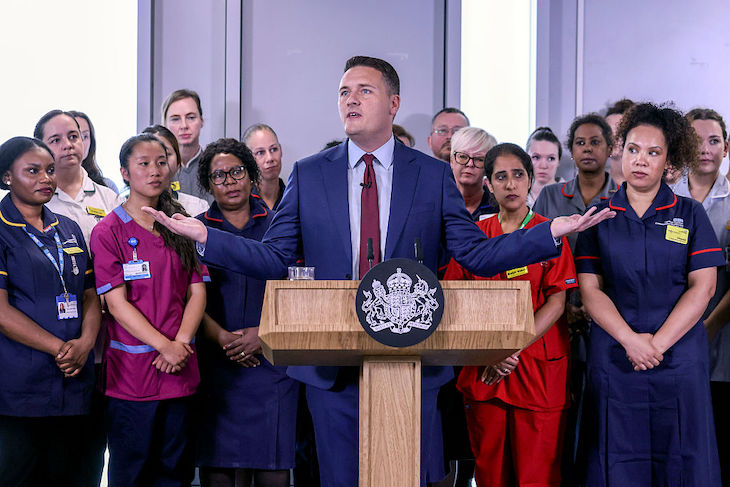
“Leaders take responsibility,” Wes Streeting wrote, in what has already been called his Wesignation letter. The charge against Keir Starmer was that he hadn’t; the boast, gift-wrapped in NHS statistics, was that the outgoing Health Secretary had. “The only question that matters in government is whether we leave our successors a better situation than we inherited.” As he angles for the top job after almost two years running the NHS, what does his record amount to?
Streeting’s no wild success, but no abject failure
Streeting’s letter is heavy with figures. Ambulance response times for heart attacks and strokes have improved, A&E waiting times too, and GP recruitment is up. Waiting lists have fallen, which was a key target, and, most importantly, overall productivity is up: by 2.8 per cent against a goal of 2 per cent. Streeting says this is down to the hard work of others, with the implication, naturally, that the credit is his.
The fall in waiting-list figures is real enough to be politically useful, but dubious enough to leave it unclear whether patients have been treated or merely subtracted. NHS England (which still exists, but is shuffling itself toward abolition) doesn’t give a breakdown of reasons why patients come off the list. Published data doesn’t distinguish between patients having been treated and patients removed from the list after administrative ‘validation’ exercises. Even if the NHS is doing better – which isn’t quite the same as doing more – we don’t know if it’s a temporary response to specific temporary funding.
That’s why the productivity figures are more encouraging, and more real. But here, too, the improvements aren’t certain. Figures from the Office for National Statistics (ONS) differ from those produced by NHS England; the last ones showed a fall in healthcare productivity. In recent reports, the ONS hasn’t given any healthcare breakdowns, citing methodological problems and the mismatch with NHS England. Streeting’s 2.8 per cent is promising, but to feel confident the NHS was becoming more efficient one would want to see years of similar figures. The NHS’s record is one of decline punctuated by temporary improvements supported by extra cash. Without any structural reform to change its downward trajectory, we should be sceptical that brief improvements signal any turnaround.
Streeting decided to abolish NHS England, the body set up to keep clinical services at one remove from political chaos. NHS England was a good idea. Had it done its job, abolishing it would have been vandalism. Given its failure, Streeting’s decision was right, though the execution has hardly been brisk. (Asked how many people worked at NHS England, one head of a royal college used to answer: about half.)
Streeting’s ten-year plan was less impressive. Style over substance is bad enough, but when there isn’t much style it’s fatal. Whitehall insiders complain of Streeting’s absence and of junior ministers notable chiefly for their incompetence and indifference.
Union relations are what Labour pretends it’s good at, but somehow never is. Streeting’s record is bad. The problems with junior doctor pay have not been solved, and the strikes have cost an estimated £3 billion to date. Even more shamefully, British doctors have found themselves unemployed, their posts going to foreign doctors, and not because those foreign doctors were better. The belated Medical Training (Prioritisation) Act 2026 has finally improved the situation. But, in some cases, Streeting has made it favour those who have done degrees in Britain over British citizens. The result is that some foreign students trained here enjoy a huge advantage over Britons who studied abroad.
Streeting has a good backstory; the sort of working class background Labour makes mandatory, even while preaching that you shouldn’t be judged by where you come from. But Streeting has not, like many of his colleagues, made his backstory his selling point. His cultural hinterland appears to be Traitors and Strictly Come Dancing. Poor stuff, but enough to make him look like Denis Healey beside Angela Rayner, whose cultural life seems epitomised by using Commons paper to complain about Star Wars-themed shoes.
Where Streeting has shown himself serious is on Israel: first, for siding with the Middle East’s only democracy against the death-cult theocracy of Hamas; and second for being willing to say so, as a supporter of Labour Friends of Israel. Principles are worth more when they come at a cost, and these may cost Streeting the premiership. If they do, the honour will be his, and the shame Labour’s.
NHS managers typically fail upwards, promoted to advise others on how to do what they never could themselves. Streeting’s no wild success, but no abject failure. He vowed to treat the NHS as a service, not a shrine, but he’s done little to help the patients or disturb the worshippers. His record is poor, but many will feel, like me, that he is the best of Labour’s front bench. He has shown neither Ed Miliband’s zeal, nor his knack for moving the levers of power.
If Streeting reaches Number 10, there is no little sign we will notice his impact. With the country in decline, that is bad; but it could be worse. If Miliband becomes prime minister, we will have, for the first time since Tony Blair, a Labour leader with grand ambitions and the drive to realise them. The prospect is terrifying.






Comments