
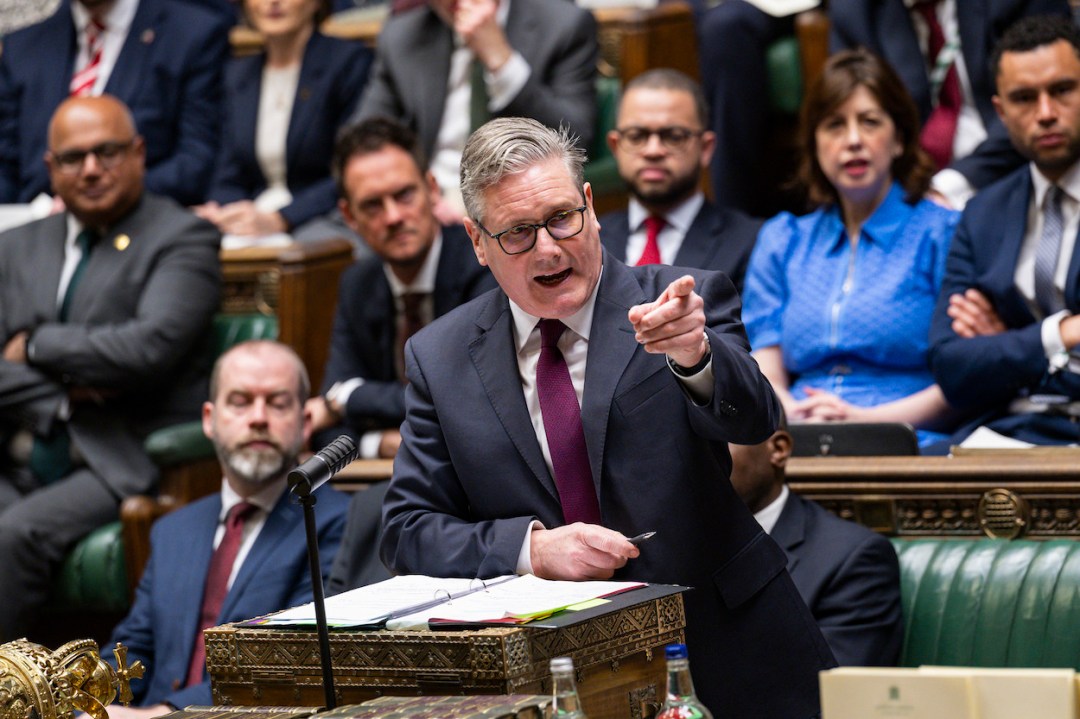
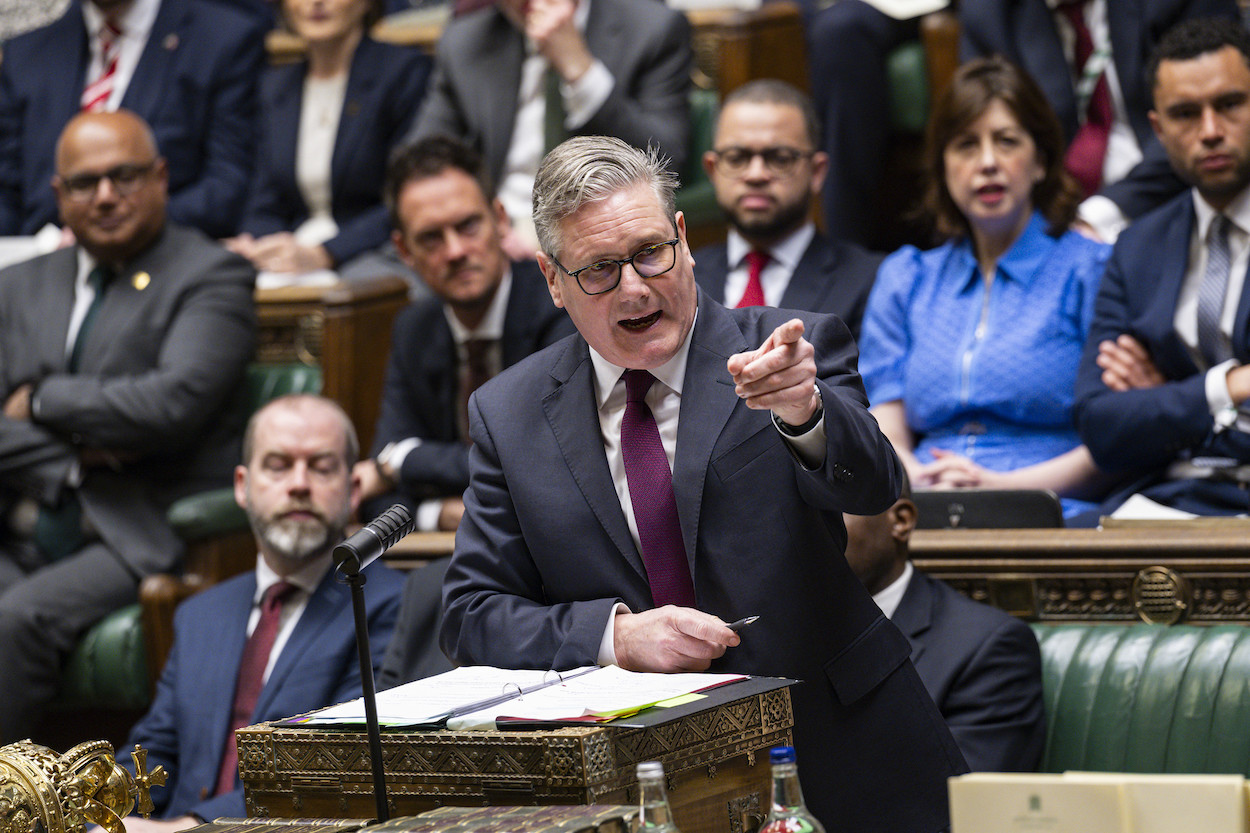
Kemi Badenoch clearly decided that it would be difficult to call for calm around the Henry Nowak case, and then to spend Prime Minister’s Questions talking about it at length. The format of the session rarely lends itself to calm, and she had rightly judged that others – including Nigel Farage – would bring the matter up themselves. Instead, the Tory leader did what Keir Starmer did when he answered his first question, which was to call for calm. And then she moved onto welfare spending, using Pat McFadden’s private message to Lord Mandelson as an opportunity to revisit Labour’s failure to reform benefits.
But Nowak still dominated the session, and not just in the questions. The atmosphere in the chamber wasn’t as rowdy as it would have been during a normal knockabout on welfare.
Badenoch’s first question was how much the welfare bill had gone up under Labour. After Starmer had thanked her for her ‘approach and tone’ on Nowak, he said ‘as she knows, we inherited a broken system from the party opposite, and we are now improving that system’. Badenoch responded that the bill had risen by £20bn under Labour, and that there was no proposed legislation in the King’s Speech. Starmer insisted that his party was reforming welfare, adding: ‘They voted against it. Welfare reform is introducing a right to try, to incentivise people to take up opportunities. That’s what we’re doing. They voted against it.’ He added that welfare spending ‘soared by £88bn on their watch’. Both leaders are right that the other party did not leave the benefits system in a good place, but of course Starmer is still notionally in power, and so Badenoch argued in her next question that Starmer had given up on welfare reform. The two carried on going back-and-forth over who had been the worst on benefits, which wasn’t very inspiring.
The Tory leader offered to work with the government on reforming welfare, and quoted McFadden’s message about the discussion in Labour being ‘who can we tax in order to pay benefits to others’, saying the ‘welfare secretary said in private what they don’t dare say in public’. She later told the chamber that Labour MPs’ cheers were getting ‘thinner and thinner’ and that Starmer ‘doesn’t have the votes to reform welfare’. She joked about his disappearing WhatsApp messages, describing them as ‘disappearing messages from a disappearing prime minister’.
It was a good line, but overshadowed by a much better one from Ed Davey, who joked in his second question about the ‘long form essay’ stage of the Labour leadership contest, which he said ‘gives new meaning to the phrase ‘drone warfare’. The Chamber genuinely collapsed into giggles at this point.
Badenoch didn’t shift the news agenda much with her questions on welfare, but what she will be trying to do is to embed that ‘who can we tax in order to pay benefits to others’ line into the public consciousness so that it has as much power by the next election as Liam Byrne’s ‘there’s no money’ note did.
But what was far more immediately newsworthy was the exchange that Starmer later had with Nigel Farage, who reiterated his claim that ‘it is now clear to growing millions in this country that we are living under two-tier policing’. The Reform leader talked about ‘the anger that you saw spilling out in Southampton’ which he said ‘is in danger of getting considerably worse’. MPs were repeatedly shouting during his question that he needed to ‘condemn the violence’, and Starmer told Farage that he was ‘really shocked that he pretends to have respect for Henry’s family’. He said the question ‘shows exactly who he is’. Farage is not going to change his line, and neither are the main party leaders, which means that no matter how much Starmer and Badenoch insist they want to avoid divisive politics, they are now very much caught up in it.



Comments