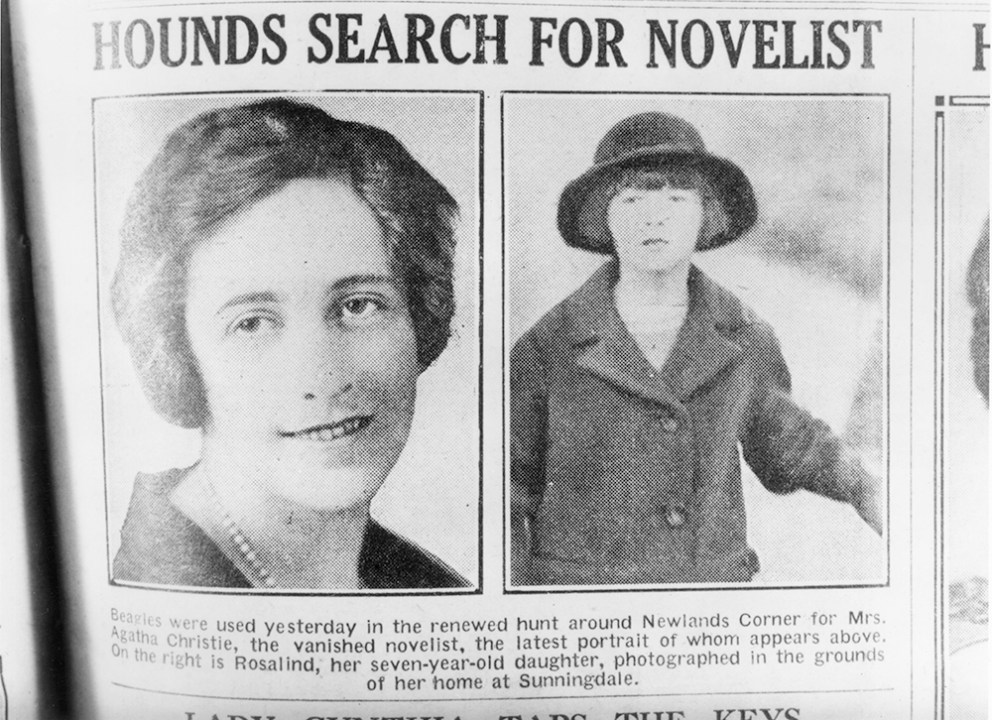
This week it’s 100 years since Agatha Christie went missing for 11 days, so for Competition 3477 you were invited to write The Case of the Missing Crime Novelist. It was quite a big entry and mentions should go to Sylvia Fairley, Greg White, Martin Bastone, Frank Upton, Mike Scriven and Shotaro Takakura, among others. The prizes go to those below.
‘Shall I be mother?’ As the spinster poured tea, the younger woman glanced outside and whispered: ‘I think I may be leaving today.’ The spinster’s eyes narrowed. For ten days they had breakfasted together in the hotel dining room. Her companion seemed less agitated now, although the indentation on her wedding ring finger was still visible (one of many things they had not discussed). Finally, the young guest spoke: ‘Thank you for your friendship. You have not pried; yet your wise eyes, I think, see much. Where there are mysteries, I suspect you discover answers. I do not know your name but, whatever the future holds for me, I will always remember you.’
The spinster smiled. ‘Well, my dear, it is perhaps easier to conceal our names than our natures. I wish you well.’ There was a sudden commotion at Reception. ‘My name is Marple. Please feel free to write.’
(Agatha Christie disappeared in December 1926. Miss Marple first appeared in print 12 months later.)
Richard Warren
You know Daphne Tweedhouse. Have probably read the opening pages of one of her thirty novels about the interminably plodding Inspector Flapdoodle. Have probably placed several such novels in a charity bag without knowing how they ever infiltrated your house. Well, Daphne disappeared last month. Though an homage to Agatha Christie has been suggested as motive, her absence lasted only a few hours. She disappeared from a bookshop in Chipping Campden high street, reappearing in Cirencester. Later, someone reported having seen her in a car during the interregnum. There were frequent, hysterical tweets from her publisher throughout and after the episode. An investigative podcast is said to be forthcoming from those who perpetrate such things, in which we shall be invited to examine the case from as many angles as creatives can contrive. Intrigued? As Inspector Flapdoodle observes thrice a chapter and through mouthfuls of cake, ‘It’s a proper facer.’
Adrian Fry
‘She is dead, surely.’
‘Mon ami, you have a taste for the dramatic, but the great detective Hercule Poirot follows a simpler course. Observe, as I do, the common tropes in the fiction of the missing crime novelist; a faked death, an obvious subject, an episode of amnesia. Yet all of them are red mullets.’
‘Herrings,’ I said with a smile, ‘what a fishy business this is.’
‘Pas du tout,’ said Poirot, ‘the guilty party here is the novelist herself. She has committed many crimes in her work, laborious plotting, clichéd prose, implausible characters. Regardez moi, with my mincing gate and unconvincing French accent. Am I not preposterous?’ He sighed, ‘I once sought a position in the estimable oeuvre of that excellent écrivaine Miss Sayers, but hélas she was not interested in my little grey cells.’ And with an exaggerated Gallic shrug, Poirot returned to The Murder of Roger Ackroyd.
Sue Pickard
Poirot gazed down at his audience, and smiled. Its components were ironically familiar: the troubled but faithless husband, the unctuously devoted secretary in sombre tweeds, the exploitative publisher, some bovine specimens of various constabularies. Outside the window the Harrogate rain fell steadily.
‘Et voila,’ he said, ‘the lady vanishes. You search the woods – rien. You drag the ponds – rien. And yet, perhaps the lady does not vanish. Perhaps the lady simply… changes…?’
Poirot pulled gently at his waxed moustache until it came away. Next, he peeled back his bald pate, revealing an auburn bob beneath, and delicately removed a wad of cotton wool from inside each cheek, consigning them to the fire. A minute later and Poirot had disappeared; instead, his creator stood before them, smiling shyly.
Superintendent Earnshaw was famously obtuse: ‘I’m all for a drag act,’ he muttered. ‘But I still reckon she’s done away with ’erself.’
Nick Syrett
Inspector Fairbrother addressed the circle of sus-pects: ‘And finally I shall reveal that the murderer is…’ He froze as if paralysed. The suspects too were suddenly still as statues.
It seemed to last for ever. Mona, the vamp, struggled to move, and finally gasped: ‘What’s happened? Not that I’m worried, because I’m the obvious suspect, so of course I didn’t do it.’
‘The author’s just stopped. As though he’s given up on us,’ said Canon Chalmers, fearfully.
‘I was in a Jeffrey Archer novel once,’ said a remarkably flat character. ‘You knew where you were with Jeffrey Archer.’
‘I should have been in a Revd Richard Coles novel,’ sniffed Canon Chalmers. ‘Much cosier.’
‘It’s the Death of the Author,’ pronounced Claude, the pretentious academic with the suspiciously watertight alibi.
‘The big question,’ said Mona, ‘is: who did it?’
Inspector Fairbrother had nothing to say.
George Simmers
Miss Trent vanished halfway through chapter 12. Her slippers stood by the fire; her tea had gone cold.
The constable searched the house. The inspector searched the village. Her publisher searched the contract. Only Mrs Pugh, who came on Tuesdays, noticed that the kitchen table had been scrubbed.
‘She always writes there,’ she said. ‘The study’s for photographs.’
Beneath a cushion she found 11 pages. The last sentence read: ‘At this point the housekeeper, whom nobody had thought to question, quietly removed the author.’
The inspector laughed. ‘A joke, surely.’
‘Very likely,’ said Mrs Pugh.
She put the pages in the stove and offered him another cup of tea.
He declined. Detectives, she reflected, were getting a little better.
Laura Gibby
No. 3480: Second thoughts
You are invited to submit a poem or passage on the theme of ‘Day Two’ (16 lines/150 words maximum). Please email entries to competition@spectator.co.uk by 14 December.





Comments