South Korean presidents have gained infamy for meeting untimely fates, whether death, imprisonment or suicide. And now, former president Yoon Suk-yeol is the latest addition to this list. Earlier today, the man whose presidency will go down in history for his abortive declaration of martial law on 3 December 2024 was sentenced to life in prison on account of masterminding an insurrection.
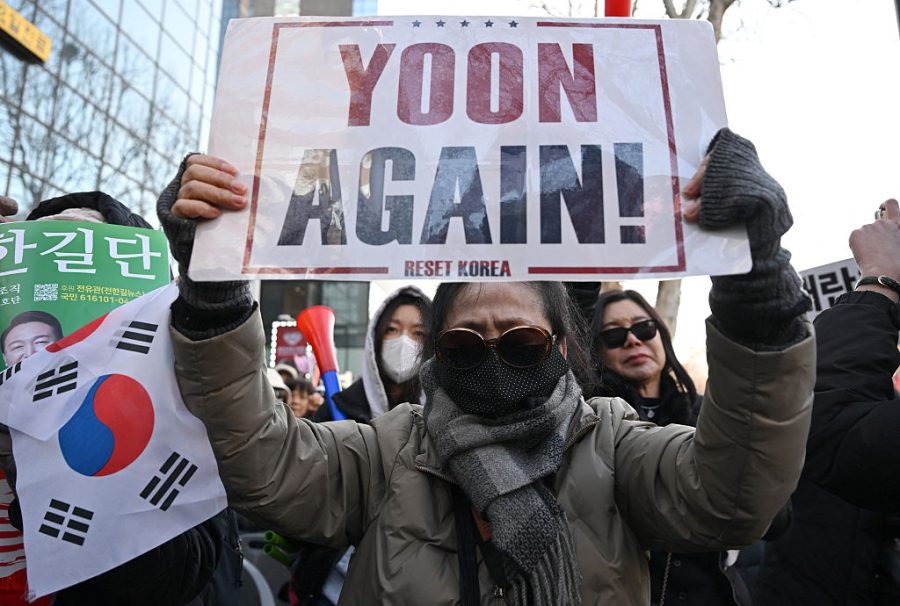
Supporters and detractors of South Korea’s thirteenth president gathered outside Seoul’s central district court to hear the fate of the leader they either loved or loathed – a fate which was also broadcast on live television to the Korean nation. This sight – and today’s decision – hammers home the fact that South Korean politics won’t become any less polarised anytime soon.
Today’s verdict saw Yoon Suk-yeol escape the death sentence, for which many of his prosecutors had called during his trial. Yet this not the end of the former South Korean president’s tribulations. Whilst being found guilty of an insurrection is the most serious of the charges against him, Yoon also faces additional serious charges: violating campaign law, perjury, and aiding an enemy state. The last is on account of allegations by prosecutors that Yoon ordered the illicit deployment of drones over North Korea to justify his decision to invoke martial law. The former president denies any wrongdoing. Yet who can forget when Yoon announced that South Korean democracy was being undermined by pro-North Korean, anti-state forces?
The Yoon Suk-yeol saga is anything but over
Whilst Article 77 of the South Korean constitution makes clear how the president retains the prerogative to declare martial law, invoking the nuclear option within the realm of domestic politics should be limited to times of war or national emergency to maintain public safety. Yoon was ruling an opposition-dominated National Assembly at the time of his decree; invoking martial law on a whim as a means of strengthening one’s grip on power was unbelievable. This was the first such instance since South Korea transitioned to a democracy in 1987.
It is not just Yoon who faces prison, although his sentence was the most stringent. His prime minister, Han Duck-soo, is already in jail, serving a 23-year term for his complicity in rubber-stamping Yoon’s martial law decree. Former defence minister and three-star general Kim Yong-hyun – who once admitted that it was he who suggested the idea of martial law to his boss – was handed down a 30-year prison sentence for being part of the inner circle responsible for that December evening decree. We must also not forget Yoon’s wife, Kim Keon-hee, a key cause of her husband’s domestic unpopularity, who, at the end of January, was sentenced to 20 months’ imprisonment on account of corruption, including stock price manipulation and bribery.
Although Yoon will go down in the history books for his martial law declaration, we must remember that, notwithstanding his many domestic flaws, his foreign policy was well-received beyond South Korea’s borders. His diplomacy with Japan – whilst predictably unpopular with the South Korean left – played a vital role in reviving the historically frosty relations between Seoul and Tokyo.
When Yoon visited the then-Japanese prime minister, Kishida Fumio, in Tokyo in 2023, it marked the first such visit by a South Korean president in twelve years. Three years later, Japan’s Iron Lady, Sanae Takaichi, is now consolidating power following her resounding supermajority in the recent snap election. Seoul and Tokyo should continue to strengthen cooperation with each other – and with Washington – at a time of exacerbating mutual threats from China and North Korea.
Following today’s events, Yoon and his lawyers are likely to appeal the judgement. Even if this is unsuccessful, however, the precedent set by Yoon’s predecessors could offer some signs as to his eventual fate. Every convicted South Korean president has hitherto received a pardon after serving between two and five years in prison. In just one example from South Korea’s pre-democracy era, former president Chun Doo-hwan and his successor, Roh Tae-woo, were pardoned in 1997 despite being initially sentenced to death and seventeen years in prison, respectively, for their roles in the Gwangju Massacre of 1980. With Roh’s support, Chun’s declaration of martial law and crackdown on student demonstrators saw both men serve only two years in prison.
The polarised nature of South Korean politics, however, was epitomised minutes after today’s verdict when the left-leaning Democrat president Lee Jae-myung stressed that Yoon ought to have received the death penalty. Inter- and intra-party factionalism in South Korea is hardly abating.
Even though, akin to his predecessors, Yoon can appeal for a presidential pardon, Lee – whom Yoon defeated in the 2022 presidential election – does not like his former opponent one iota. Only in December last year, the president stressed how perpetrators of a coup d’état should be punished in the same vein as war criminals. It was a hardly unsubtle reference to his predecessor. We must wait and see whether Lee prioritises national unity over personal preferences.
Whilst the Yoon Suk-yeol saga is anything but over, what can be said with greater certainty is that the memory of the six hours of martial law in South Korea on a cold December evening will not go away. Despite this, South Korea remains a resilient and vibrant democracy. One can only hope that political factionalism, not least within ruling parties, does not hinder this vibrancy.

Comments