
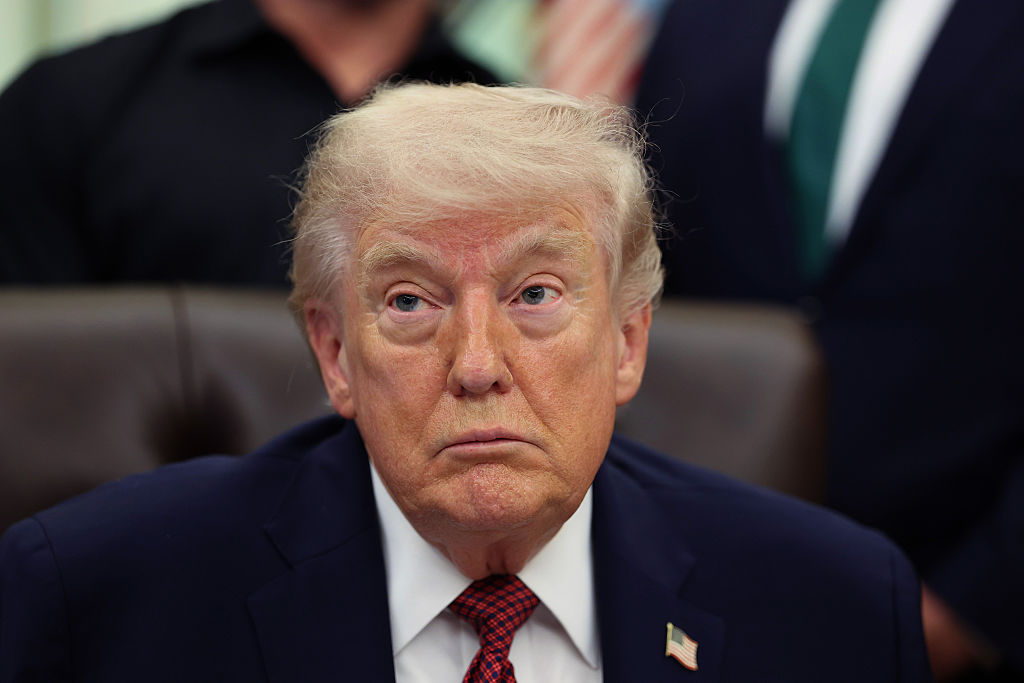
There are still those who argue that President Trump’s aggressive, impulsive and inconsistent foreign policy is radical and disruptive, and because of this delivers results. The jury remains out on that. But there is one aspect of international affairs in which Trump is at a marked disadvantage.
This is an expression of anger, not a policy
The President is often governed by impulse, satisfying his instinct of the moment. That has been underlined by a leaked email from the Department of Defense, setting out a list of potential punishments for countries which so far have failed to support Trump’s military action against Iran, Operation Epic Fury.
The lack of cooperation has enraged the President, who bears grudges and is sensitive to perceived slights. Because he thinks he has been let down, he wants to exact punishment. The United Kingdom is one of the more prominent malefactors identified: the President is particularly furious that Sir Keir Starmer initially refused a request to use facilities at Navy Support Facility Diego Garcia in the British Indian Ocean Territory and RAF Fairford in Gloucestershire.
The former has been a lynchpin of American operations in the Middle East and the Indian Ocean; the latter, home to the 501st Combat Support Wing Headquarters and the 420th Air Base Squadron, is USAF Strike Command’s preferred forward operating base for its bombers in Europe.
Although Keir Starmer quickly agreed to qualified use of these bases – on the wholly cosmetic condition that they should only be available for “defensive” operations – the damage was done. Consequently, the email from the Pentagon includes the option to reassess American diplomatic support for “imperial possessions” such as the Falkland Islands.
Irony has no place in the Trumpian vocabulary but it is worth noting that the Falklands are one of 14 British Overseas Territories, as is the British Indian Ocean Territory created specifically in 1965 to allow for the creation of the joint base on Diego Garcia. Skeptical observers could also look at the status of some of the United States territories like Puerto Rico, subject to the powers of the US Congress but without voting representation in it, or Guam, whose single delegate to the House of Representatives can speak but may only vote in committee.
Despite the defeat of its attempted annexation of the Falkland Islands in 1982, Argentina maintains its spurious claim to sovereignty over the territory, and the current President of Argentina, Javier Milei, is an ally of the Trump administration. A change of attitude towards British sovereignty by the United States would not pose an immediate threat but would be indicative.
Other US “options” to punish its allies are not meticulously developed suggestions for action. One is the suspension from Nato of Spain, whose Prime Minister, Pedro Sánchez, has been a prominent critic of US action against Iran. But there is no provision for a member state of Nato to be suspended from the alliance, certainly not at the unilateral behest of the United States.
None of this means the ideas raised by the Pentagon should be ignored or treated lightly. The United States remains the single biggest contributor to Nato’s funding and capabilities. Perhaps more importantly, it supplies a number of assets – so-called “strategic enablers” – which no other member state possesses or can deploy at a comparable scale: satellite and airborne intelligence, surveillance, target acquisition and reconnaissance, in-flight refueling, heavy lift aircraft and anti-missile defense. The President cannot easily withdraw the United States formally from Nato, but a straightforward disinclination to cooperate with or assist other member states would have a very similar and dramatic effect.
This resentful desire to settle scores is not a sensible policy. Some of the lack of cooperation when it came to Operation Epic Fury stems from previous high-handed actions by the Trump administration – simply turning the bullying up to 11 is not always a reliable way of achieving agreement or consensus. Long-term international relations involve exploiting your strengths, which comes to Trump as naturally as breathing, but also weighing up sacrifices against rewards, which is anathema to him.
The aggressive steps outlined in the Pentagon’s email would do little to ensure future cooperation, or rather the fealty Trump desires. They are expressions of anger, not policy, too reliant on the President’s relish for the stick and with no acknowledgment of the influence of the carrot. In that, they reflect his fundamental nature, but may also represent something else: a frustration and bewilderment that the conflict with Iran is still going on, and uncertainty about how to bring it to an acceptably advantageous solution.
Operation Epic Fury is currently costing the US around $1 billion a day and has dramatically eaten into its stockpiles of expensive and complex munitions. With the mid-term elections only six months away, something has to change, but Trump seems not to know what that something might be.




Comments