As I try to wrestle my 15-month-old son into a nappy, or stop him from throwing himself down an escalator, or teach him not to spear himself with a fork, I remember that slightly lesser-known Winston Churchill quote: ‘I am always ready to learn, although I do not always like being taught.’ It appears, however, that children are increasingly not ready to learn, and parents increasingly dislike doing the teaching.
The results of the annual survey of primary school teachers are not just mildly depressing reading on a rainy January day: they are a stark and shameful indictment of the failures of so many parents. Teachers claim that 37 per cent of children starting reception class are simply not ready, the highest on record. They state that around a quarter of four- and five-year-olds are unable to eat or drink independently, or use basic language skills like being able to say their name or answer questions. Staff estimated that they were spending 1.4 hours a day changing nappies or helping children who are not fully toilet-trained and, in total, lost over 2 hours of teaching time a day assisting pupils with basic skills such as dressing themselves.
Screen time is polarising parenting styles as it does everything else
We have known for years now that children are missing a range of developmental milestones. Increasingly they are also demonstrating limited vocabulary, delays in basic motor functions and a lack of core strength (there are utterly demoralising cases of perfectly able-bodied children not knowing how to use stairs or hold a pencil).
How have we got to a situation where it is normal for almost a third of students not to know how to use a book correctly and try to swipe it like a phone or a tablet? Worse, how have we got to a situation where less than half of parents actually think children should know how to use a book before starting school?

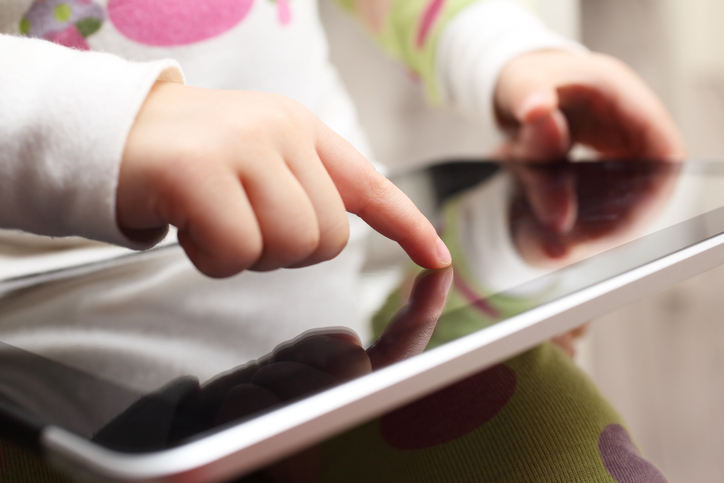
If I sound exasperated, it’s because I am. We know – and have known for some time – that the smoking gun here is really a smoking phone. Parents and children are no longer umbilically tethered to each other but to their devices: half of parents admit that they spend too much time on their phones (whilst the other half are probably in denial). A third of pre-school children have their own tablet, which they use on average for an hour and 20 minutes every day, whilst nearly a quarter of five- to seven-year-olds have their own smartphone. Another recent study found that the average toddler is missing out on hearing more than 1,000 words spoken by an adult each day due to screen time.
These digital pacifiers are the reason why primary school pupils can use Americanisms like ‘diaper’ and ‘garbage’ but can’t communicate that they need to go to the toilet. As a parent and teacher, I find it utterly soul-crushing that a video of a child’s hands playing with Peppa Pig toys exists which has been watched over 500 million times. This 10-minute clip – this sad, strange simulation of imaginative play – is yet another reminder that children are watching when they should be doing.
Meanwhile, parents will continue to bury their heads in the pixelated sand and hope that things will get better once their children start school and someone else is responsible for them.
It’s also important to remember that all this consumer technology is doing is creating clearer class segregation. Children from lower socio-economic backgrounds are more likely to own mobile phones at an early age, and on average they spend twice as much time a day on screens. Resisting giving your child a phone is becoming an increasingly popular middle-class signifier: it’s easier to impose stronger boundaries around screen time when you are not a working or single parent, or when you have the resources to send your children to extracurricular activities and clubs instead.
There seems, therefore, to be a growing divergence between hyper-scrupulous middle-class parents – who have Pinterest boards of neutral, low-stimulation nurseries and worry about everything from the impact of seed oils to how to give their children the perfect Steiner childhood – and a more negligent parenting style fuelled by deprivation and distraction. The choice seems to be Montessori genius or AI-slop addict: screen time is polarising parenting styles as it does everything else.
It’s easy to resist calls for national parenting advice programmes on the grounds of state overreach, but clearly something has to change, and expectations need to be raised. The state either needs to re-teach parents (and therefore children) the basics, or it needs to get everyone looking up from their phones, tablets and TVs long enough to realise that the basics are in reach anyway. A social media ban for under-16s now seems inevitable (and long overdue), but we need to protect toddlers as well as teenagers.






Comments