


Ester Ledecká, Tomoka Takeuchi, and Arthur de Villaucourt were all part of the Richard Mille “family” at Milano Cortina 2026, and while the first two competed in the Women’s Parallel Giant Slalom for snowboard, the latter attacked the Men’s Moguls and Men’s Dual Moguls. For athletes to have associations with watch brands might not be unusual, however there is one crucial difference here – where Richard Mille is concerned, those it invites to become part of its network are required to wear their watches while competing.
Ledecká went into this Olympics chasing a fourth gold medal, having remarkably won the top gong at the 2018 Pyeongchang Winter Olympics in both the Parallel Giant Slalom (snowboarding) and the Super-G (alpine skiing). She won her third gold at Beijing in 2022, defending her snowboarding title. Though she didn’t add to the trophy cabinet in Italy this year, she remains the first woman to claim gold at a Winter Olympics in two different sports.
Since 2018, Ledecká has been partnering with Richard Mille, and told me that she knocks her watch against the poles, known as gates, that mark the slalom course as part of her technique. Her RM 07-04 Automatic Sport, the brand’s first women’s sports watch, is thus given rough treatment. The timepiece is typical of Richard Mille’s aesthetic, being a skeletonized design in a tonneau shape and extremely lightweight, but at a retail price of around $185,000 excluding taxes, you’d be forgiven for thinking Ledecká had taken leave of her senses.
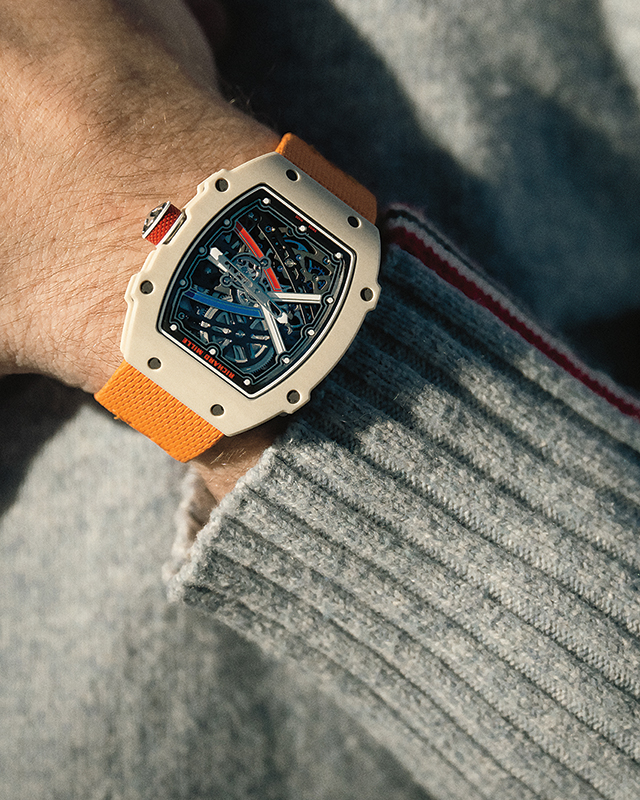
Her fellow Olympian, Alexis Pinturault, the most successful French World Cup skier and four-time Olympic bronze medalist in the giant slalom, also uses this method, known as cross-blocking, as it is common practice for those racing slalom, as the skier effectively knocks the poles out of the way. Pinturault confessed that he had smashed his RM 67-02 – designed for him, with its hand-painted bridges in the blue, white, and red of the French flag – while tackling a course. He sheepishly contacted the manufacture in Switzerland to be told not to worry, this was valuable feedback for the technicians who would be assessing the potential damage to the watch.
Mogul specialist Arthur de Villaucourt is the most recent addition to Richard Mille’s impressive roster of sportspeople – which also includes, among others, Nafi Thiam, triple Olympic gold medalist in the heptathlon (Rio, Tokyo, Paris), cyclist Mark Cavendish, and Ferrari’s driver Charles Leclerc (who is forbidden from wearing his watch by F1’s rules). Like Pinturault, De Villaucourt wears the RM 67-02 Automatic Extra Flat in the colors of the French flag.
It’s normal to see athletes reach for their watch sponsor’s products for post-match press conferences, but Richard Mille makes a point of asking them to test its timepieces to the limit. All but the F1 drivers (Charles Leclerc, Lando Norris, and Fernando Alonso), who are not permitted to do so, wear theirs in the heat of competition. The desire to see how the product performs stems from founder Richard Mille’s decision in 2001 to launch a watch brand committed to exploring new materials and engineering, a form-follows-function approach.
His first creation, the RM 001, has a tourbillon complication, which is regarded as a delicate piece of watchmaking. But on launch, Mille would get people to try it on to feel its comfort on the wrist and then routinely throw it on the ground to demonstrate its robustness. Years later, in 2010, he would design a tourbillon specifically for Rafa Nadal to play with on court, and today the Spanish tennis ace wears the fifth iteration of the RM 027 collection, the RM 27-05 Manual Flying Tourbillon Rafael Nadal, which holds two records on account of its being able to withstand a g-force of 14,000 and weighing only 11.5 grams without its strap.






Comments