
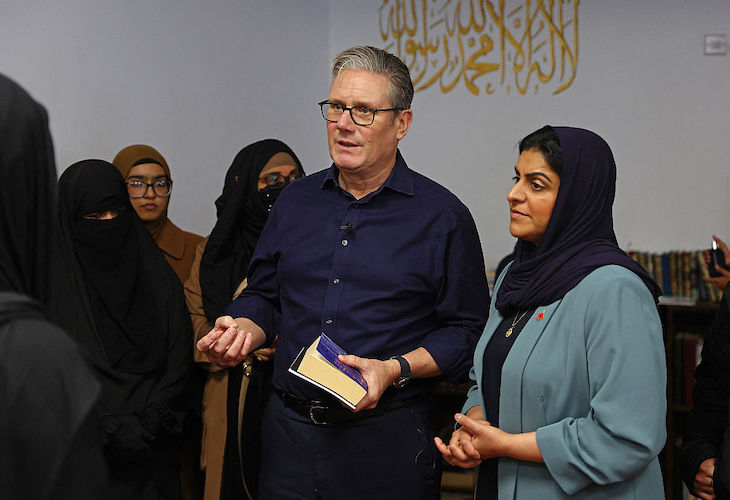
Britain is to get a new ‘anti-Muslim hostility tsar’ under plans to be outlined by the government on Monday, which will also include a new definition of Islamophobia.
The Spectator has been leaked a draft copy of Protecting What Matters, a document outlining Labour’s new cohesion strategy
The Spectator has been leaked a draft copy of Protecting What Matters, a document outlining Labour’s new cohesion strategy which is to be unveiled in a cross government push next week. The 47-page paper features a crackdown on extremism and names Islamists as the biggest threat to community cohesion. It also outlines fresh demands that new arrivals in Britain seek to integrate and speak good English, described as a ‘fundamental basis for participating in society and an expectation of those who wish to call the UK home’. It states: ‘Those who come here must make a genuine effort to integrate into and engage with our shared way of life.’ The last census found that more than a million people could not speak English well or at all.
The report states clearly that Islamists are responsible for three-quarters of the police’s counterterror workload and 94 per cent of all terror-related deaths in the past 25 years. The plan also rejects calls, predominantly from British Muslims, for blasphemy laws in the UK.
Following the case of the religious studies teacher at Batley Grammar school, who was forced into hiding after showing caricatures of the Prophet Muhammad, the document promises to ‘stand against those who try to intimidate, threaten and harass others because they are offended by so-called “blasphemy”. We do not recognise blasphemy law in the UK.’
Further powers will be established to close extremist charities and suspend trustees with ‘unspent hate crime convictions’, to ‘strengthen monitoring’ of non-violent extremism in universities and to exclude hate preachers from the UK. As part of this, there will be rules to ensure that ‘public bodies do not confer legitimacy, funding or influence on extremist groups’.

But the plans will also raise alarm bells on free speech by outlining new rules to tackle ‘divisive content’ and ‘ensure trusted news sources are prominent’. Critics fear these measures will be used to silence critics of Islamists or even TV channels like GB News which some Labour people view as too right-wing.
Andrew Gilligan, a senior fellow at Policy Exchange and a former No. 10 adviser, said: ‘There are clear risks to free speech. But there are also several worthwhile commitments, if they ever happen. The risk is that the bad things happen, and the good ones do not. The other risk is that the new strategy is implemented by the same old identity-politics activists, woolly-minded councillors and 40-watt policemen who have made the current mess.’
The creation of a ‘special representative on anti-Muslim hostility’ is likely to give a prominent platform to an activist voice. Their job will be to ‘champion efforts across the UK to tackle hostility and hatred directed at Muslims and those perceived to be Muslim’.
Alongside that is a new definition of anti-Muslim hatred, which has been watered down to avoid defining Muslims as a race, but which will still condemn ‘the prejudicial stereotyping of Muslims, as part of a collective group with set characteristics, to stir up hatred against them, irrespective of their actual opinions, beliefs or actions as individuals’. Critics think this will create a blasphemy law by the back door.
Reading the paper highlights the difficult balancing act ministers are attempting by hailing the way some marchers and campaigners have embraced displaying the union flag or the English cross of St George before, a few sentences later, condemning right wing groups for using them as ‘tools of hate’ in their demonstrations, a ‘misuse of national symbols to exclude or intimidate’.
The paper paints a picture of a country where traditional cohesion in communities has broken down by immigration and the use of social media, which enables people to cluster with like-minded people online rather than the people they live near. Britain’s ‘historic social cohesion that has kept us united in the face of adversity’ is now ‘under threat’, it says.
Despite the scale of the problem, the cohesion strategy comes with little new money
And the government admits the role mass migration has played in this. ‘For many living in the UK, the changes brought about by mass migration have been too much, too quickly, leaving people feeling as thought they are losing their local and national identity.’ Calling integration ‘a two way street’, it says calling for ‘respect for different cultures’ and that ‘newcomers have a responsibility to engage with and embrace what it means to be British’.
The strategy will also seek to protect those who speak out, though it is unclear precisely how this will combat cancel culture. ‘Many people feel they cannot air perfectly legitimate concerns about the change they are seeing in their local communities. There must be space for honest discussion without assuming bad intentions or policing language.’
However, it also states that everyone must ‘embrace’ LGBT rights, opening the door to censure of those whose religious views are hostile to homosexuality and those who do not embrace trans rights. Ministers will also float the idea of religious education in the national curriculum and suggests the government should ‘promote’ religious education councils.
The paper also goes further than the government has done before to acknowledge that anti-Jewish hatred is a growing problem in the UK. ‘Antisemitism is being normalised in many corners of society – from our schools and universities to workplaces and the NHS,’ it says.
Despite the scale of the problem, the cohesion strategy comes with little new money. Ministers will announce plans for £800 million over ten years for 40 areas where ‘social cohesion is under pressure,’ plus £750 million over four years for youth, sport, and community infrastructure and a £5.5 million fund to ‘restore local news where it has disappeared’.
A source close to Steve Reed, the secretary of state for housing, communities and local government, whose department helped coordinate the strategy, declined to comment on the leaked paper, but suggested it was not the final draft. The document, as published, will include a foreword by the Prime Minister.



Comments