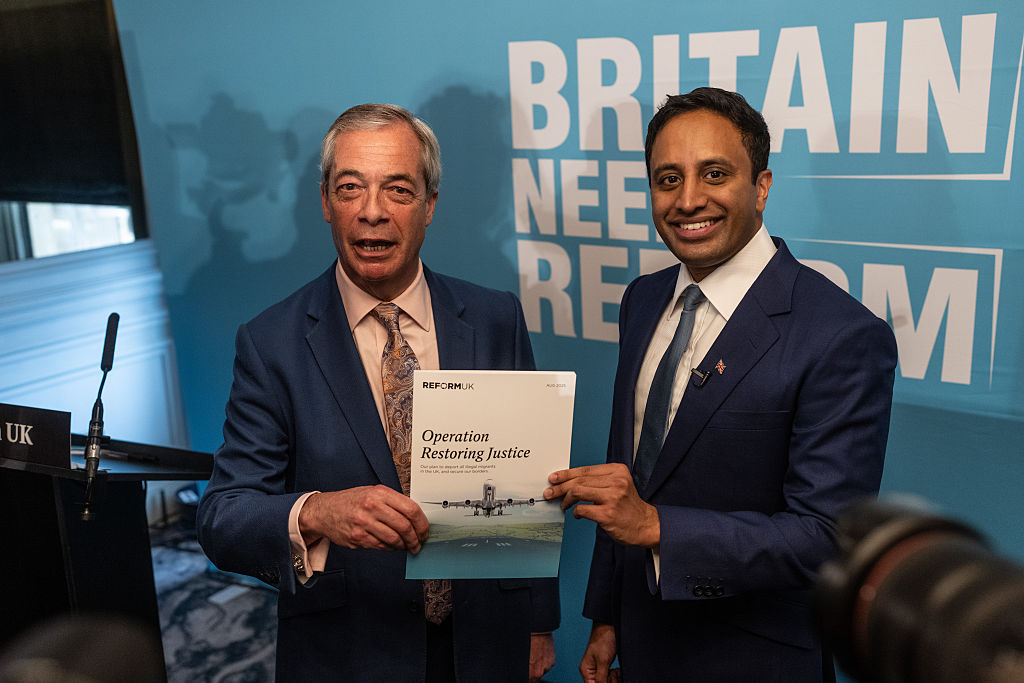
After Zia Yusuf’s announcement that Reform would create a ‘UK Deportation Command’ (UKDC), much of the media leapt to make comparisons with ICE in America. The Guardian described it as an ‘ICE-style deportation plan’, the Independent an ‘ICE-style UK border agency’, and even the Mail stated that ‘Reform is planning to create a British version of Trump’s ICE unit’. I spoke to Yusuf this morning, who was quick to dismiss these comparisons, telling me that ‘I have never wanted to create a British ICE’, and that ‘the reason why the media want to immediate call it a British ICE is that they want to take advantage of the very negative headlines around the excesses of ICE in America’. The Reform shadow home secretary argued that, ‘UK Deportation Command won’t carry weapons’, and that the party’s vision is to ‘properly’ fund and expand the existing Home Office deportation team, such that ‘for the first time the funding will be proportionate to the problem’.
Making this a reality will mean leaving the ECHR, repealing the Human Rights Act and, in music to my ears, ‘derogating from the 1951 Refugee Convention on a five-year emergency basis’
Zia sees UKDC as just one part of an effort to respond to the ‘frustration and anger the British people have’ about migration by ensuring they ‘point every instrument of state’ at solving the migration emergency, and it is clear from his explanations that Reform are thinking very seriously about how to change the system. To this end primary legislation ‘will create a legal obligation on the Home Secretary to deport anyone in the country who is here illegally’, and will mean that anyone who has ‘chosen to come to this country illegally… will not be allowed to stay’. Making this a reality will also mean leaving the ECHR, repealing the Human Rights Act and, in music to my ears, ‘derogate from the 1951 Refugee Convention on a five-year emergency basis’.

Reform have tasked those drafting their legislation with ensuring ‘that no judge in Britain should be able to prevent a legitimate deportation flight from leaving’, meaning that under Reform deportation cases will be non-justiciable. Deportation lists would be drawn up by civil servants and signed off by ministers. This would mean an end to the immigration tribunals preventing deportations. When I asked Zia if Reform would consider making immigration matters more generally matters for the Home Secretary rather than the courts he said ‘yes, absolutely…the principle is that we cannot allow the industrial complex of so-called human rights lawyers who have allowed for the accumulation of well over a million illegal migrants in this country and prevented the British people having a border to continue’.
Speaking about the proposed Reform red list of countries, (Pakistan, Afghanistan, Eritrea and Iraq), Zia told me that Reform ‘estimate well north of 200,000 illegal migrants from those countries’ are in Britain at the moment, and that their homelands will be compelled to accept their returns by the government refusing to issue new visas.
All of that being said, Zia believes that once deportations are functioning properly, Indefinite Leave to Remain has been replaced with five-year worker visas, and benefits which ‘turn Britain into a foodbank for the world’ are no longer available to foreign nationals, the natural human tendency to ‘respond to incentives’ will mean that voluntary departures increase. He mentioned the example of Obama, ‘dubbed the deporter in chief’ who ‘deported millions of people’ and under whom ‘voluntary removals increased dramatically as enforced removals increased dramatically… because once people realise that the law is being upheld… they choose to leave’.
Ultimately, Zia is clear that ‘of course this is going to be hard’ but that Reform are ‘very, very serious about doing this’ and that ‘if we get elected as… the government and Nigel’s Prime Minister, and I’m the Home Secretary this will be the most important thing that we’re judged on’.
It’s hard to argue with him. The dividing lines in our politics seem clearer than ever. More of the same that we’ve had in recent decades, with ministers unable to order deportations or control our borders, or Reform’s promise of a Britain where no illegal migrant is ever allowed to stay here, and no judges can prevent ministers from deporting them.






Comments