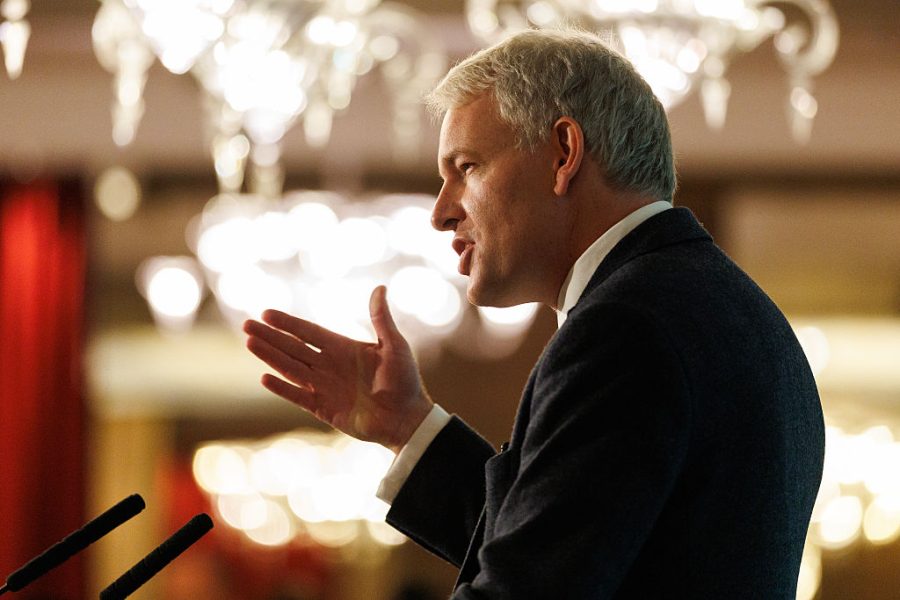
Earlier this week, Danny Kruger offered one of the first glimpses of what a national security policy might look like under a Reform UK government. Building on the work that the party has done recently on public accountability and civil service reform, Kruger warned that defence and security policy had also fallen under the remit of unaccountable bureaucrats. Speaking at The Spectator’s National Security Summit, Kruger declared that his party would restore democratic leadership over this critical part of the state.
First, came the facts. With a good dose of realism, Kruger argued that Britain was no longer a great power and that the stability enjoyed under the ‘rules-based international order’ had given way to an era of increasing great power competition, shaped by the wills and actions of the United States, China, Russia, India and Japan. While Britain remained a ‘regional heavyweight’ with capabilities beyond its size, it could no longer credibly claim to have a seat at the top table.
Reform UK’s strategic objective would be to make Britain a great power once again
At the same time, fractures in the Western alliance of nations are emerging. Meanwhile, Britain’s adversaries are becoming better integrated both economically and militarily. Kruger warned that the level of coordination between the so-called ‘CRINK countries’ (China, Russia, Iran and North Korea) was increasingly sophisticated.
Finally, Kruger asserted that British power is much more than just the capacity of the state. Pointing to the technologies that have already begun to define the 21st century, he argued that the state’s job was to ‘build the architecture’ on which British industry and commerce could develop the products and tools that would allow Britain to secure her place among the family of nations.

On the basis of these observations, Reform UK’s strategic objective would be to make Britain a great power once again. This would be underpinned by a doctrine of ‘active deterrence’ replacing the conventional philosophy of deterrence by punishment with a proactive and continuous model of defence and economic competition, one which would likely be more aggressive in the face of foreign intrigue.
While conceding that the party was still working on fleshing out the policy details, in conjunction with a host of defence, foreign policy, industry experts and intelligence specialists who have recently joined the ranks, Kruger did offer a partial preview. He singled out the importance of the defence of the homeland and of taking a more proactive approach to dealing with Russia – indicating that increased domestic resilience and a stronger response to the Kremlin’s hybrid interference could become party policy.
Importantly, Kruger stated that Britain should reassert its role as leader in the defence of Europe, and retain sovereign AI capabilities, pointing out that Britain’s technological power and ability to organise coalitions has cemented this role over the past three centuries. Restoring this position would provide Europe with security guarantees that are in stark contrast to the shortcomings of the European Union, whose policy of deterrence by committee is jeopardising continental security.
Though ambitious, Kruger’s hard-nosed realism diverges from the ‘progressive realism’ outlined by David Lammy when Labour came to power in 2024. When discussing defence and economic growth, Kruger was particularly alive to the concerns that defence investment and procurement were being redirected to fulfil economic or social requirements such as job creation or spurious environmental objectives. He was adamant that defence and security policy must focus on rebuilding British hard power, to the point of suggesting that procurement decisions could be moved out of the Ministry of Defence entirely.
While it remains to be seen what that might look like, it is clear that Reform is concerned about the onerous number of additional requirements that make it difficult for innovative defence companies to sell to the government, as well as the mandatory ‘social value’ criteria that officials must consider when allocating contracts.
It is worth acknowledging that Reform have focused on setting out the fundamentals of their energy, welfare and immigration platforms. These form key prerequisites for national security. Without them, questions on the defence industrial base, additional money for defence spending and national cohesion cannot be addressed.
Much of the detail is still to come, of course, alongside whispers of national security strategy that would crystallise some of the announcements made at the summit. It would also be interesting to see the party set out some benchmarks against which they would consider Britain’s status as a great power to have been reaffirmed. What is clear, however, is that far from being a relative weakness in terms of policy focus, Reform is devoting serious time and resources to developing their defence and security pitch.



Comments