
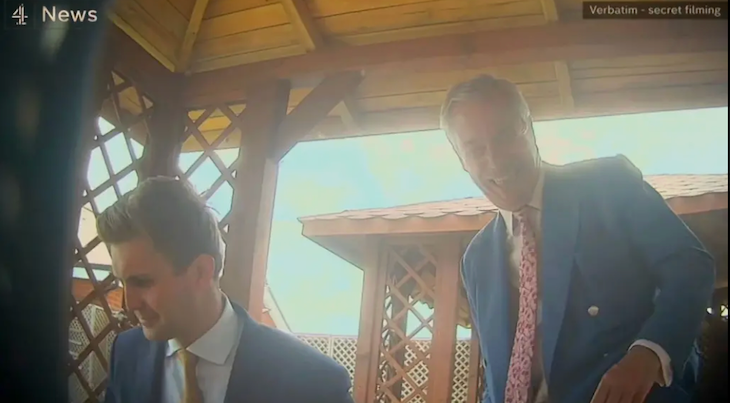
Deputy heads have rolled. Britain’s populist Reform UK party, in the person of chairman Lee Anderson, announced this morning that Dan Jukes, Nigel Farage’s right hand man, and James Orr, the party’s head of strategy, have stood down and abandoned the party conference. “They have left the building and they won’t be coming back,” Anderson said.
Footage screened by Channel 4 on Thursday night showed Jukes appearing to suggest a way to get around electoral law to secure a foreign donation of £500,000 ($675,000). A reporter posed as a UK-based son of an American father, who was to give money to the son to give to Reform after being wooed by both Orr and Jukes. British electoral law sets out that to be a permissible donor to a UK political party you must be a UK registered voter, or a company registered in the UK. In a statement, Jukes said: “I totally deny any wrongdoing but have stepped back from politics in order to clear my name.”
“It worked, boom.”
— Channel 4 News (@Channel4News) September 3, 2026
That’s Nigel Farage celebrating a Reform UK plot to break election law – by having a US company secretly pay for three influential political polls that benefitted the party.
Earlier in the investigation, Reform’s Head of Policy James Orr and senior advisor… pic.twitter.com/jJD7Xn1lLu
For a party exposed for apparently operating in a quite different fashion to conventional parties, this was a reassuringly traditional response to crisis, one which has governed British politics for a thousand years – kill the aides in the hope you can save the king.
Anyone who knows anything about Reform, knows what a big deal this is. Orr was one of the figures from the world of think tanks and ideas who gave the party intellectual credibility. Jukes is like a son to Farage, a prickly working class lad who has been with Farage for a decade and is effectively his guard dog. Given any choice at all there is no way Farage would ever have thrown him under a bus. That he has gone is a measure of the seriousness of the situation.
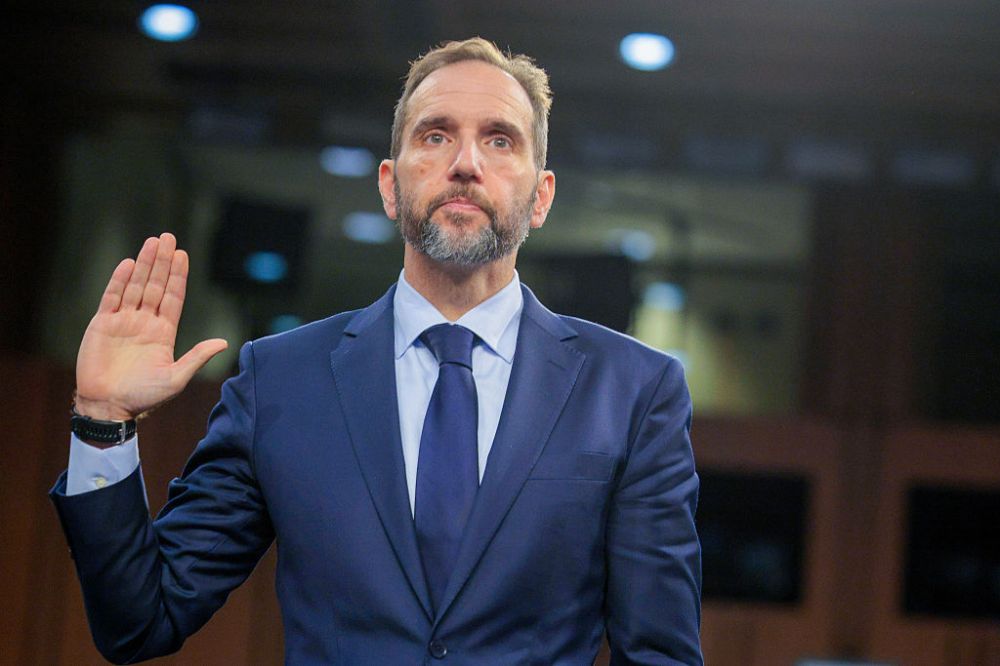
Faces at their conference in Birmingham, themed around the first 100 days of a Reform government, are near universally ashen. Spare a thought for the director of communications, Ed Sumner, who spent his 30th birthday fire fighting this mess.
The initial reaction, of course, was to attack the expose as a “hoax” on Reform perpetrated by a bunch of climate change activists. The undercover filming was carried out by Verbatim Investigations, founded by journalists from the Centre for Climate Reporting. But I’m afraid this is too serious to dismiss with a machine gunning of the messenger, as Reform’s actions this morning tacitly acknowledge.
Farage has just called the sting “entrapment” and insisted his party had “done nothing wrong”. But even he admitted the recordings “don’t look good, and that’s why we’ve taken the action we have”. They “said things that shouldn’t have been said,” he told LBC radio. The footage appeared to show both Jukes and Orr explaining to a potential donor how the rules could be circumvented. It was not the other way around.
Farage should also be cognizant that the mood in the bars around Birmingham last night was utterly mutinous. Those who are putting themselves forward as Reform candidates confided their despair. “We are giving up our businesses and putting family lives on hold to fight for Reform and this is going on behind the scenes,” one said.
I caveat what follows with the usual observations. A police investigation seems inevitable, and Reform is carrying out an internal probe. It is necessary to assume that the footage run by Channel 4 was fairly edited and that nothing significantly exculpatory was excluded.
The overwhelming reaction in my WhatsApp groups from operatives in the other main parties was incredulity at the recklessness of it all. “If this is how they talk to people they don’t know, imagine what they are saying to people they trust,” observed one former Downing Street Tory. Channel 4 redacted several of Jukes’ comments but he appeared to be explaining how Reform had previously got donations in what must be assumed to be a similar fashion.
The overwhelming reaction in my WhatsApp groups from operatives in the other main parties was incredulity at the recklessness of it all
All political parties need more money than they have got, but the art of extracting it is knowing where the rules can be stretched and where they cannot. It is about knowing what is fair game and what sends the shark jumping over the line of propriety. “There is no way anyone who has ever worked in CCHQ [Conservative Central Headquarters] would talk like that,” a Conservative staffer said. The view of Labour and Lib Dem operators was much the same. “It’s just rank unprofessionalism,” a Lib Dem said.
So why did they do it? It is the experience of everyone I have ever known near the summit of politics that political operations take their character and operating logic from the person at the apex of the triangle. Leaders set culture. The worrying thing for Farage admirers is that if Jukes and Orr behaved like this it is because they believed it to be okay by the boss. Both boasted on camera of their closeness to the leader. In the meeting at the pub with the fake donor, Farage seemed both au fait with how the money would be transferred to Reform, and grateful for it.
The scrappy, screw the rules, bugger the establishment vibe comes from him. This is another reminder of the timeless rule that every major politician’s greatest strength is also their greatest weakness. Farage’s insurgent image has put him in a place where he might win power but made his operation demonstrably less suitable to exercise it.
We needn’t get too pious about this. Britain’s last five prime ministers have been, more or less, a failure and Farage might yet earn the right to try his hand. But when you are trying to transform a broken country, anything that sidelines you for a day is a problem. Anderson called the revelations “a big distraction.” And you don’t need to be as prim as Melanie Hamilton to think governments making laws for the rest of us ought to give a passing impression of wanting to stick to them.
This is another reminder of the timeless rule that every major politician’s greatest strength is also their greatest weakness
I’ve used this line many times, but one of the best political advisors I’ve worked with used to tell his ministers: “If you don’t want to read about it on the front page of the Daily Mail [a muckraking tabloid] don’t do it.” Inside Reform, the footage suggests that the attitude is that the mainstream media are out to get them, the Electoral Commission are dolts and the rules are for losers.
It remains to be seen whether, as Anderson put it, “they’re gone for good.” I can well imagine a world in which Jukes, in particular, is back at Farage’s side in the medium term.
But the wider lesson is that Farage’s view that personal loyalty is the most important attribute, above competence, intelligence, probity or a working knowledge of politics is a potentially dangerous one. It is totally the case that Farage thrives in ecosystems which resemble family rather than a traditional political party. But he’s trying to portray himself as a prime minister in waiting and (even he realizes) does not yet have the heavy hitters he needs to ram through landmark changes to the way Britain is governed.
Jukes is a canny character, well plugged into the tropes and tactics of the new right, but he has literally no governing experience and an in-built resentment of the political establishment – one which has often served him well but may now have been his undoing. Very few things raised more eyebrows last night than his claim, downing pints outside the Westminster Arms pub, that he would become chief of staff in Downing Street, arguably the second most important job in government and one which usually requires a working knowledge of Whitehall. “Dan Jukes versus Antonia Romeo [the Cabinet Secretary] is something I want to see,” said one Tory virtually in near-Earth orbit on schadenfreude. (p.s. it’s a shame no one used the headline: THE HAZARDS OF JUKES this morning)
The other Reform specific observation here is that Farage and his team are just a little too intoxicated by the American right. Farage’s relationship with Donald Trump could yet prove very useful if he becomes prime minister while Trump is in the White House. But his gang have been going to new right conferences for years and are totally immersed in the tactics and issues of MAGA world and the online right. They spent years telling the left “Twitter is not real life” but seem to have succumbed to believing that every approach which works for Trump can also work here. And the infatuation with American money is one always likely to end in tears.
The irony is that Reform’s closeness to the Trumpies ought to have made it easier for them to run due diligence on the prospective “donor.” “Did they Google this amazingly rich man,” says the former No. 10 Tory. Another asks: “Would they not have asked the GOP [Republicans] if anyone had heard of this guy. You never get a rake thin right wing American donor. I want to see a piggie.”
The pollsters embroiled in this debacle are also in crisis. The polling firm JL Partners, headed by James Johnson, was paid by Reform to produce a series of polls that were favorable to the party. I have worked with James Johnson on and off since he was Theresa May’s No. 10 numbers man. As I’m sure Johnson would be the first to point out, he has behaved like an utter goofball. It’s a pity because he has always seemed to me both humble and serious. JL Partners said in a statement that it is “reviewing (its) procedures in order to eliminate possible gray areas and ambiguities and strengthen our safeguards for the future.”
The one point I would make in Johnson’s defense is that JL Partners are good pollsters. They have a commendable record of accuracy and called the last US election right when others were predicting a Kamala Harris win. I have also known pollsters, during a 25-year-career in journalism, who will give both parties and newspapers the answers they want, ask the questions in a certain way or flat out keep asking them until they get what the client requires. That is emphatically not Johnson’s MO.
This conference was supposed to show they have the plans to save the country. Their plan for government is taking shape
Indeed, in several regards, Reform did not get what they wanted from the polls featured in the exposé. The union workers polling showed that a majority (52 percent) of union members wanted to affiliate with Labour, not Reform. A majority (51 percent) of union members said Labour best represents working people, not Reform. It is even the case that Keir Starmer beat Farage on the measure of who would make the best PM with union members, at the nadir of Starmer’s popularity.
It is for the police and Electoral Commission to determine what happens to him and the Reform duo. But it is quite something for the Daily Telegraph to falsely claim they commissioned the poll they ran and then ditch JL Partners when they got caught with their trousers down.
Reform high command hopes that when Farage addresses the conference he will have such big announcements that they will blow all this out of the water. Perhaps. The party – Robert Jenrick, Richard Tice and Zia Yusuf – are offering credible plans for power.
Their ongoing party conference was supposed to show they have the plans to save the country. Their plan for government is taking shape. But, as many observed when Boris Johnson was in No. 10, “character is destiny” and character is what you do in the dark when you think no one is looking. On that front they have more, rather than fewer, questions to answer.
These points are linked. Even those who don’t care about propriety must know that the stench of incompetence is the real killer in politics.





Comments