
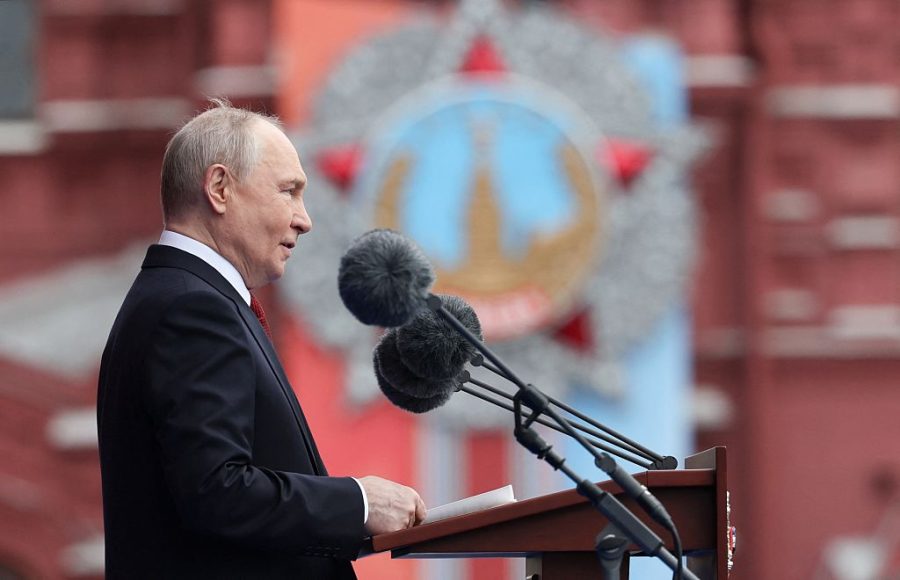
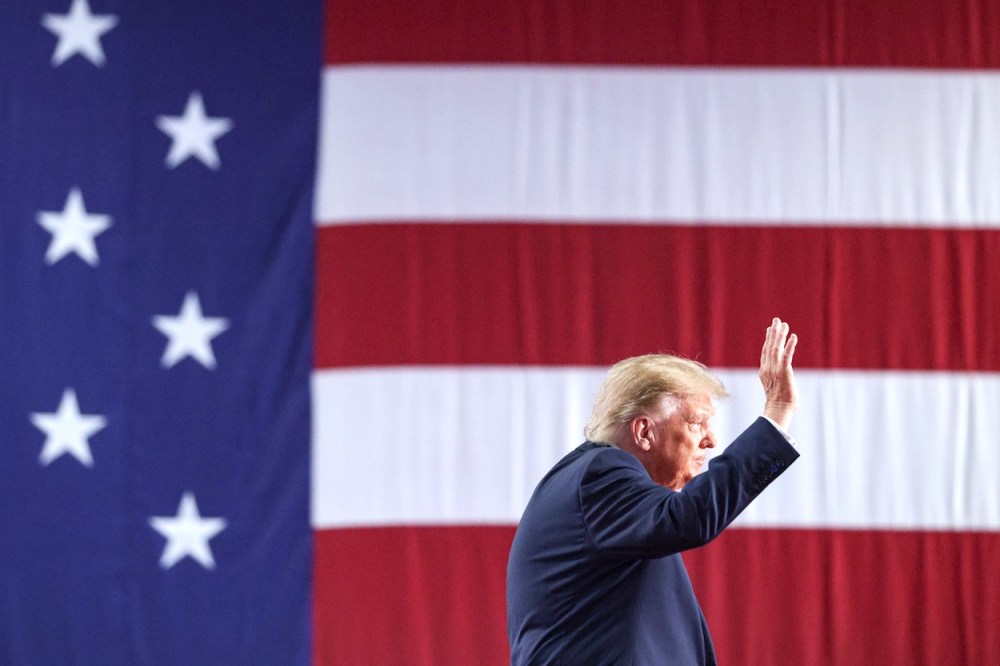
Thanks to Donald Trump, Vladimir Putin could enjoy his Victory Day parade in Moscow safe in the knowledge that no Ukrainian drones would come hurtling onto Red Square while he was inspecting the Russian troops. Taking to Truth Social last night, the American president declared that he had requested that Moscow and Kyiv observe a three-day ceasefire, starting today and lasting until 11 March.
‘This ceasefire will include a suspension of all kinetic activity, and also a prison swap of 1,000 prisoners from each country,’ Trump said. At the time of writing that truce is still holding, with both Putin and his Ukrainian counterpart Volodymyr Zelensky stating that they would stick to the agreement.
A centrepiece of Putin’s calendar, Victory Day – marking the victory of the allied forces over Nazi Germany in 1945 – is usually a seemingly never-ending celebration replete with brocade, pageantry and heavy weaponry. Since coming to power 25 years ago, the Russian president had used the day as a platform to showcase the might and strength of Russian army to friends and enemies alike.
The eerily empty streets of Moscow this morning were a far cry from the usual throngs who turn out to watch
In the four years since invading Ukraine, the Victory Day parade in Moscow has gone through various iterations that have reflected – and at times attempted to compensate for – the Russian army’s performance on the front line in Ukraine. This year was distinctly different from any that have come before it.
The military parade onto Red Square today did not feature any military equipment – the first time this has been the case since it was introduced into the event in 2008 a few months before Putin’s invasion of Georgia. Rumours had been circulating for a few weeks that this would be the case, before the Russian Ministry of Defence confirmed it as fact earlier this week. The reason given by the MoD’s spokesperson was that this was ‘due to the current operational situation’ – a reference to Ukraine.
Nevertheless, different theories have cropped up as to what was truly behind this ambiguous excuse. Some have suggested that, in light of the recent success of Ukrainian drone attacks deep inside Russia, parking up military equipment ahead of the parade would have made them a target for attack. Alternatively, running a huge convoy through the centre of Moscow would have potentially created a big, moving target in close proximity to Putin himself. Were there to have been any kind of incident, this would have been hugely damaging to the President’s reputation and the Kremlin’s narrative – not least because the event is beamed live around the world. Others have suggested that the Russian forces simply couldn’t spare the equipment from the Ukrainian front.
And yet it wasn’t just with regard to military equipment that today’s Victory Day parade in Moscow was scaled back. Compared to the 29 heads of state who attended last year’s celebration, there were just three on the podium next to Putin today. Aside from Belarus’s Alexander Lukashenko, the presidents of Laos and Malaysia were the only two international leaders in attendance. Perhaps in an attempt to save face, the Kremlin insisted they had not issued any invites to foreign dignitaries this year; those that came, as one Russian TV anchor paraphrased, did so ‘out of the goodness of their own hearts’.
According to multiple reports, Putin has grown increasingly paranoid in recent months over the possibility of an assassination attempt. This was reflected in the eerily empty streets of Moscow this morning – a far cry from the usual throngs who turn out to watch the parade make its way down towards Red Square. Most Muscovites stayed home, hampered by the fact that an internet and mobile phone signal blackout had been introduced for the duration of the celebrations.
The exception was the heavily armed machine gunners stationed around the city centre. Russian forces had also reportedly relocated air defences from around the country to protect the parade – an indication of just how vulnerable the Kremlin really feels to the possibility of a Ukrainian attack.
In place of the missing procession of military equipment, video clips from the frontline in Ukraine were, for the first time, broadcast into Red Square. The footage, narrated over in documentary style, featured Russian soldiers launching drones and surface to air missiles, pilots flying bomber jets, and submariners aboard the nuclear-powered submarines Arkhangelsk and Knyaz Vladimir. When the camera cut back to the stands between clips, they repeatedly landed on Putin, his mouth twitching, barely able to suppress a smile.
This was also the first time that North Korean troops had taken part in the parade on account of their ‘liberation of the Kursk region from neo-Nazi invaders’. Over 10,000 are believed to have been sent to Ukraine following the incursion into the Russian region of Kursk by Ukrainian troops two summers ago.
Putin’s speech was also notably shorter this year than on previous occasions, done and dusted in a snappy nine minutes. It contained the President’s usual history lesson on the Soviet Union’s contribution to the second world war. It was the Soviet people, he declared, ‘who made the decisive contribution to the defeat of Nazism, saved their country, saved the world’. Inevitably, he drew on those stories to create a parallel with the war he is waging in Ukraine. Russian forces are ‘confronting an aggressive force armed and supported by the entire NATO bloc’, he said. Putin went on to issue a rallying cry to the nation:
We will overcome any challenge! We have a common goal. Everyone makes a personal contribution to Victory. It is forged both on the battlefield and in the rear.’
In light of reports of increasing unhappiness in the country tied to rising economic hardship and seemingly catalysed by the urban internet blackouts of the past few months, this part of Putin’s speech seemed somewhat tinged with desperation.
In recent years the Kremlin has barely kept up the pretence that Victory Day is a celebration marking the end of the second world war. In truth, it is now no more than an opportunistic veneer for Putin to hammer home his justifications for invading Ukraine. There is no small amount of irony that that conflict has been running for longer now than the USSR was ever involved in the fight against the Nazis over 80 years ago.
Perhaps that was only apparent to the few remaining second world war veterans pressganged onto the stands behind the President. No one on Red Square, though, would have dared to say that out loud.




Comments