
Theodore Roosevelt, the blur of energy who occupied the White House for the first years of the 20th century, famously advised statesmen: ‘Speak softly and carry a big stick.’ Sir Keir Starmer is increasingly performing a morbidly fascinating inversion of this, and pursuing a policy of speaking loudly (and piously), while having no stick at all.
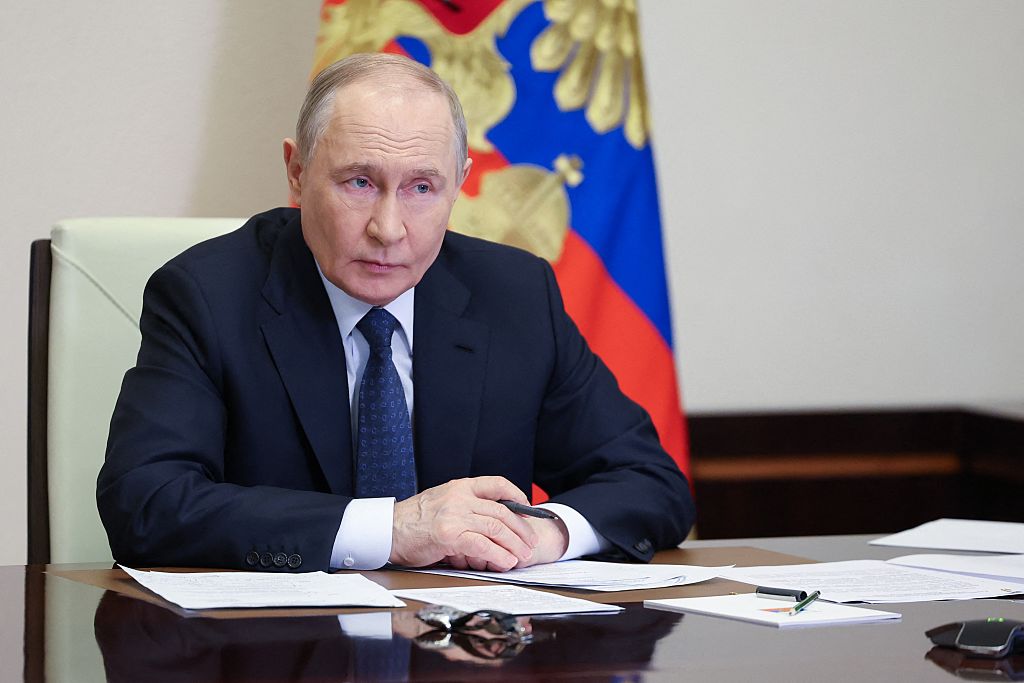
Putin currently has little to fear from Starmer’s moralising bluster
At the end of March, 10 Downing Street proudly announced that the United Kingdom would ‘step up its pressure on Putin’ by giving permission for military and law enforcement personnel, including our still-vaunted Special Forces, to board vessels from Russia’s ‘shadow fleet’ if they passed through UK waters. These are the sanctioned, illegal and uninsured oil tankers which are sustaining oil exports from Russia and, in Downing Street’s words, ‘fuelling Putin’s barbaric war in Ukraine’.
This determination on the Prime Minister’s part may have been rather tardy, but his language was tough and uncompromising.
‘Putin is rubbing his hands at the war in the Middle East because he thinks higher oil prices will let him line his pockets. That’s why we’re going after his shadow fleet even harder, not just keeping Britain safe but starving Putin’s war machine of the dirty profits that fund his barbaric campaign in Ukraine. He and his cronies should be in no doubt, we will always defend our sovereignty and stand with Ukraine for as long as it takes.’
Starmer is never the most convincing international hard man, but the intentions and the direction of policy were correct.
On Wednesday, two tankers from the shadow fleet sailed through the English Channel. The Cameroon-flagged Enigma and the Universal, sailing under the Russian flag, are both under sanction by the UK, the European Union and the US Department of the Treasury’s Office of Foreign Assets Control. They were escorted by the Russian Navy frigate Admiral Grigorovich, a smaller warship than the Royal Navy’s Type 23 frigates but equipped to carry Kalibr and Oniks anti-ship cruise missiles.

What was the government’s response? Did it, to quote Number 10’s bravado, ‘put a further stranglehold on the shadow fleet, closing off UK waters, including the Channel, for sanctioned vessels’?
It deployed RFA Tideforce, a Royal Fleet Auxiliary replenishment tanker only equipped with armament for close self-defence, to follow the trio of Russian ships, which passed through the Channel unmolested.
Vladimir Putin is expert at testing the determination of his opponents. He can judge with great precision when and how far to provoke and has an eye for interpreting the results. Last September, around 20 Russian drones entered Poland’s airspace, provoking a Quick Reaction Alert by Polish and other Nato aircraft in which at least four drones were shot down. Three days later, Nato launched Operation Eastern Sentry, a strengthened mission to protect the airspace of the alliance’s eastern flank. The deployed force comprised 15 fighter aircraft, an air defence frigate and a surface-to-air missile battery from six nations. This was hardly an overwhelming force, and it will have told Putin a great deal about Nato’s capabilities, available assets and willpower.
The lesson for the Russian President from the passage through the English Channel of the Admiral Grigorovich and its two charges is much clearer. The UK has yet to interdict and seize a single shadow fleet vessel, while US forces seized the Russian-flagged oil tanker Marinera in the North Atlantic in January; the French Navy has also intercepted a number of ships in the Mediterranean. Putin currently has little to fear from Starmer’s moralising bluster.
Of course this is about more than the Prime Minister’s willpower. The gap between his rhetoric and actions is yawning and grows wider by the day. But he is also faced with a virtually bare cupboard in terms of available naval assets. Of the Royal Navy’s six Type 45 destroyers, only HMS Dragon could be deployed to the eastern Mediterranean after RAF Akrotiri in Cyprus came under drone attack at the beginning of March. It took three weeks to get her on station, and she has now been forced to put into port with a faulty water supply system.
Only one of the five Astute-class attack submarines is currently operational, and HMS Anson is believed to be in the Persian Gulf region; she was in Australia when the conflict with Iran erupted. That leaves seven Type 23 frigates for the Royal Navy’s global commitments, of which only six are operationally active while HMS Kent undergoes a major refit. At least three are already deployed, HMS Iron Duke is coming to the end of a maintenance period and HMS Richmond is scheduled for decommissioning this year.
Sir Keir Starmer’s threats have been proven empty. It was not only that he did not order any action against the shadow fleet tankers in the Channel; it is hard to see how he could have done so. As he approaches his second anniversary in office, the responsibility for the Royal Navy’s threadbare capacity shifts more and more to his shoulders, and with the Defence Investment Plan now at least six months late and no firm date set for publication, there is no way of knowing how the government intends to address this issue.
President Putin learned a valuable lesson this week: vessels from the shadow fleet can transit the English Channel more or less at will. It would be comforting to think the Prime Minister had learned a lesson too, but I doubt it.

Comments