Starter for ten: why did Britain declare war on Nazi Germany 87 years ago this month? If you answered ‘to defend Poland as a result of a British-Polish alliance’, you’d be partly right. I’ll get to that in a minute, but first let’s think about the roots of that decision.
After all, what a remarkably strange decision it was to ally with Poland. Britain had neither diplomatic ties nor longstanding friendship nor geographic closeness to the country, nor much appetite for acquiring any closeness to it. This wasn’t Belgium. For the most part, Poland was seen (as it still is too much today) as a new and brittle country on the map, then perilously perched between Germany and Russia, two far greater powers. Where Poland wanted integrity, its perimeter for most of the late 1910s and early 1920s resembled that of a colander: awaiting the decisions of plebiscites and conflicts and diplomatic decisions at Versailles, marked by dashes and dispute on the map.
Britain had little patience for a country that seemed to spend rather a lot of its time changing its borders. The last war had been so bad that surely the best reaction was to peacefully stand by and watch the peaceful remilitarisation of the Rhineland, the peaceful demands of Germany to peacefully regain land lost at Versailles, the peaceful annexation of Austria to Germany, and the peaceful annexation of the Sudetenland, helped peacefully along by the Munich Agreement. It was simply ‘a quarrel in a far-away country between people of whom we know nothing,’ said Neville Chamberlain, peacefully. Europe was having a remarkably peaceful run, if one defined peace as Germany repeatedly taking things.
We forget Polish perspectives at our peril in the UK
It wasn’t until Germany, now apparently not so peacefully, marched into the rest of Czechoslovakia in early 1939 that Poland suddenly seemed vital to European security. Hitler’s defiance of the Munich Agreement proved that his plan for the domination of the continent was unstoppable. Except Poland – with its newly modernising army, and strategic position, and longstanding suspicion of its puffing neighbours – stood in the way. Poland had gone from being somebody else’s problem to Britain’s problem rather quickly.

Britain hoped a promise of support might be enough and pledged an Anglo-Polish alliance in the case of an invasion. Poland had a big brother behind it, and the school bully might just skulk away. So sure was Britain, in fact, that it promptly neglected to fund Polish defence or even offer much tangible help when Poland was, indeed, as they predicted, invaded. The British blockade limited some resources to Germany, but other military efforts were limited to a handful of skirmishes between fighter planes. Poland fought bravely, but slightly over one month later the country fell to the German forces – and to the Soviets, who had jumped on the bandwagon to invade Poland from the east on 17th September.
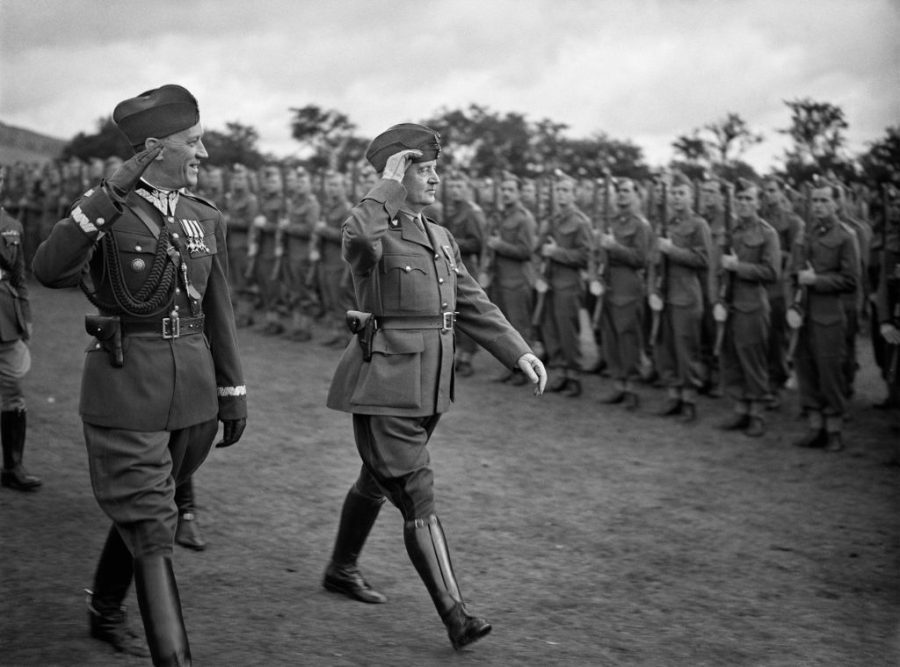
It may have been a defeat for Poland, but here’s the catch. The British still needed Poles – needed their military skills, their passion, their patriotism, their righteous anger. Polish forces were already proving vital to the British, though initially phoney, war effort.
Polish skills were in high demand. They lay in cryptography: the Poles had invested in cryptanalysis since the 1919 to 1921 Polish-Soviet war. With the help of French intelligence, they had cracked the Enigma code in 1932 (the point at which one feels Britain might reasonably have started paying attention). They handed their material to their French and British allies on the eve of war, after which it permeated to Bletchley.
Poland’s skillset also lay in the army, navy and air forces. The Polish government fled to France after the 1939 occupation before decamping to Britain when Germany moved westwards over Europe; the Polish armed forces created there went with them. By mid-July, a particularly stellar Polish Air Force had been formed and was seeing numerous triumphs in the skies during the Battle of Britain (and on the ground with British girls). Poles also fought with the Allies in the Mediterranean and Middle East and in Europe, particularly at the battle of Monte Cassino. Poles also established lively communities in Britain – including the wedding-cake-esque haven of pickle-cocktails (try them), the club and restaurant Ognisko, in South Kensington.
Despite this, the Poles felt royally screwed over. At Yalta, Churchill, Stalin and Roosevelt agreed for much of Poland’s pre-war territory to be incorporated into the Soviet Union, and a communist government was imposed, involving the forced migration of Poles west into territory taken from Germany. So too was Polish history incorporated into a Soviet viewpoint.
We forget Polish perspectives at our peril in the UK. What might have happened, perhaps, if Polish – or indeed Ukrainian, or Lithuanian, or Latvian, or Estonian – fears of Russia had been taken into account in the 2010s, after the invasion of Crimea in 2014? Or if Polish links had always been a central part of British foreign policy?
Poland seems to be answering the question for us. The country is now at the forefront of efforts to resist Russia and one of the leading military powers in Europe. It is on track to build Europe’s largest army and spend the highest of its GDP on defence of any Nato member. It is a vital conduit for Ukraine – for supplies and aid – and is investing in essential infrastructure for security, as well as a domestic defence industry. Perhaps the Poles were saving us all along.




Comments