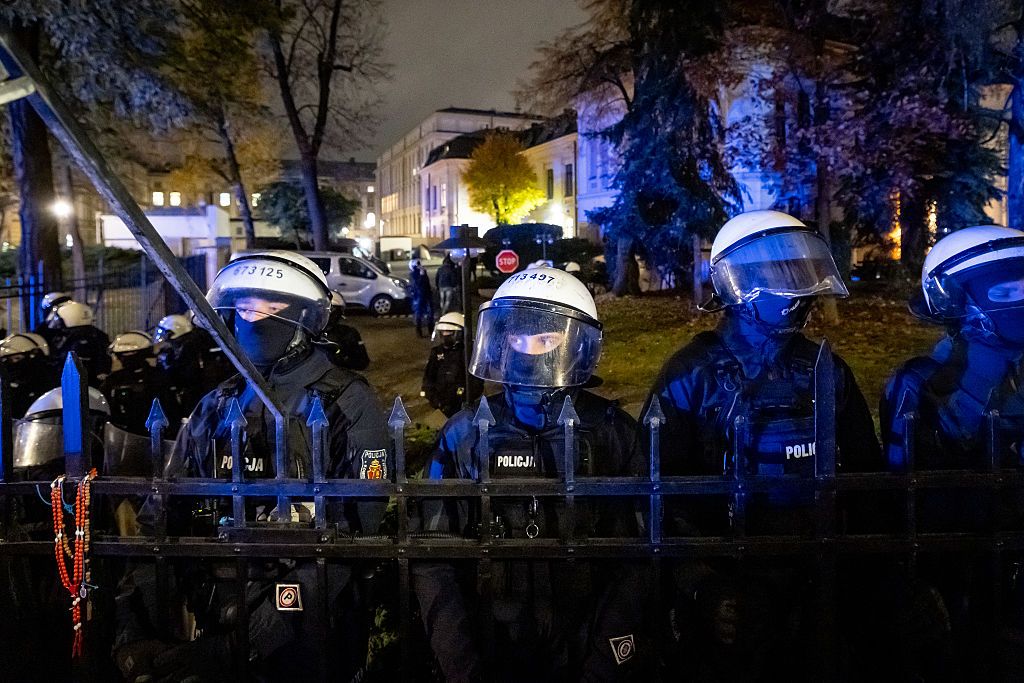
Karol Nawrocki was en route to Senegal when he instructed his flight crew to return to Poland. When he got back to Warsaw, riot police were surrounding the Constitutional Tribunal, the nation’s highest constitutional court. Shortly after midnight, the Polish President pushed his way into the court through a wall of people, confronting the judges whose authority he refuses to recognize.
Poland’s left wing has spent over a decade accusing the nation’s conservatives of undermining the rule of law and judicial independence. With Prime Minister Donald Tusk back in power, they appear emboldened to employ the very tactics they once condemned. On Friday evening, Poland’s long-running constitutional crisis arrived at a crossroads when a group of judges elected by Tusk’s parliamentary majority moved to suspend the Tribunal’s President. Beyond the immediate crisis, a more troubling question is posed by these events: if restoring the rule of law requires disregard for legal procedures, what exactly is being restored?
There is a fundamental contradiction in the idea that the rule of law can be restored by disregarding the constraints that it is supposed to uphold. Tusk’s government argues that the Tribunal was compromised by the previous government, when Poland’s conservative Law and Justice party (PiS) rose to power. In an X post, Tusk wrote: “Restoring the rule of law is our duty. After years of Law and Justice’s lawlessness, this is a difficult, sometimes painful process that requires decisive action. There is no other way.” Nevertheless, the legitimacy of an institution, let alone one as important as the Constitutional Tribunal, cannot rest solely on whether its composition is acceptable to those in power. If that becomes the new standard, then judicial independence ceases to be a constitutional principle – and as such, can be bent to the will of whoever finds themselves in charge.

None of this is to suggest that Poland’s previous government was beyond reproach. PiS’s judicial reforms drew significant scrutiny, both domestically and from Brussels. But should the existence of previous wrongdoing justify any and all methods to correct it? If constitutional restraints are to be respected as a tool to prevent governments from treating political necessity as a substitute for legal authority, then a government that claims to be committed to the rule of law must be willing to accept these restraints, even when they obstruct its preferred outcomes.
This danger extends beyond the present confrontation; if precedent is established by Tusk’s government, then it can, and will, be invoked by its successors. If the declaration of existing leadership in the judiciary as illegitimate can be invoked by a parliamentary majority, then what prevents a conservative government from employing the same logic? This, coupled with the fact that the confrontation unfolded while Nawrocki was mid-air, only adds to the suspicion surrounding the motives of the would-be reformers. Should they succeed, Poland risks creating a feedback loop in which every new administration claims to restore judicial independence while further eroding the continuity upon which such independence stands.
For years, Brussels treated Poland’s judicial independence as a test of the nation’s commitment to the values of the Union. In 2017, the European Commission levied Article 7 of the EU treaties against Poland, making it the first member state subjected to the bloc’s most serious rule-of-law enforcement mechanism. Following Tusk’s return to power, the Commission moved to close those proceedings in 2024, with Ursula von der Leyen congratulating Tusk’s government on their progress. The question now is whether Brussels will subject Tusk and his government’s methods to the same standard it once applied to his conservative predecessors. It would be welcome proof that at least some institutions are not on the left nor the right, but on the side of democracy.






Comments