
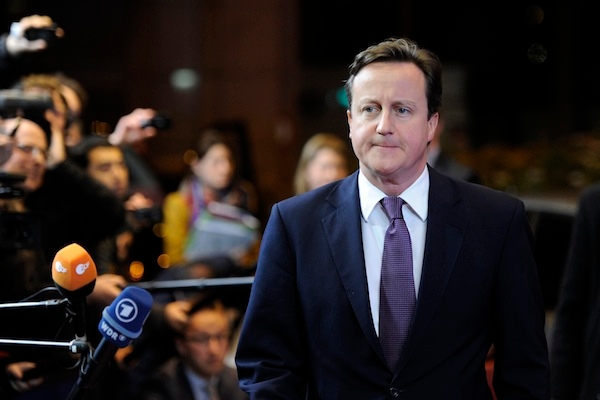
David Cameron looks set to address backbench concerns about Britain’s relationship with the European Union over the next few weeks. Nick Robinson reports today that though the Prime Minister will not use his party conference speech to talk about Europe, he is considering making a ‘major speech about Britain’s future relationship with Europe’ before EU leaders meet in December.
As Robinson points out, Cameron will come under pressure from backbenchers this autumn with votes in the Commons on the European Banking Union. There is also the first meeting of the all-party parliamentary group for an EU referendum in mid-October, and its leader John Baron is still waiting for an answer to a letter he sent to the Prime Minister in June, which was signed by 100 backbench Tories and called for legislation in this parliament for a referendum in the next. Former defence Secretary Liam Fox is on manoeuvres on Europe, too. So the time has come for the Prime Minister to do something before his party starts running ahead of him.
Bernard Jenkin summed up colleagues’ fears about the changes in the European Union this morning on Radio 4, saying:
‘We [Conservative backbenchers] think we have to have a relationship with our European partners that’s positive and constructive and co-operative but I don’t want and I don’t think the British people want the European Union to determine the law of our country more and more so that our democracy doesn’t count anymore. And what we’re faced with now is a very, very fundamental change in the character of the European Union, which is going to change our relationship with the European Union whether we want it or not and the question is, do we get dragged along in the slipstream of this or do we have to say… we have to put up some red lines, we have to claw back some of the powers for example we cant submit to the banking union – that would wreck the City of London.’
One of the key questions Cameron needs to address in his speech is what his negotiating position is on a new relationship between Britain and Europe. He dismayed backbenchers in July by revealing that he would not campaign for an ‘out’ vote. They felt he had shown his hand before even walking into the negotiating room, as other European leaders now know that the worst threat of an exit by Britain won’t be one the Prime Minister uses. And they want a promise on a referendum of some form to be in place for the European elections in 2014. Many will be wary of a speech that turns out to be just another holding line from the Prime Minister rather than at least a sketch of a new relationship with the EU.





Comments