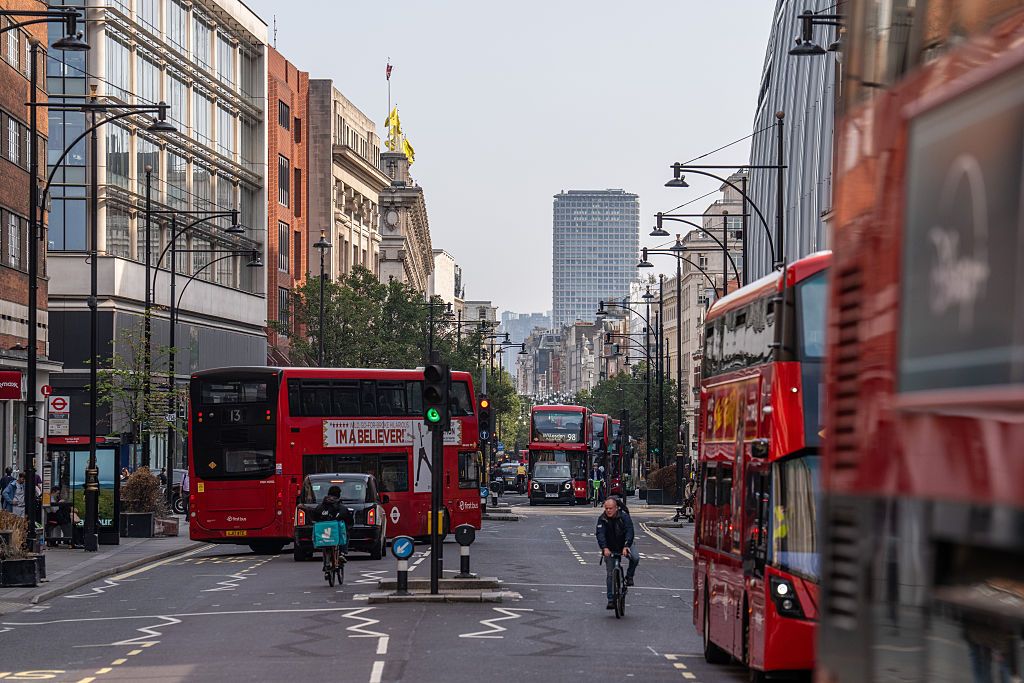
Oxford Street is set to be pedestrianised on Monday. The change to what is often called the world’s longest shopping street is controversial and opposed by Westminster Council. But London Mayor Sadiq Khan, having taken control of the area via the Oxford Street Development Corporation, hopes pedestrianisation will revive its flagging fortunes and bring back the shoppers in the run-up to Christmas.
Well, I am a member of the demographic planners hope to attract back: a woman of a certain age and a lifelong shopper on Oxford Street. I’ve been tramping its pavements since I could barely walk as my mother hunted for what she needed in its department stores. As an adult, I often joined the throng of women bearing shopping bags and satisfied expressions. In its golden age Oxford Street offered variety and quality from a range of trusted retailers.
Subsequently I witnessed its slow decline as consumers moved online, and then the effects of the Covid closures. In the wake of 2020, Oxford Street was a grim place, lined with empty retail units and shops selling tourist tat. It now has only two department stores, and the demographic it attracts is predominantly a young crowd more interested in hanging out than searching for that special outfit or household item. And with self-service tills and limited stock available for physical inspection, the stores aren’t encouraging actual humans through their doors. So is pedestrianisation likely to help?
The main point is a practical one. Oxford Street is long – 1.2 miles, to be precise. Strictly speaking, it isn’t the world’s longest shopping street and this first wave of pedestrianisation only affects the stretch from Marble Arch to Great Portland Street, about 0.6 miles.

But when you’re at one end of Oxford Street, having been on your feet a few hours, and you realise the thing you want is most likely in a store at the other end, you either hop on a bus or call it day and go home. I know this as a distance walker who can stride on while her contemporaries are begging for a sit-down. The buses and taxis that traditionally course its length do so because Oxford Street is part of the A40, a central transport spine running through the network of small streets to the north and south. It cannot be turned into a plaza or city square at the waive of a mayoral edict.
So I was momentarily surprised by the reaction on X when I made this point in a tweet. Respondents informed me, variously, that disabled people could ride mobility scooters, tired shoppers could use the Tube and that walking in nearby Hyde Park was more demanding. But I soon realised these absurdities came from the foot soldiers of a battle that could be described as ‘Ideology vs Common Sense’, with a reduction in motorised transport as the campaign objective.
This new political cause can be summed up by the slogan ‘Two Feet/Wheels Good, Four Wheels Bad’ and has affiliations with net zero and its lesser-known counterpart vision zero, which calls for lower speed limits. Since central government launched Active Travel in 2022, it’s become fashionable for councils to introduce schemes which discourage travel by vehicle through the simple expedient of making driving more difficult. Under Low Traffic Neighbourhoods, the quickest routes are blocked, while roads are narrowed and the number of parking spaces reduced. The overall goal, as the transport chief in Oxford – where you now need a permit to drive across the city – recently admitted, is to ‘persuade more people to leave their cars at home more often’. When talking to supporters of such schemes, it is useless to make practical points about the need to transport shopping, or children, or equipment. They simply don’t care.
And so – alas, poor Oxford Street – Britain’s iconic shopping street has become an ideological football, the centre of a social engineering experiment to ‘persuade’ the nation to eschew the vehicle. And while the central target is the private car, many of the tactics affect bus travel. As a result, London is now officially the world’s slowest city.
By the way, I have been disabled on Oxford Street. Last summer, following a mis-step on Charing Cross Road, I fractured my foot. The Tube was out of the question and a subsequent trip to central London in an orthopaedic boot taught me that ‘step-free access’ does little to alleviate limited mobility. If you’re frail for any reason, navigating the London Underground can be a nightmare.
To put the dystopian cherry on the cake, Oxford Street is also to become part of the UK’s experiment in mass surveillance with the introduction of permanent live facial recognition cameras. So, for a target consumer like me, the new Oxford Street presents a decidedly untempting prospect – a long walk among under-stocked chains and tat shops while under police surveillance. What’s to like?
As both a sentimental Londoner and a discerning consumer, my tears for Oxford Street were cried and dried some time ago. I have no doubt that this latest turn in its misfortunes will accelerate its decline.






Comments