
Dante’s Beach, Ravenna
Daily life in Punta Marina, the next little town but one from me here on the Adriatic coast has gone globally viral after being portrayed as some kind of horror show worthy of Alfred Hitchcock.
This frenzy of interest is a tiny example of how the media, all too often, will not, perhaps cannot, tell the truth.
It also shows how far too many people are so brain-washed about what matters in life that they are incapable of realising when perhaps God Himself is trying to tell them something.
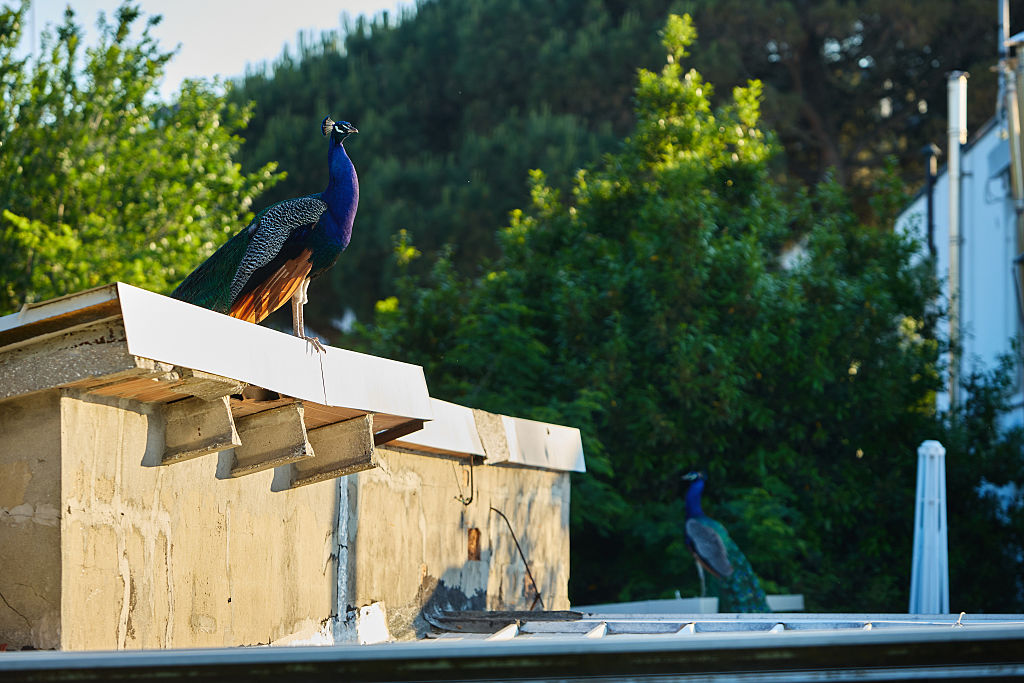
Peacocks are sacred and symbolic birds. They also have a crucial connection with Ravenna that goes back to the early days of Christianity. No one knows why they are in Punta Marina but it is obviously as a result of some kind of miracle. There are about 120 of them, it is said.
Only a hysterical minority want to get rid of them, many of whom, it has to be said, are women. Plus the odd man whose shiny stainless steel chimney has been punctured by male peacocks attacking their reflections
Yet to read the headlines you would think that the town has been taken over by tens of thousands of them and that their intent is evil like in Hitchcock’s The Birds and that as a result residents dare not risk coming out of their homes.
‘Invasion of the peacocks leaves Italian town crying fowl’ (the Times). ‘Italian village overrun by rampaging peacocks’ (the Telegraph). ‘These peacocks have taken over an Italian town’ (CNN).
For two whole weeks, one Italian daytime TV talkshow has broadcast daily bulletins from Punta Marina about its peacocks as if reporting from the front line in a warzone.
It is all nonsense, pretty much.
Worse, the media herd bleats as one that the residents of Punta Marina object to the presence of the peacocks. But this, too, as far as I can work out, is nonsense. A lot of local people actually like the peacocks. Only a hysterical minority want to get rid of them, many of whom, it has to be said, are women. Plus the odd man whose shiny stainless steel chimney has been punctured by male peacocks attacking their reflections.

A few facts: there have been peacocks in Punta Marina for about 30 years, and there are now thought to be about 120. They used to live mainly in the grounds of a small abandoned military base near the beach in the centre of town, where they roosted in the pine trees. But in the past five or so years they have branched out.
Yes, they do occasionally dislodge tiles on roofs, which they like to sit on, and the males do sometimes scratch cars because they see their reflections in them. But really, is that such a big deal?
The cry of the male peacock, it is true, is impressively intrusive. It is a prolonged screech. This really does upset certain women residents, it seems. They say it stops them sleeping at night as peacocks wake up at about 4.30 a.m.
Indeed one woman says the sound of peacocks has made her ill with a cocktail of different afflictions. Another, interviewed by a TV troupe, screeches repeatedly on camera ‘Basta! Basta! Basta!’ and sounds just like a male peacock at full throttle.
Norman Mailer understood the destructive effect of the sound of certain birds not so much on women but on drinkers like him. His murder mystery novel Tough Guys Don’t Dance, set in Provincetown Massachusetts, begins when the protagonist wakes up with a thumping hangover, unable to remember the night before.
Mailer writes: ‘At dawn, if it was low tide on the flats, I would awaken to the chatter of gulls. On a bad morning, I used to feel as if I had died and the birds were feeding on my heart.’
I know how bad seagulls can be as well because I love a drink and sometimes have to sleep in central Rome where there is a large resident colony that never goes to the sea. But Mailer was wrong about the sound of the seagull. It is far worse than mere chatter, more like a scream. And it is relentless, whereas the shriek of the peacock is short and occasional. Though, it must be said, it does become much more frequent in the ‘Stagione degli Amori’ which is now.
What, however, no one is even mentioning in this whole palaver is the vital importance of the peacock to Ravenna – and to us all.
The city, last capital of the western Roman empire, is full of fifth and sixth century Byzantine mosaics in which the peacock plays a prominent role. The Greeks and Romans associated the peacock with the goddess Hera (Juno) whose chariot was said to be pulled by a peacock. Early Christians regarded the radiant blue breast of the male and the fabulous colours of his tail feathers, with their circular patterns that look like eyes, as a symbol of immortality and resurrection.
Saint Augustine of Hippo, no less, writing in the early fifth century, noticed that a piece of cooked peacock flesh, which he had decided to observe, did not go rotten like other meat and poultry. He took this to mean that it was incorruptible and thus proof that God can preserve the flesh of resurrected bodies for eternity and that human beings go to Heaven (or Hell) in body and soul.
In The City of God, written just after the catastrophic sack of Rome by the Visigoths in 410 AD, he wrote: ‘For who but God, the Creator of all things, gave to the flesh of the dead peacock the power to prevent it from putrefying?’ When Fra Angelico painted his The Conversion of Saint Augustine, he included most conspicuously a peacock.
Yet I find just as compelling as all this the use to which Italy’s greatest film director, Federico Fellini, puts the peacock in his Oscar-winning masterpiece Amarcord (1973) which is local dialect for ‘I Remember’.
The film is set in his home town of Rimini just down the coast from Ravenna in the days of Mussolini’s fascist regime and is a series of semi-real and surreal episodes that mirror the four seasons.
In a piazza covered with thick snow, teenage boys are having a snowball fight when the object of all their sexual fantasies, the hairdresser, whose nickname is Gradisca (roughly, ‘would you like some?’), emerges from her salon in a tight-fitting white dress and scarlet shawl and is pelted with snowballs.
But then, as if from nowhere, a male peacock flies into the piazza, screeching, and settles on the frozen fountain amidst the icicles and unfurls its magnificent tail feathers. Everyone stops and stares, and is spellbound. This scene is usually regarded as representing Fellini’s view that beauty, though fleeting and accidental, causes irresistible wonder that transcends everything else, however bleak.
When I paid a visit to Punta Marina at the weekend I had to really look hard to find a peacock and most people I spoke to were not especially bothered by them. The most eloquent was an Albanian called Hardy, named after Oliver Hardy, who said he had witnessed his neighbours, a husband and wife, beat a peacock to death in the road with broom sticks. Police were called, he said, and the couple now face trial.
‘In my view, those who do not like the peacocks are not happy in their lives or in themselves,’ said Hardy.
I had bumped into him outside the piadineria (a stock component of Romagnola life which sells their equivalent of hot pasties and pitta bread sandwiches) near the sea in the centre of town next to the ex-military base which was the site of the original peacock colony.
There were, it is true, four peacocks, males I seem to recall, perched on the stainless steel chimneys above us. Yes, if you really wanted to distort reality, you could say that the silhouettes of such large birds perched in such a way were scary.
But give me those peacocks any day rather than the wolves that live in our pine forest at Dante’s Beach – or the nudists who have colonised the best bit of our beach.




Comments