
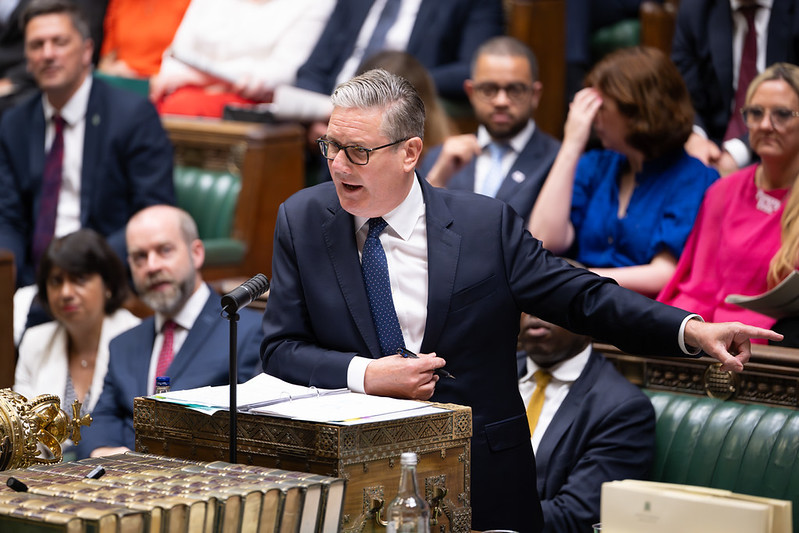
Parliament always has an otherworldly feel; it’s a world of gothic crenelations, of specialised language, of deliberate artifice. But something even less real has crept in recently. A deliberate indulgence by the governing class of mawkishness and sentimentality, just as the reality of the country they’re supposed to be governing turns grimmer and more violent. The two – the rise of violence and the dominance of mawkishness – are not unrelated.
Scarcely a week goes by without a minister hailing a victim or relative in the viewing gallery – sometimes for manifestly self-interested reasons
We are entering day two of the fallout from Kemi Badenoch accusing Bridget Phillipson of being a ‘spiteful class warrior’ at PMQs. Phillipson, who likes to claim she has a thick skin, spent the intervening period appearing on TV and radio saying how nasty and unfair the epithet was, and marshalling Labour MPs to put out outraged tweets communicating much the same sentiment. Proportion went out the window. Murdered MPs were invoked. Anything rather than discuss Phillipson’s dire record on education. We are becoming used to pompous lectures about civility in politics, often from people who elsewhere throw around terms like ‘far-right’ and ‘racist’ with joyous abandon.
Parliament historically offered a refuge from the emotive and sentimental. According to the authoritative guide to parliamentary procedure Erskine May, ‘until recent times it was not in order to refer to persons in the galleries (except generally for the purpose of an order for their withdrawal)’ though the Chair could decide whether to intervene. The ‘until recent times’ is crucial: this is no longer the case. In 2017, this strict rule was relaxed by then-Speaker John Bercow, though he did specify that references by Members should remain ‘brief… directly related to proceedings, and not… phrased so as to be in any way intimidating or to seek to influence debate.’ This has, like so much, fallen prey to the reality of the slippery slope. Increasingly, ministerial statements lead on not just the ‘lived experience’, but often the physical presence of wronged members of the public in the Commons. Sir Lindsay Hoyle could instantly raise the quality of debate by returning to the stricter regulations and the useful purpose they served.

Now it’s open season on the invocation of emotion. Scarcely a week goes by without a minister hailing a victim or relative in the viewing gallery – sometimes for manifestly self-interested reasons. A particularly egregious example came during a PMQs session in 2024, when Sir Keir Starmer, then-leader of the opposition, countered Rishi Sunak’s (accurate) observation that he had U-turned on his definition of biological sex by haranguing him for insensitivity since Esther Ghey, the bereaved mother of murdered teenager Brianna Ghey, was in the Chamber that day. ‘Of all the weeks to say that, when Brianna’s mother is in the chamber. Shame. Parading as a man of integrity’, he huffed. As Starmer now seeks to build a myth that he was a decent man brought down by events and by a toxic environment in social and other media, it is worth remembering his own willingness to play dirty.
Duncan Robinson, author of the Economist’s Bagehot column, has documented the growing salience of victimhood in politics. Since the start of 2020, he notes, the word ‘victim’ has been mentioned in Parliament more than ‘Brexit’, ‘welfare’, ‘immigration’, ‘pensioners’ and ‘voters’. It is an apt metaphor for our politics: questions of ideology, policy, even specific causes of a particular tragic incident are all secondary to the hyper-personal.
In the wake of a tragedy, politicians excel at having the conversations they want to have, rather than acknowledging inconvenient truths. David Amess’s murder by an Islamist prompted discussions about ‘civility in politics’. Axel Rudukubana’s massacre of children in Southport triggered parliamentary censure of Amazon’s delivery practices. The Manchester Arena attack generated little soul-searching from the authorities about why a security officer was reluctant to approach the bomber for fear of being called racist, despite his suspicions. Instead it ushered in additional, victim-led regulation (‘Martyn’s Law’) requiring both large and small public venues to improve their terror preparedness. Following the murder of Henry Nowak, MPs accused those asking questions about potential ‘two-tier policing’, of trying to ‘divide the country’ and ‘stoke tensions’ and invoked Nowak’s family to close down discussions. But what if many people were simply appalled, without any stoking required?
Increasingly I think this emotional blackmail and tiptoeing around the actual issues – mass migration, violence on our streets and, frankly, evil – is a coping strategy. Humankind cannot bear very much reality. It’s also, perhaps, a measure of impotence; mawkishness allows the British state to engage in displacement activity rather than tackling real problems. It can sometimes trick politicians into viewing their words as genuine substitutes for action.
It isn’t just in Parliament but almost every single public sphere where this happens. The Samaritans advise journalists to avoid ‘[attributing] blame for suicidal behaviour’ or citing a simple ‘single event’ as the cause of an individual’s suicide. These rules of engagement were suspended as Ofsted – and former Ofsted head Amanda Spielman – were blamed for the suicide of headmistress Ruth Perry, who took her own life following a critical Ofsted inspection. The tragic event was framed as a moment of reckoning for the inspectorate, an unanswerable case for its reform. Single-word Ofsted judgments have since been banned.
The sentimental mode hastened the passage of assisted suicide through the Commons. Individual, upsetting stories of people scared of being trapped by physical decline superseded the extensive evidence from other countries and the concerns of experts and professionals in relevant fields. The mawkish tendency explains the growing prominence of children in politics; from the annual meetings of the British Youth Parliament to the influence of ‘young climate leaders’ on environmental policy around the globe. You’d be amazed how often questions begin with reference to some local eight-year-old with views conveniently similar to those of the middle-aged MP quoting them. This is a rehash of the semi-Victorian ideal that children are pure and never wrong; the difference is that no one put Tiny Tim in charge of our energy supply.
What possible solution is there? Certainly, the logical conclusion is that ‘lived experience’ is now the only currency that matters, and the only way to get MPs to take up a cause in Parliament. Given the recent preponderance of named legislation, perhaps I can propose Madeline’s Law: that the state is forbidden from spending more than 40 per cent of GDP; fare dodgers will be electrocuted; and anyone campaigning to give away sovereign territory to a China ally should be hanged, drawn and quartered. Just something small, nothing silly. But the thing is, I don’t actually think our laws should be based on my ‘lived’ experience. More worryingly, I believe mawkishness is being used as a mask – for incompetence, hypocrisy and sometimes malice.





Comments