
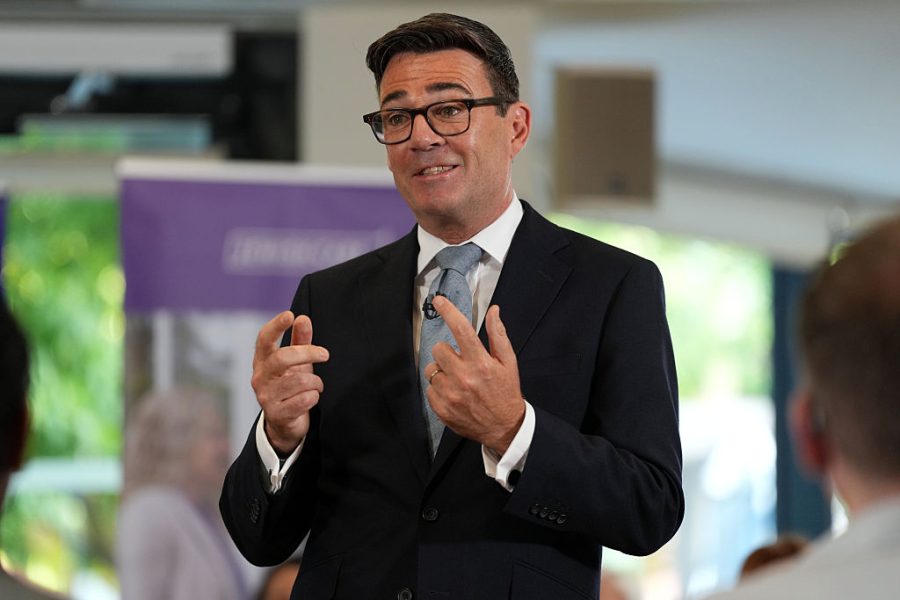
It’s amazing how far a prime minister can get just by not being Keir Starmer. There’s considerable political success to be had in simply reversing his stupidest policies, from digital ID to scrapping jury trials, and today, for now at least – assisted suicide – which Mr Burnham announced he wouldn’t be taking forward until social care is in better shape.
The most kamikaze-shaped policy of the Starmer government, the Chagos surrender, still technically remains on the books. Whether Burnham will have the balls or nous to do a full-scale scrapping of his predecessor’s deranged programme remains to be seen.
Burnham is helped by the contrast in his tone – Starmer invariably sounded like an impatient undertaker when announcing policy. In contrast to the tedious baby-and-bathwater style of his predecessor, the PM began his speech today by speaking about what the social care sector did well.
Of course, there was the classic Burnhamite schmaltz as he announced that he wouldn’t be reading his speech after all: ‘You can’t speak from notes, I’ve just gotta speak from the heart.’ Lines like this, which could be delivered by an anthropomorphic car or seagull in a Disney Pixar film, might well take people in during the summer of goodwill but they will inevitably begin to grate eventually. He compared the iniquity of social care to American healthcare, since ‘the vulnerable pay for everything and it can completely leave them with nothing’. Catchy line but a tad misleading. Unlike in America, vulnerable people without assets pay nothing; it’s those who have saved who really get rinsed.
The problem that Burnham faces is that all the real issues remain the same
He took a classic sideswipe at the media for having dared to write up briefings his team had given them. ‘Can we not let the country look at this in a clear-eyed way,’ he moaned, ‘without all the hype and overwriting of some of these issues?’ Again, an example of Burnham’s superior political nous – no one ever lost money underestimating the public’s general contempt for journalists. However, it was a bit rich when, very clearly, members of his team have been merrily briefing every hack in town about possible policy ideas to see how the public reacts – while at the same time ducking all forms of scrutiny in parliament.
As it happens, there is a very simple way to avoid ‘hype and overwriting’ and it’s not to blab, constantly, to journalists. Moments after this utterance, a reporter from the Telegraph briefed that Burnham’s team are considering taxing workers over the age of 34 an extra 1.8 per cent on earnings over £6,240 to fund their care needs later in life. (Not yet clear was who would pay for those requiring care now). This seemed an awfully specific figure for them just to have made it up or, per Burnham, ‘overwritten’. Perhaps every single member of his staff team is a sieve.
Burnham concluded by saying that ‘difficult decisions’ would be made on tax to fund social care reform, without specifying what they were – or, indeed, whether they would be a breach of the 2024 Labour manifesto and its tax promises, which elsewhere in his speech the new PM claimed he remained committed to. He signalled the creation of a ‘dementia tsar’ which sounds like the title of a revisionist history sympathetic to Ivan the Terrible.
The problem that Burnham faces is that all the real issues remain the same: no action on defence, wealth creators are still leaving the UK in their droves, a tenth of taxpayers’ money each year is spent servicing the national debt. Theresa May tried to tackle social care head-on in 2017 and we all know what happened then.
Later on, Burnham met a gaggle of elderly people by way of giving a humanising angle to the policy. Again, this is in contrast to Starmer who would just stand in front of members of the public like a fleshy but malfunctioning marionette. Tellingly Burnham wore a tie to meet the wrinklies, perhaps in case one of them mistook his usual get-up for that of a burglar. Among those he met was the luckiest man in the world: a pensioner who appeared not to know who the Prime Minister was. ‘Another one?,’ the gentleman squawked when told that Burnham was in fact the PM.
If Burnham doesn’t want to join the ranks of the leaders this fortunate gentleman has already forgotten, it will require a little more than good vibes and no notes.




Comments