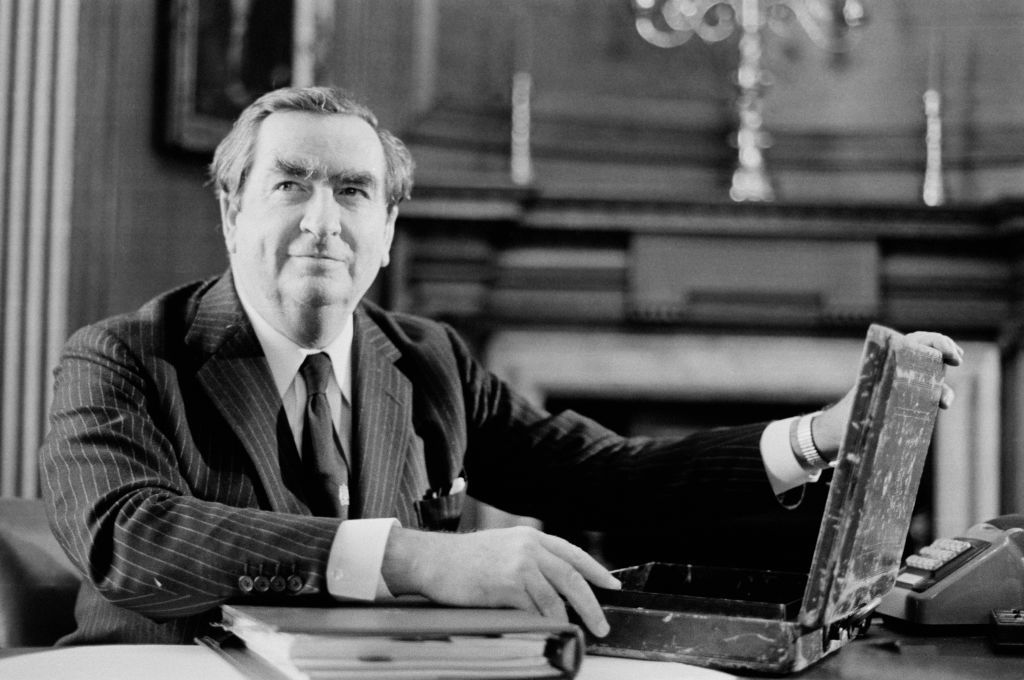
A Labour chancellor called Healey grappling with the public finances amid fears of an economic collapse. Pressure from the right to slash spending, from the left to put the people before the bankers.
Politicians generally at that time were more cultured and interesting than today’s equivalents
Sounds familiar? Well, actually I’m talking about 1976 not 2026 and Denis Healey, not John. I suppose I couldn’t have picked a better day to be transported back 50 years to watch The Gang of Three, a wonderful play in which Healey, Roy Jenkins and Tony Crosland ‘clash over the soul of British socialism and their own relentless ambitions’.
But while the economic situation seems more or less the same, the calibre of the politicians is sadly most definitely not.
Whether you’re Labour, Tory, Lib Dem, Reform or of any other allegiance, you can’t help feeling nostalgic when watching The Gang of Three – and not just for the background music. Nostalgia for a time when there was genuine political debate and genuine intellectuals among the political elite.
Each of the Gang of Three were compelling in their way. Roy Jenkins, the son of a coal miner – later trade union leader, who was arguably Britain’s best Chancellor of the Exchequer since the war (with ‘Woy’ at the Treasury the UK the balance of payments moved into a healthy surplus – imagine that today), but whose passion for Europe and upper-class, croquet-loving High Table persona ruined his chances of ever becoming Labour leader. Tony Crosland – the privately-educated Oxford friend of Roy’s – who in many ways went in an opposite, anti-elitist direction, campaigning for comprehensive schools and greater egalitarianism in society at large, always with a stiff drink and cigar in his hand. And Denis Healey, a Bradford grammar schoolboy who joined the Communist party at Oxford and became a major in the second world war before serving in both Harold Wilson’s and James Callaghan’s Labour government as Defence Secretary (1964-70) and Chancellor (1974-9).

Whatever we think of the policies they espoused, all three men were brilliant. Jenkins got a first in PPE, was a codebreaker at Bletchley Park, read Simenon in the original French, and was the author of several books, including critically acclaimed biographies of Gladstone, Asquith and Churchill.
Crosland got a first in PPE, and a second in Classical Moderations in Greek and Latin literature, and taught economics at Trinity, his old Oxford college. He was the author of The Future of Socialism in 1956 (later updated and revised), in which he argued for a more libertarian and joyous version of socialism for the post-war era, in which we didn’t just need ‘higher exports and old age pensions’, but more open-air and riverside cafes, local repertory theatres and later closing times for pubs.
Denis Healey (who got a double first), meanwhile had a vast hinterland away from politics, which encompassed photography, classical music, poetry, literature in general, painting and gardening. A ‘silly billy’? No, Denis was a true Renaissance man.
And it wasn’t just the gang of three. Politicians generally at that time were more cultured and interesting than today’s equivalents. Michael Foot, who pipped Healey for the Labour leadership in 1980 was a Plymouth Argyle-supporting bibliophile whose library contained an estimated 70,000 books and who in addition to his journalism wrote essays and biographies of H.G. Wells and Aneurin Bevan, as well as being a noted authority on the works of Jonathan Swift and Lord Bryon.
In the foyer of the Oxford Playhouse before watching The Gang of Three, I chatted to a lively 90-year-old lady who had been in a meeting once with Foot. ‘He was absolutely brilliant, he could talk about so many things’, she said.
The list goes on. Tony Benn, the anti-war anti-EEC Labour left-winger who became a ‘bogeyman’ for the right in the 1980s, was another engaging intellectual, who famously focused on the ‘ishoos’ not personalities. There was Peter Shore, another brilliant man whose ‘Fear, Fear, Fear’, pre 1975 EEC referendum speech at the Oxford Union went viral ahead of the Brexit referendum in 2016. When I was teaching economics at a school in Switzerland in the 1990s I corresponded with Shore about the ERM and the Euro and the issues involved – can one imagine doing that with a politician today?
It wasn’t just the Labour party which was a veritable brains trust. The Tories too had figures such as Sir Keith Joseph, a key intellectual driving force behind Thatcherism – and Sir Ian Gilmour, a former editor of this magazine, on the party’s One Nation left. I remember Gilmour coming to talk to our politics society at university and making a coherent conservative case against monetarism and a defence of the post-war welfare state, which had improved the lives of millions of Britons. And of course, even though her views were at variance with Gilmour’s, we mustn’t leave out Mrs T either, who did, whatever we think of the long-term consequences of her policies, have intellectual heft.
Politics was more fascinating in the 1970s and 80s because not only were the politicians more compelling as characters there was a true ‘battle of ideas’ going on, which made the whole thing more stimulating. Today it all seems rather bland and second-rate. Politicians are always ‘on message’. Always keen to say or tweet ‘the right thing’, so much so that their tweets are often identical. Imagine how someone like Denis Healey would cope in today’s climate. Or Tony Crosland for that matter? I suppose you could say we now have AI politics and AI politicians for an AI age. How utterly boring. Go along and see The Gang of Three and mourn for the far more interesting world we have lost.



Comments