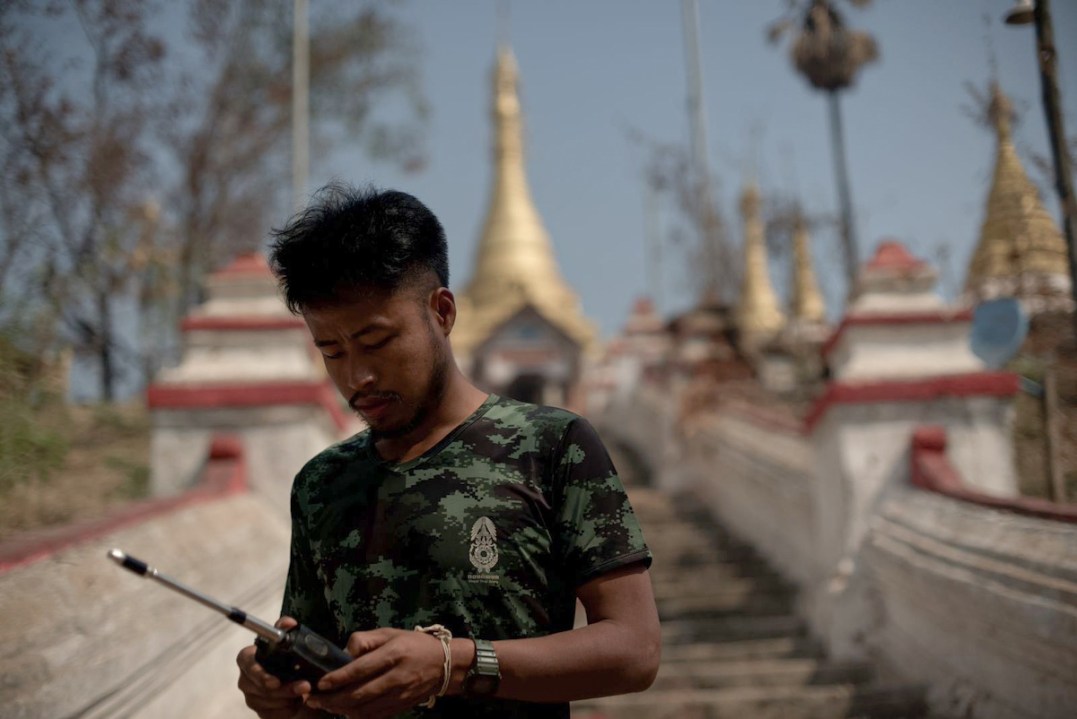
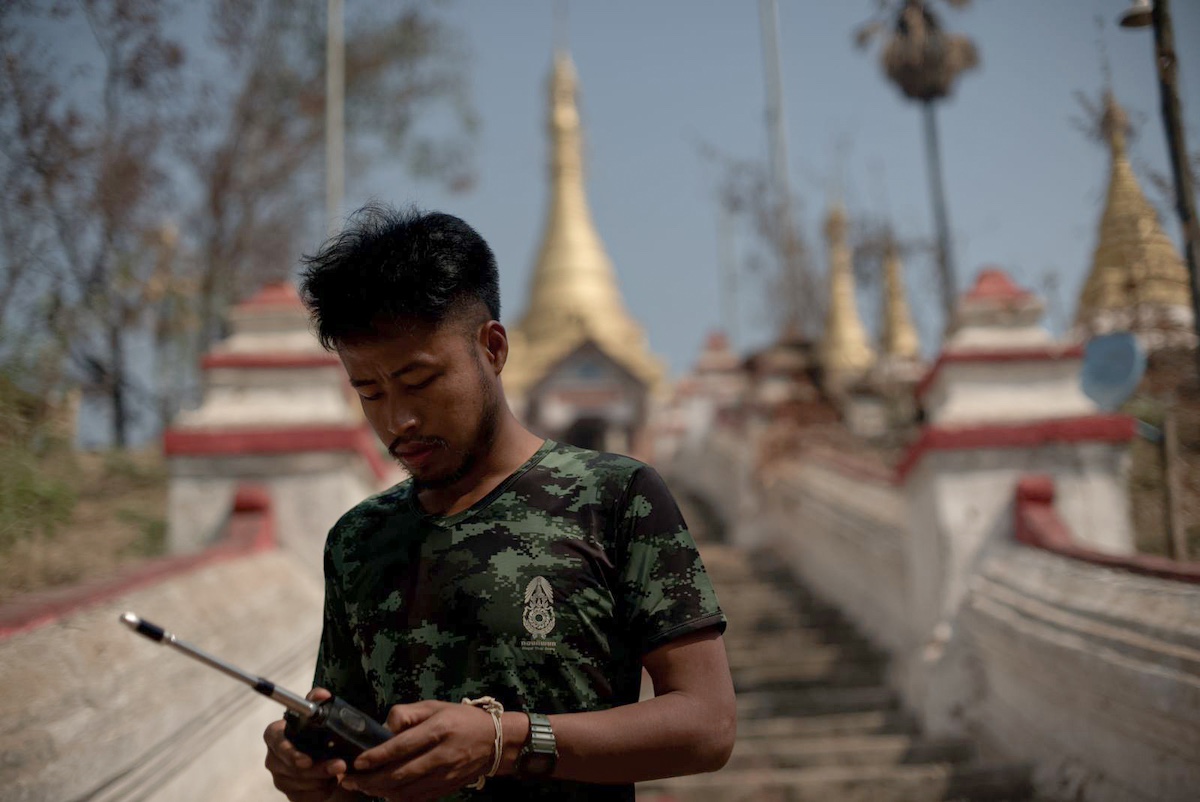
When Khu Reedu first joined the resistance following the 2021 Myanmar coup, it was like a prophecy had been fulfilled. There is an old belief that one day a young man of Karenni descent would rise to free his people from nearly a century of oppression and violence. Today, many see that prophecy beginning to take shape as Reedu leads one of the most effective and influential revolutionary forces in the country.
Reedu tells me that in Karenni, it’s not possible for freedom to occur without armed revolution. Liberation must be taken, not achieved through dialogue
In March, I found myself riding alongside him on motorcycles, racing through rough terrain somewhere between Karenni state’s Shadaw township and the town of Demoso.
Since 2023, I’ve spent months alongside Reedu, living among a platoon of his men and women who had been with him since the beginning. I’ve spent long stretches near – or directly on – the frontline, at times falling into the crosshairs of the Myanmar junta myself. Reedu’s rise has taken place in the wake of Myanmar’s so-called Spring Revolution, or civil war.
The conflict erupted after the military seized power in a 2021 coup, ousting the elected government and triggering a nationwide uprising. What began as mass protests quickly evolved into armed resistance, with newly formed People’s Defence Forces joining long-established ethnic armed groups to fight the junta across multiple fronts. The military has responded with airstrikes, scorched-earth tactics and widespread abuses, while the resistance has captured territory in many parts of the country. The conflict is now a fragmented but sustained war, with no clear end in sight.
Reedu is a member of the Karenni Nationalities Defense Forces (KNDF) – and one of its most fearsome fighters. Although he is no taller or more muscular than the other men, his eyes have an intense determination. He has led numerous attacks on Myanmar forces, winning many battles and liberating entire towns from the junta. Resistance soldiers tell me that he fights from the front and has personally killed dozens of regime soldiers himself. Many of the resistance leaders before the revolution were academics and teachers who traded their books for machine guns. Reedu was a teacher before he dropped everything to fight.
He certainly has an undeniable aura, paired with cautious optimism and a measured sense of practicality. He does not risk his troops unless absolutely necessary. Off the frontline, life under his leadership is strikingly egalitarian; when not in battle, he’s often found repairing broken trucks or taking on the most trivial tasks alongside his soldiers.

For the past three years, I’ve been travelling through Myanmar’s southeastern Karenni, Karen, and Shan states to cover the war. Back in 2023, the resistance was pushing the military to the brink, seizing territory and dismantling junta positions. Morale was high. There was something exhilarating about that moment, victory felt within reach, and Karenni state stood on the edge of what seemed like victory.
But on this last trip, there was a different feeling about the general. The resistance has been losing ground over the past two years and in Karenni state, the smallest, yet one of the most strategically important resistance zones, the situation has become increasingly tenuous.
This regression started in early 2024 when the junta regrouped and rolled out mandatory conscription of young men and women. The regime has since enlisted tens of thousands of new troops who are being trained quickly and then dropped on various frontlines across the country. This increased fighting force has led to resistance losses over the last year.
‘There was almost no doubt that we would win, the SAC could not stop us,’ Reedu told me, referring to the Myanmar military. ‘I believe this is still true, but we have new challenges now.’
On this last trip, I noticed a low, underlying sense of frustration among the men and women fighting. They knew they were losing ground. Yet despite so much loss, the resistance is refusing to give in.
In many ways, the country is collapsing, breeding desperation, cutting off education for children, and eroding basic livelihoods. The resistance is facing a convergence of pressures that are slowing momentum despite continued territorial control in some areas. In places like Karenni state, commanders say the issue is no longer funding – local taxation, including revenues from lead mines, have helped sustain its finances. But access to weapons and ammunition remains severely constrained, particularly advanced systems such as anti-air capabilities, drone warfare tools and jamming equipment needed to counter the military’s growing technological edge.
On the ground, the junta’s expanding use of drones and aircraft, including upgraded surveillance systems and Y-12 recon aircraft, has made daily operations increasingly dangerous, with fighters routinely targeted from above. But it’s the airstrikes that are inflicting the heaviest toll. Thousands of strikes have taken place within the past year alone, with much of the strikes targeting civilians.
While some foreign volunteers have entered the conflict, resistance leaders say manpower is not the problem and warn that foreign fighters risk causing a diplomatic backlash and tighter border controls, already evident in increased surveillance and military fortification along the Indian and Thai borders, complicating aid flows.
At the same time, civilian morale is falling. Many still support the resistance, but express fatigue, with some quietly favouring a ceasefire simply to escape the constant airstrikes. Broader economic pressures, including rising fuel costs, are further straining transport and supply lines, while the military has regained control of key roads in recent years.
In response, resistance forces have at times destroyed critical infrastructure, such as bridges, to slow junta advances, decisions that may create tactical advantages, but deepen hardship for civilians already struggling to survive.
Reedu tells me that in Karenni, it’s not possible for freedom to occur without armed revolution. Liberation must be taken, not achieved through dialogue. The ultimate goal is the emergence of a federal democracy, one that can only take shape once the junta is dismantled by force. Reedu says no amount of international support or dialogue will bring meaningful change.
We pulled over to the side of the small dirt road high on top of a hilltop. We needed a moment of rest. Villagers walked by and smiled, and some recognised the general and approached us. Reedu inspires loyalty to a degree I’ve never seen before. Not because he demands it, or coerces it through manipulation or dominance, but because his actions are so often for the good of his countrymen. There is something about the way he moves and meditates that draws trust and affection.
In one conversation, under a full moon in January 2024, he told me something that sums up his leadership style: ‘To be a leader, you must love your soldiers. You need to stay with them, you need to eat with them, you need to sleep with them and walk with them. If you do not love your soldiers, then you cannot be a leader. As for me, I am not a leader, but a brother; we are a partnership, a brotherhood.’
Despite the losses, there are signs of a more unified front beginning to take shape. In late March, some of Myanmar’s main anti-junta forces formed a new alliance to strengthen coordination and accelerate efforts to dismantle military rule, marking a major step toward a more unified resistance. Launched by the exiled civilian National Unity Government, the Steering Committee for the Emergence of a Federal Democratic Union (SCEF) brings together powerful ethnic armed groups that control significant territory. The alliance says it aims to end military dominance, scrap the 2008 constitution, and build a federal democratic system under civilian rule.
What stands out above all is not the strain, but the endurance of those fighting. Across frontlines and villages, the message is consistent: they will not stop. For those sacrificing everything, this is no longer just a battle for territory or power, but a struggle rooted in survival, dignity, and the belief that surrender is no longer an option.
‘If we give up now, we would be betraying our fallen brothers,’ Reedu tells me. ‘Until the day the junta no longer exists, only then will I truly feel a sense of peace.’



Comments