
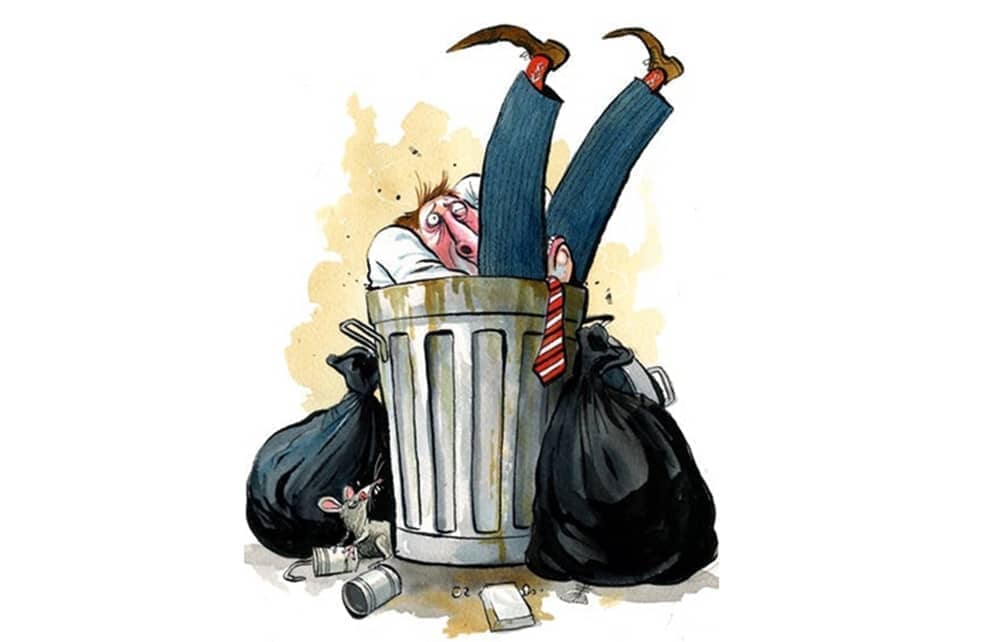
Anyone who has passed through an education in the past decade will have encountered the term ‘toxic masculinity’. It is one of the many charming phrases that our age has come up with to pathologise ordinary people. Brewing for some decades, the concept of ‘toxic masculinity’ was brought into the mainstream in the last ten years by fourth-wave feminists intent on portraying half of our species as ‘problematic’, to use another of the delightful watchwords of our era.
The simple assertion of the ‘toxic masculinity’ crowd is that specifically male behaviours are a problem. The most extreme aspects of male misbehaviour are portrayed as though they are routine. So young feminists insist that we live in a ‘rape culture’, in which men are alleged to be allowed to rape with impunity. Likewise, male-on-female domestic violence is portrayed as a kind of pandemic. And the answer to all these things is essentially to feminise men – to tell specifically young heterosexual men that they must curb their masculinity and subdue many of their most natural instincts. In every direction their path is cut off. For instance, men who come to the rescue of women are dismissed as ‘white knighting’, as though even the wish to help a woman is proof of ‘toxic masculinity’.
Of course, the concept itself is toxic – quite as much so as if our age decided to talk about women in a similar way. There’s no reason why ‘toxic femininity’ couldn’t be made as popular a concept as its opposite number. There are certainly plenty of grounds for talking about such things. For if men are, for example, more prone to physical violence then the data also shows that women are more prone to subtler methods of undermining opponents, such as reputational destruction. There are behaviours that are more male and behaviours that are more female, and the fact that some members of each sex are quite capable of one or other, or both, does not negate that fact.

Nevertheless, we do not hear much talk of toxic femininity. It is men who have been portrayed in recent years as a problem. And if you don’t believe this, speak to any teenage boy. They will be able to tell you some version of this.
Yet there must be consequences to interventions this hamfisted. It is one thing to try to fine-tune our species; quite another to attempt to do so while wearing mittens. And that is what concepts such as toxic masculinity are. They are blundering, blunt, inept efforts at rewiring – efforts that must have consequences.
In New York last week a woman sitting on the subway was approached by a madman. Not a particularly rare occurrence in itself. But this interaction was of the kind that sticks in the mind. For the man sat down beside the stranger and when she got up he grabbed her by the hair and yanked her back down, holding her in place in this way. Clearly terrified and crying for help, there she stayed. Was this an example of ‘toxic masculinity’? It would be a stretch to say so.
What was clear was that the answer should have been a bit of good, decent masculinity. In such a situation the men in the carriage (and there were many) should have stepped forward and sorted this guy out themselves. Perhaps it would have just taken one of them to confront him, or perhaps it would have taken several. The man in question was clearly disturbed and violent. Still, the men present clearly ought to have done something. I would say they should now hold their manhood cheap, but I suspect they do already. One man filmed it on his mobile phone – the pinnacle of present-day courage. Others stared into their devices in the hope that it would all go away.
There’s no reason why ‘toxic femininity’ couldn’t be as popular a concept as its opposite number
And in one way it is understandable. Everybody has heard stories in which someone has stood up to some thug and been knifed or shot for their troubles. And then there is the reputational risk of any bad interaction in the age of camera phones. Since the offender on this occasion was black, perhaps the other men in the carriage feared the possible racial component of any resulting footage.
In any case America had to confront this question on a far bigger stage this week. After the initial shock over the school shooting in Uvalde, Texas, the country was shocked anew to learn that the police had been on the scene for a long time while the gunman was shooting elementary school children in their classroom. Every time there is a school shooting there is the inevitable discussion about whether the answer to a bad guy with a gun isn’t a good guy with a gun. But on this occasion it transpires that there were plenty of ‘good guys’ with guns. Nineteen of them, in fact. One for each slain child. For the best part of an hour and a half these policemen sat around in a corridor waiting for backup while the bad guy had the scene to himself.
Those defending the police say the commanding officer thought it was a hostage situation. But for 90 minutes phone calls were coming from inside the school, including from children, begging the police to enter. Until a Border Patrol tactical team finally made it to the scene, the most action the police saw was in handcuffing and tasering parents who were desperately trying to save their children.
Does this prove that masculinity is dead? Not in itself, no. But it should remind us that society needs men to behave in certain ways at certain times. In warfare masculinity is a very good thing, as it is for the police, firemen and many others. It would have been good to see some masculinity on that New York subway. It would have been good to have seen some male heroism in Texas. But there must be consequences to telling men that their instincts are wrong, that their behaviour is wrong, and that all their intentions are tainted by dint of their chromosomes.




Comments