
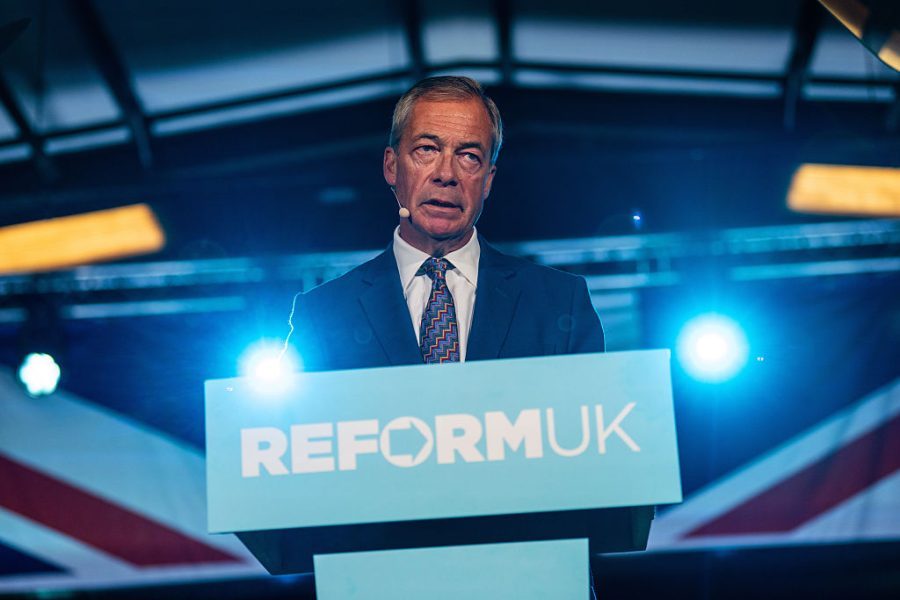
Reform today pledged the ‘biggest mass deportation programme’ in UK history, as Nigel Farage thrust the issue of illegal migration back onto the Westminster agenda. Over the long conference recess, Andy Burnham has made an immense effort to steer public discourse away from the dinghy crisis, opting instead to make bogus claims about Russian interference in Brexit and focus on forging closer ties with Europe. At a press conference in Dover today, Farage sought to put an end to Labour’s distraction tactics – and he was shrewd to do so.
Burnham and his advisers appear to believe that by avoiding the subject of illegal migration, the crisis will simply be forgotten. There was hardly a peep about the issue at Labour’s jamboree in Liverpool and, with the weather beginning to cool, Channel crossings are likely to slow. Burnham will take this as a free pass to avoid offending his base by drawing attention to the scandal – or to his government’s supposed efforts to clamp down on it. Reform’s determination to keep the issue on the agenda, and force the Prime Minister onto the defensive, is an astute political strategy.
Burnham appears to believe that by avoiding the subject of illegal migration the crisis will simply be forgotten
At today’s press conference, Farage, flanked by Zia Yusuf, set out further details of his party’s strategy for tackling illegal migration. The Reform leader vowed to impose a five-year ban on migrants being granted asylum and confirmed plans for the immediate deportation of 90,000 asylum applicants. A ‘national security emergency’ would be declared, under which all asylum tribunals, refugee routes and resettlement schemes would be frozen.
In explaining the plan, Farage was at pains to stress that his proposals were ‘nothing radical or crazy’. He said:
We want to get back to being a normal country, a country that puts national security at the top of the agenda, a country that does everything it can to protect its own citizens, and a country that detains and deports people that come illegally, as virtually every other country in the world does, and indeed, as we used to do.

Farage added: ‘All we’re asking here is for normality. All we’re asking here is for normal service to be resumed.’
The sentiment is spot on. There is a bizarre tendency on the British left to treat almost any declaration about the seriousness of illegal migration, or the need for a robust response, as morally repugnant or even fascist. It is a hysteria that is conspicuously absent in other countries governed by the left.
Take Australia, for example. While former Liberal prime minister Tony Abbott is credited with stopping the boats down under, the Labor government has neither dismantled nor shown any appetite for abandoning Operation Sovereign Borders, one of the world’s most restrictive border control systems. Under Anthony Albanese – who is of the left of his party – Australian authorities still intercept boats and turn them back, while unauthorised maritime arrivals can also be transferred offshore to have their asylum claims processed. Crucially, those arriving by boat without authorisation are barred from ever settling in Australia, even if they are subsequently recognised as refugees.
While the policy has attracted criticism from human rights organisations, it has endured under governments of both political persuasions and maintains consensus across the political divide. Beyond the fringes of Australian politics, tough border enforcement is not treated as an exclusively left-right issue. It is simply regarded as a ‘normal’ – to borrow Farage’s description – function of a sovereign state.
In Denmark, the left-wing government led by Social Democrat Mette Frederiksen has adopted one of Europe’s toughest immigration policies, restricting asylum rights, making refugee protection temporary and prioritising the deportation of failed asylum seekers. It has also tightened family reunification rules, pursued offshore asylum processing and introduced tougher measures to expel foreign criminals, arguing that strict immigration controls are essential to protecting Denmark’s welfare state.
Yet the British left, with the exception of a handful of Blue Labour MPs, has fostered a political climate in which demanding a tough response to illegal migration is portrayed as abnormal or morally objectionable. At today’s press conference, Farage sought to expose the absurdity of this mindset. And while Burnham continues his efforts to divert attention elsewhere, Reform has every reason to keep dragging the issue back into the spotlight.






Comments