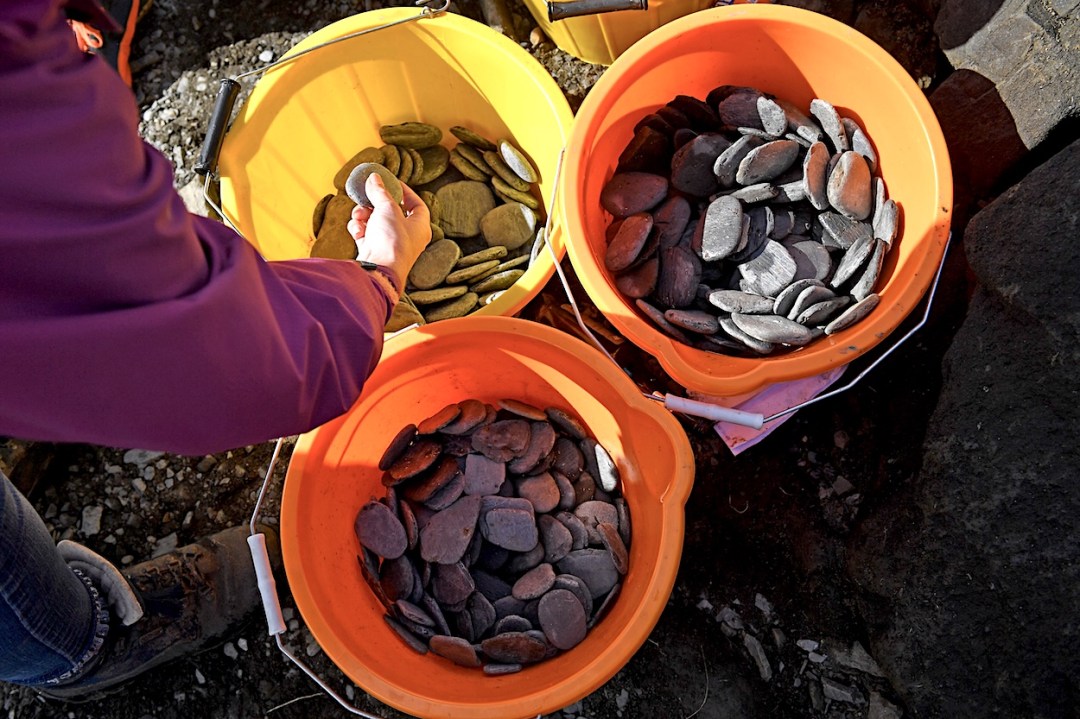
The three Dafereras brothers can’t remember how they learned to throw stones. Niko, Harry and Ross are all annual competitors in the World Stone Skimming Championship on Easdale Island in Argyll, Scotland. ‘I reckon I just picked one up and started throwing,’ says Harry. But Niko reckons they had help. ‘Dad taught us to throw. On Paros, looking at Antiparos.’ We are by a bonfire in the rain on the eve of the championship. It is dark and stormy without a star in the sky, and I can barely see their faces for wood smoke. Different conditions, then, to summer on the Aegean. I ask Niko if he ever hit Antiparos. ‘You can’t hit Antiparos,’ he says seriously.

Niko is a fisherman and razor-clam diver who spends most of his time on fishing boats around the Hebrides. When on land, he lives in a caravan in coastal Argyll where people have come from far and wide to camp out before the championship. I have never seen so many pick-up trucks in one field. Dolly Parton’s a week gone and whisky’s being passed around to the strains of Wild Flowers. By midnight, the hopeful champions have turned in.
The next morning, the sky is improbably blue. This summer’s drought is a distant rumour in Argyll and, after months of rain, the land is green and full. Fat blackberries wait within the briars. We get off lightly with a 40-minute drive to the ferry port, compared with others who have flown over from as far as New Zealand, Argentina, Jamaica and India. But as we approach the ferry port, a line of cars has slowed to a crawl. Men in high-vis jackets patrol up and down doing ominous head-shaking. Easdale is normally home to 70 inhabitants, but the organisers are expecting more than 3,000 competitors and spectators this weekend. Drivers are getting creative, ditching cars where they can and skedaddling before they can be asked to move.
Stones are thrown in a former slate mine which was flooded by a ferocious Atlantic storm in 1881, creating a circular arena for the tournament. Easdale isn’t won by the number of skims; it’s about distance. If entrants are able to hit the back wall – achieving the coveted, echoing thunk against the slate cliff – they are entered into the final toss-off where the best tossers go head-to-head. Last year, 14 made it to the final.
The tossmaster and committee organiser is one Dr Kyle Mathews. He lives on Easdale and is the local GP. ‘You do it for the drama of the toss-off. That tension, those stakes. You just feel it.’
Competitors get three throws across the 63-metre stretch, which is marked off like a swimming lane. Dr Mathews believes world champions need four things. ‘They need to have guts. If you want to be world champ, you’ve got to perform in front of 2,000 people. You need distance to hit the back wall. You need accuracy to stay within the swimming lane. And you need consistency.’
I ask Dr Mathews if he has ever hit the back wall. ‘Good grief, no.’
As we get out of the car, one thing is undeniable. It’s windy. I hear mutterings about technique, getting low to avoid deviation. But the island’s still a long way off. A mighty queue of 700-odd people stretches back from the jetty. When the shuttle boat trundles into view it’s clear what the hold-up is. The dinghy has a maximum capacity of 10 people for the short crossing of 200m. Queuers eyeball the channel between the island and the mainland. ‘Reckon you could swim that?’ But the profile of the waves in the centre of the crossing hints at a particularly nasty rip current. ‘If it was a hot day I’d consider it.’ And the punters stay comfortably dry. Settling into the queue, toss enthusiasts have come prepared. Cans of Tennent’s, Scotland’s favourite lager, are produced from backpacks and a merry atmosphere prevails.
‘We never get queues in Argyll. This is an excellent queue,’ says one local.
A lean, blond young man ferries his fortunate pals back and forth in a rowboat, two at a time. Turns out he has a particular set of skills as cox for the Cambridge Blues.
When we get to the boat three hours later, Andy the skipper is in good spirits. ‘I was a judge last year but I got in trouble because I didn’t know you had to be nice to the kids. I just thought, if they can’t throw, they can’t throw.’
On the island, the boom of a megaphone draws the crowds to the quarry. The organisers increased security this year in response to growing interest, ramped up by a BBC documentary and last year’s well-publicised scandal when a few entrants used doctored stones to get a better skim. Stonegate was handled good-naturedly by all involved. The organisers asked the suspects if they did and the suspects immediately admitted that they had. The two culprits were disqualified and the remaining finalists were bumped two places up the rankings. Names of those involved have been withheld to protect their privacy.
But memory among skim stalwarts persists. I speak to one returning spectator who hasn’t forgotten the perpetrators. ‘I had some great photos on my phone from last year. But that man is in one. The man who cheated. The photo’s ruined. I’m so cross with him.’
Spectators line the grassy banks around the arena. At the halfway mark in the competition, only one tosser has achieved back wall glory. The Dafereras brothers have all had a good go. Niko’s best shot finished just a few metres away. Close but no cigar. ‘There might not even be a toss-off at this point,’ he glowers.
All contestants are introduced with aplomb in Dr Mathews’s commentary in a cadence which would befit a ringside wrestling MC. Some tossers use their own names, but others opt for monikers like Fatboy Skim, or Skim Kardashian.
‘And now from the greatest country in the world…’ Dr Kyle Mathews’s voice booms through the arena. His intros always favour his home country of Ireland. A man with the Edinburgh burr Ewan McGregor was reaching for in Trainspotting growls, ‘Arrrgh. Second greatest. Scotland’s the greatest.’
A while later, the spectators behind me are going wild for their friend who’s next up to throw. One of them stands up with a bugle, managing a few muted squalls. When all three of his stones sink after only two or three skims, one of his loudest pals shakes her head. ‘That was shite.’ The crowd seems discontented. Only one competitor has got the better of the unfavourable wind. Drama and tension all feel thin on the ground. The chances of a toss-off – the high-stakes climax after all the travelling, the queuing – are dwindling.
And then Dr Mathews is thanking everyone for coming and inviting the crowd to give a big cheer for the volunteers. It’s over. Liam Knight from North Carolina has won. And we have barely had the chance to learn his name.
It seems sensible to hang about the island until the ferry queues calm down. People are making friends, moving between their clusters, playing with dogs. But there’s an unresolved atmosphere. The day hasn’t delivered and they’re all looking for a bit more sport.
On a grassy pitch where, hours earlier, children were playing football, there is an inflatable ball. It’s red, it’s eight feet high and it seems to serve no purpose. A few young men are standing at the edges of the pitch with their arms folded, sizing up the ball. Too big to play football with, this red behemoth represents untapped potential. They circle the ball with interest, as though a mysterious television set has appeared on Planet of the Apes. And then one is breaking away from the pack, making a run for it, charging at the ball and launching himself through the air from a foot away, his arms spread wide. He is trying to mount the ball. After a few scrabbling gestures, he falls. He has failed.
With the gauntlet thrown, another of them runs at the ball. ‘You’ve got to go fast, you’ve got to go fast.’ He does a bit better, managing to get his knees planted. As in the hundredth-monkey effect, the rules of the game have planted themselves simultaneously in the minds of these men, many of them strangers. They want to stand on it.
As the challengers of the ball get closer in their attempts, the stakes of the game reveal themselves. One promising champion, window installer Dennis O’Brien from Tipperary, very nearly makes it to the top but falls. As he hits the ground, the growing crowd utters a collective gasp. He has landed on his back, folding in on himself at the neck, feet up over his head. You feel it in your bones. But he’s up again and limping away, grinning and waving with a sportsman’s good grace.
The hopefuls are not deterred. After fifteen minutes, a serious crowd has been drawn to the lawn and one person has managed to stand on the ball, to raucous cheers. The problem is no longer mounting it, but getting down again. Some are able to slip down the side of the ball on their front, but the unlucky fall backwards. And they fall hard. Each makes a good show of grinning and running back to their friends, but you can see that as the adrenaline wears off, they’re having to be very brave about the pain.
‘Something’s up with my shoulder’
One of the best to do it, Ewan from Edinburgh, stands up with his arms spread for the crowd like Christ the Redeemer. A few seconds later, he falls. Staggering back to his friends, something is wrong. ‘Something’s up with my shoulder.’ A while later, as the aspirants continue in their attempts to mount the ball, Ewan is very pale. Two reassuring paramedics have jogged over. ‘What happened?’ ‘I stood up on the ball,’ he says sheepishly. The gruesome phrase ‘broken collarbone’ is thrown about. After that, Dr Kyle Mathews appears.
‘I’m sorry,’ says the steward who radioed for the tossmaster. ‘I don’t want to be the bad guy.’ Dr Mathews places an outstretched arm on the ball, shaking his head. The game is over. One more challenger attempts a run towards the ball but Dr Mathews gives it a lazy roll, pushing it out of the way of his charge. The tossmaster carries the languid authority of the tired headteacher who has seen hundreds of boys do hundreds of silly things. Reinforcements are called in to deflate the ball. It’s branded for an outdoor adventure company with the tagline ‘Keep Life Fun’. The crowd stands vigil as the words collapse and the ball slowly sinks into the ground.
‘They’re not going to bring the ball back next year, are they?’ Dennis and his ball brothers are doleful. Modern health and safety measures have once again seen an end to good old-fashioned fun.
Night falls and the most zealous challengers have found one another, hanging around drinking at the island’s pub, batting away the midges. Scotland’s newest Highland sport was almost born last weekend at the world’s oldest stone-skimming championship.



Comments