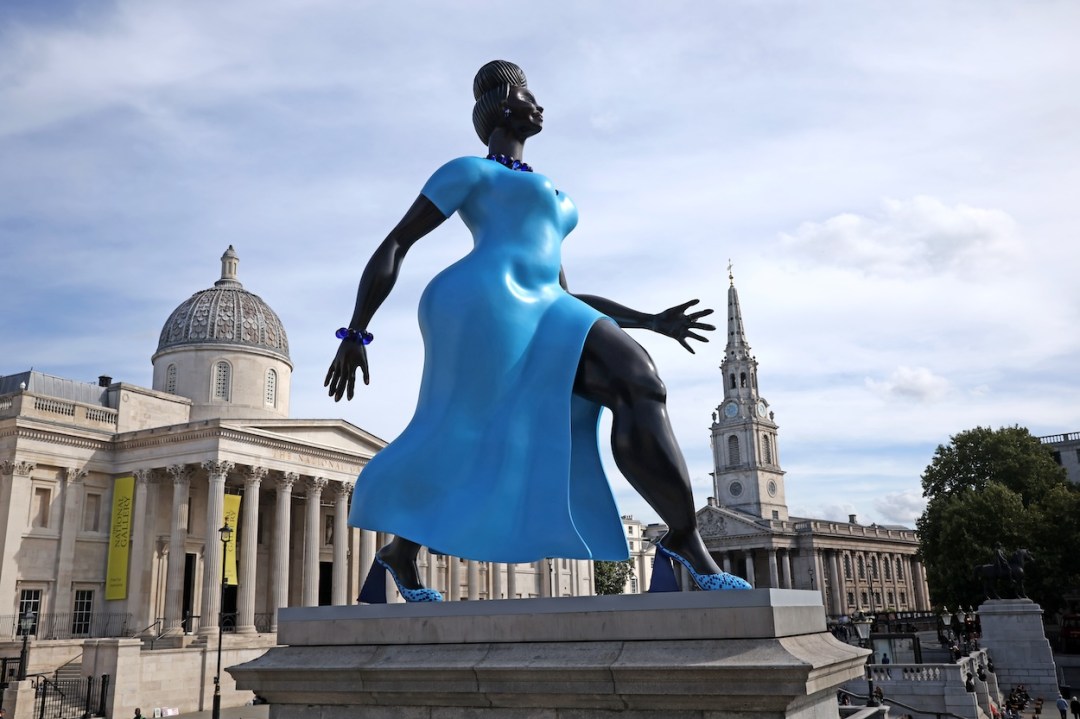
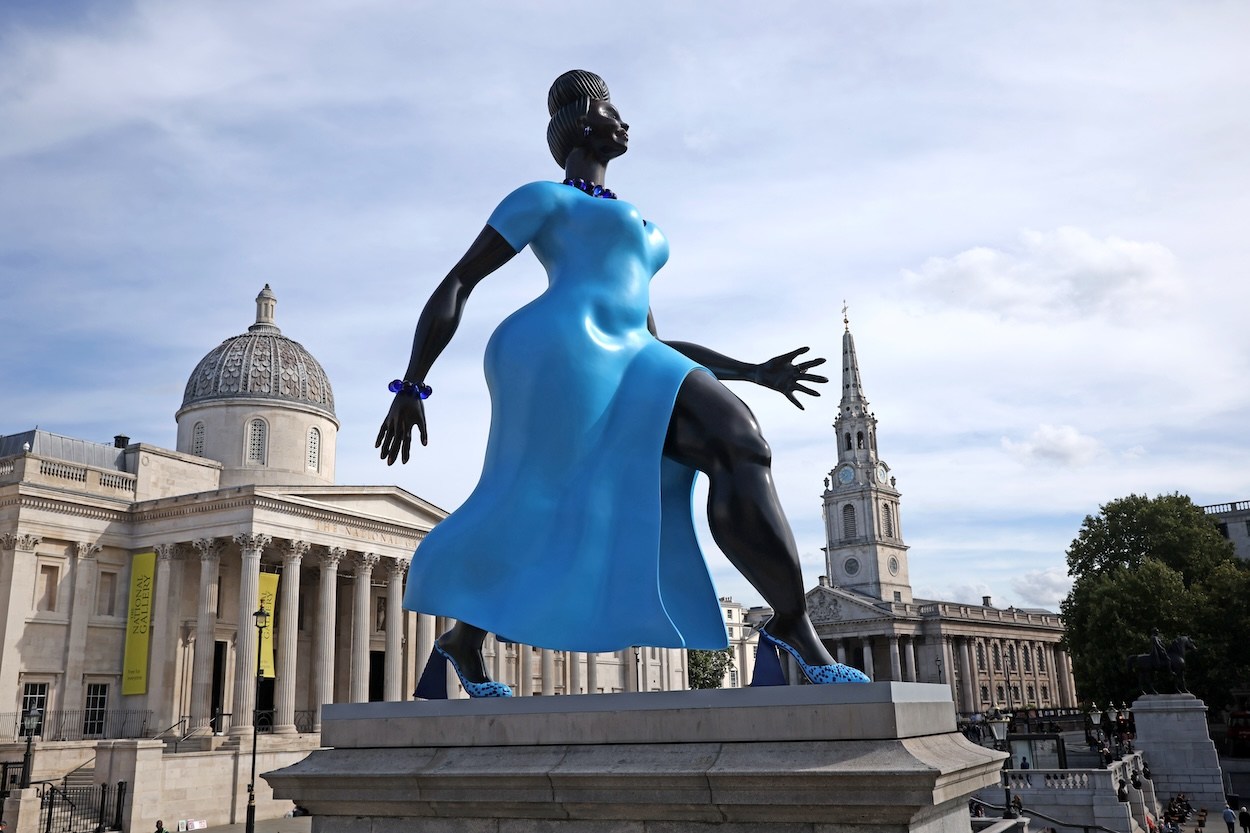
Ever since the fourth plinth in Trafalgar Square became the location in 1999 for a succession of temporary artworks, many of which have conveyed a progressive political message, it’s been the source of controversy and outrage. Among its most infamous installations have been a marble torso-bust of an artist born with no arms and shortened legs, and a memorial which consisted of plaster casts of 726 trans, non-binary and gender-nonconforming people. In the wake of that work comes Lady in Blue, the creation of the black American artist Tschabalala Self.

The ten-feet tall bronze statue presents onlookers with a representation of a curvaceous, exaggeratedly muscular black woman in a capacious sky-blue dress bowling along confidently. As the plaque below the conspicuous structure explains: ‘She is not an idol to revere or a historic figurehead to commemorate. She is a woman striding forward into our collective future with ambition and purpose. She is a Londoner, who represents the city’s spirit.’
While the London mayor’s press office called it ‘a symbol of confidence and purpose’ upon the occasion of its official unveiling last Thursday, its creator described it – deploying a familiar roll-call of arty-progressive watchwords such as ‘histories’ and ‘narratives’ – as essentially representing ‘joy’.
Many who have heard or read about it have been somewhat less effusive and enthusiastic. As one prominent right-wing populist on X, John Hannam, put it baldly: ‘It’s a pile of shit. It’s basically “woman with fat arse”. It’s totally out of place with its surroundings.’
When I went to see Lady in Blue yesterday, I was surprised to find one onlooker unashamedly give me much the same evaluation. ‘Fucking horrible’, was the judgement of someone I will call ‘Gary’, a white man in his sixties now living in Edmonton, in the north of the capital. ‘Woke nonsense,’ he continued. ‘Should be teared down. There should be a Union Jack flying from there instead.’
Such sentiments were surprising because while one expects unfiltered opinions of this kind from people who dwell behind screens, they aren’t commonly articulated in the flesh to strangers. But that’s a privilege which comes to right-wing people approaching retirement age who no longer fear being sacked for speaking their minds. And Gary, in a more protracted conversation than I‘d anticipated, in which he also spoke bitterly about ‘white flight from London’ and a city that’s ‘got even worse in the last five years’, evidently belonged to this category.
Ironically, and inadvertently, in mourning the capital’s demographic transformation, Gary would appear to agree with the plaque that said Lady in Blue was there ‘reflecting many of today’s Londoners.’ The heavy-duty yellow security barriers erected in Trafalgar Square this summer to prevent vehicle-ramming attacks – presumably by Islamists – remind us that London is indeed far more diverse these days, and that with more diversity comes more problems.
If Gary’s politics are commonplace and his sentiments intrinsically unsurprising, so were those I heard from a well-spoken white woman in her fifties who enthused earnestly: ‘It’s different. You’ve got to have something different.’
More surprising were the feelings expressed by a young black woman who grew up in Shepherd’s Bush but now lived in Twickenham on the south-west periphery of the capital. She had made her way from her leafy neighbourhood especially to see the statue. Noting that ‘it stands out, it makes a change’, she conceded that ‘it does clash’ with the dead white males perched on the other plinths. But that ‘didn’t really matter’, she concluded cheerfully, because it wouldn’t be up for long, and that she was looking forward to whatever came next.
Decidedly more ambivalent was an older black woman, originally from Zimbabwe, who told me that she and people from ‘my community’ had mixed feelings about it. She specifically took issue with it depicting a ‘stereotypical figure of a voluptuous black woman with muscles.’
I can’t deny that the installation stands out
Whatever the variety of feelings this statue aroused among passers-by and dedicated visitors, as the great numbers of who swarmed around it throughout yesterday morning testify, it’s unquestionably become an object of great curiosity, with many telling me that they came as a consequence of the heated debates it had triggered.
As for this layman who is no expert on art, I can’t deny that the installation stands out, and I’m also reassured that it’s not permanent. I just can’t warm to its implicit message. It seems to me to epitomise the triumph and triumphalism of identity politics. It doesn’t commemorate a real person who has made a difference. It inanely celebrates merely being black and being a woman. It’s a tribute to two preferred and accidental categories of personhood, with an unfortunate whiff of historical caricature.
Ultimately, Lady in Blue commemorates a non-existent person who has done nothing.





Comments