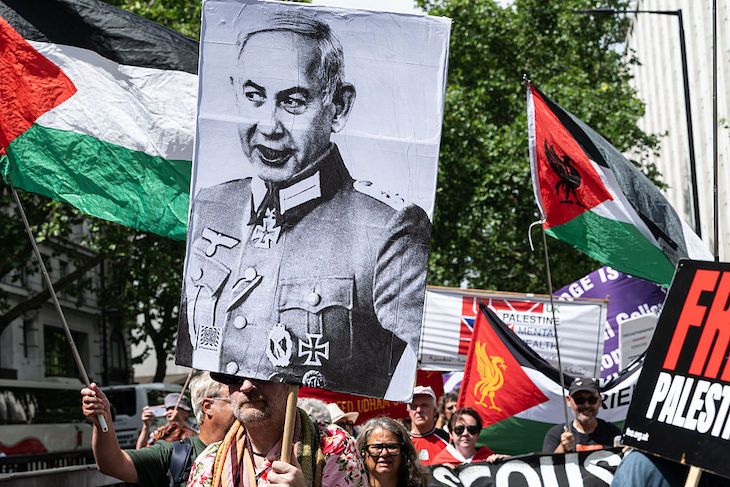
It is the third anniversary of the killing of 1,200 Israelis by Hamas and Islamic Jihad, the worst such massacre of Jews since the Holocaust. It is also the day chosen by a group of students calling themselves the University of London Coalition to convene on the streets of London, the latest in the long line of hate marches since that atrocity in Israel on October 7, 2023.
The idea that these people should be free to roam the streets, spreading their poison, should be anathema
Of course they have chosen October 7. From day one, the so-called Free Palestine or anti-genocide marches have shown what they are really about: Jew hate. Literally from day one: on 7 October 2023, as the massacre in Israel was still unfolding, the Palestine Solidarity Campaign contacted the Metropolitan Police to give notice that they would be marching the following week. That march, the first of what became regular hate marches through London, took place on 14 October, before a single Israeli soldier had set foot in Gaza as part of Israel’s response.
Today’s march is in the same vein. Those taking part are leaning in to what has become a settled part of British life: open Jew hate, under the guise of anti-Zionism. Last weekend’s Green Party ‘Zionism is racism’ motion, for example, pretends to distinguish between Zionism and Jews. But quite apart from the fact that the vast majority of British Jews are proud Zionists, believing in the right of Jews to self-determination in our homeland, when the Greens assert that membership of a Zionist organisation is effectively racist, they assert that any Jew who is a member of a mainstream synagogue is racist, since the synagogues are avowedly Zionist.
Likewise, supposed anti-Zionist marches are in reality anti-Jew marches. But this begs a question: how – why – are the racists involved allowed to parade their racism through the streets?
For that, we need to turn back to the first such marches in October 2023. While some of those present doubtless had decent motives (although it is difficult to fathom how anyone could think the most appropriate response to a massacre is to march in support of the cause of those who carried it out), the marches were characterised by open displays of Jew hate. There were chants such as ‘From the River to the Sea, Palestine will be free’, ‘Globalise the intifada’ and ‘Khaybar, Khaybar, Ya Yahud! Jaish Mohammad sawf ya’ud!’, (which means ‘Khaybar, Khaybar, O Jews! The Army of Muhammad Will Return!’), as well as Hamas placards and other similar banners.
The Metropolitan Police’s response was to stand and watch, sending out a message heard loud and clear which has reverberated to this day: do your worst and we will do nothing. Between October 14 and the end of 2023 there were large scale hate marches in London on October 14, 21, 28, November 4, 11, 25 and December 9. From all those marches, and one on January 13, there were just 327 arrests.
In the three years since, little has changed. The Met has, in the past few months, talked a better game about refusing to tolerate such open hate. But the police’s refusal to act appropriately remains a key part of the problem.
Take today’s march. Faced with a prospective hate march through central London, the Met’s first response was to appeal to the better nature of the organisers. In a statement two days ago, responding to anger by the Jewish community that, yet again, the police are going to stand by and allow the march, the Met asked those planning to join the march to “please reflect on the impact and distress it will cause on this very significant day and exercise your right to protest on a different date.”
The idea that people who choose to join a march on the third anniversary of a massacre of Jews, supporting the cause of those who carried out the massacre of Jews, even have a better nature to appeal to, let alone that they would then decide not to inflict distress on the Jewish community given that their march is aimed at just that, is not so much naïve as risible from the force charged with keeping the peace.
Yesterday, the Met imposed a limited number of conditions, telling the marchers where to assemble and detailing the route they must take: “The procession must start by 12:30hrs with participants moving along the prescribed route. Anyone taking part in the procession must not deviate from this route…The rally assembly must conclude by 14:00hrs when participants are required to disperse… Anyone who breaches these conditions can be arrested.”
Well, yes. But will they be? For three years, the Met has turned a blind eye and done next to nothing. I am sceptical, to put it mildly, as to whether they have suddenly decided to act when the law is broken. Indeed the conditions they have imposed are themselves a cop out: the route is more or less exactly that originally planned by the marchers. Instead of deciding to contain them in a static protest, as many have asked for, the marchers have simply been told to stick to the route. The idea that these people should be free to roam the streets, spreading their poison, should be anathema.
Even now, the Met insists that the march does not meet the threshold of causing “serious disruption or serious disorder, or disruption to the life of the community”. That really says all one needs to know about the Met’s policing of hate marches. If a march by a terror-supporting rabble timed specifically for the anniversary of the worst antisemitic massacre since the Holocaust is not deemed such, then it is difficult to imagine what would be.





Comments