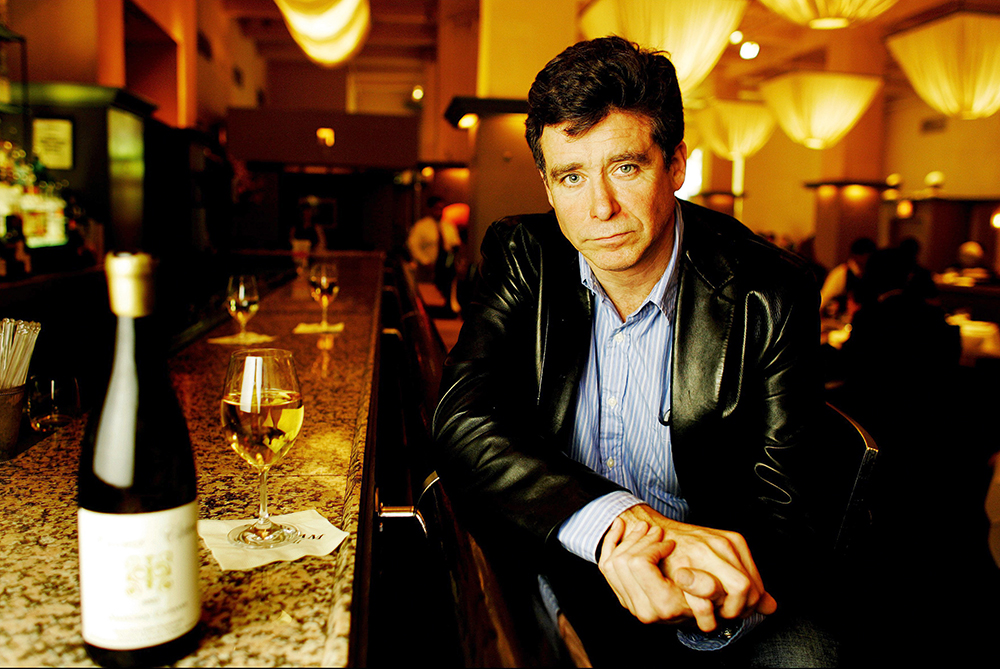

Since his debut novel Bright Lights, Big City appeared in 1984, Jay McInerney has been one of the best-known writers whose work is mostly grounded on the long, skinny, granite-bedrocked river isle the Lenape called Manahatta, “island of hills.” He has lived in town for most of the past four decades too, and currently divides his time between a Village penthouse apartment and Water Mill in the Hamptons.
McInerney walks into the lobby of the Marlton Hotel on West 8th Street, just paces from Washington Square, and heads turn. Young lovelies on their laptops with Mission Control Center-sized cans over their ears and chic hairstyles look up and blink, appealingly. Waiters slide swiftly to his side. When we settle into a comfortable table, I’m expecting he’ll order a gin martini at this hour on a warm late afternoon in Greenwich Village. No, it’s a cappuccino – he’s heading back to work after we talk. Today, he is eager to talk about his new novel, See You on the Other Side, as well as what he’s writing now that his tetralogy about Russell and Corrine Calloway is done.
We first met the Calloways in McInerney’s fourth novel, Brightness Falls (1992). Russell was a smart young editor who’d made a name for himself publishing a college friend’s brilliant short stories; Corrine, his college sweetheart, made the family’s money as a stockbroker but cared more about her volunteer work for New York’s hungry and homeless.
McInerney took his novel’s title from a sign in the window of his local coffee shop on University Place
In The Good Life (2006) and Bright, Precious Days (2016), McInerney continued the story of the Calloway family, their friends and frenemies, set in, respectively, the aftermath of the September 11 terrorist attacks and the 2008 mortgage-driven financial crash.
In 2026, Russell is still an editor looking for the next big writer, and Corrine still full of heart and gentleness, still volunteering in soup kitchens and helping the unhoused – until the Covid pandemic puts a stop to the city’s life. McInerney took his novel’s title from a sign in the window of his local coffee shop on University Place. What was “the other side” of the pandemic? No one had any idea in March 2020, as the disease rooted and spread through the restaurants and subways and offices, East Side, West Side, all around the town.
See You on the Other Side begins – unsurprisingly, but also nostalgically, and ultimately elegiacally – down in TriBeCa at the Odeon, which was opened by Lynn Wagenknecht and Keith and Brian McNally in 1980 and which featured prominently in Bright Lights, Big City. “Any time someone sneezed at the Odeon, my publicist would get phone calls,” McInerney laughs of the corner café he helped make famous, a place he still loves. His book party for See You on the Other Side was at the Odeon on publication eve, April 13.
In the book, the Calloways have gathered to celebrate their friends’ wedding anniversary. It is early March, and people don’t know whether to hug or kiss or just rub elbows. Some longtime pals have chosen to stay home instead. And yes, some of the characters come down with Covid after the party, and are very ill.
In her 1992 review of Brightness Falls, Cathleen Schine commended McInerney for his human warmth amid keen, sassy social criticism, comparing his writing to that of Tom Wolfe: “Mr. Wolfe reveled in the comedy of social incoherence in The Bonfire of the Vanities, a cold, inhumanly brilliant book. Mr. McInerney, try as he might, cannot be cold.”
His descriptions of Corrine when she is sick from the plague, and her interior thoughts as Russell hovers outside, leaving food, fretting, wondering about a hospital, are as intricate and moving and refined as any of the many moments of illness written by McInerney’s literary ancestor – and a writer he admires immensely – F. Scott Fitzgerald.
For his early success, McInerney was immediately likened to Fitzgerald, whose This Side of Paradise (1920), published when he was just 23, made Fitzgerald a literary star as well as a darling of the New York social scene. For his writing as a social novelist, McInerney was variously coupled with John Cheever, John Updike and Philip Roth (I’d add Anthony Trollope, too, for the sense of humor with which McInerney is too infrequently credited).
Of the three, the Calloway tetralogy sets him in closest company now with Updike, and McInerney is happy with that. He first read a Rabbit novel when he was an undergraduate at Williams College – “it was the second one, Rabbit Redux,” McInerney recalls – and enjoyed all four of the books covering Harry “Rabbit” Angstrom. Initially, McInerney hadn’t planned a fourth Calloway novel. Since Bright, Precious Days (2016) he’d written many other things, from short stories to popular essays on food and wine. As the pandemic spread, as we all stayed home if we could and sheltered in place, McInerney started thinking about Russell and Corrine. “It was a book I had to write,” he realized. “I wanted to round out the Calloways.”
Setting them in the pandemic was difficult in some ways. Workplace settings, dining out and extramarital relationships are hallmarks of the other three Calloway novels. “During Covid, nothing was happening,” says McInerney, and then with a small grin, “no cocktail parties, nobody could have affairs.”
The Calloways’ daughter Storey has the misfortune of opening a restaurant in Brooklyn just as the pandemic begins. “I wanted to write about the whole family, and let Storey get her words in, have her moment. Jeremy too – he’s a barista, and he’s working for Bernie Sanders.” Their New York is not their parents’ New York, though, and as See You on the Other Side unfolds, quietly, don’t look for a New York that is gone.
“I feel bad that people in their twenties can hardly afford to live here. Young starving artists and writers could find apartments in New York in 1979 – now it’s hard to find a restaurant that’s open after 10. Manhattan had a bohemia, if you lived down here. So much was happening within walking distance of Washington Square Park, SoHo, and then into TriBeCa.”
McInerney remembers the old places taken over by young people, Puffy’s (still here) and the Raccoon Lodge (now gone), and the advent of John Belushi and Dan Aykroyd’s blues bar. But while nostalgic, he’s not remotely elegiac. About the Calloways, and in his fiction, he is. Not in real life. McInerney lights up when I ask him what remains in New York: “Superb restaurants, shopping, museums, events, but most of all the people. The people. The most interesting and ambitious people in the world are here, and move here.”
Reading See You on the Other Side, now that I’m almost the age of the Calloways, I thought a lot about lost youth, the passage of time, and what is to come. In the late 1980s I was still 38-21-36, and could eat a baked chèvre and lettuce salad, then the steak frites, at the Odeon at midnight without entirely derailing my metabolic system – and didn’t need so much as a grain of Bolivian marching powder to stay up all night. Now I have supper early and it’s vegetarian; nothing but decaf after noon. Spend time with the friends you most value, stay close to your children, go to your doctors for regular checkups.
As long as there’s life in the big city, I’ll be looking first to Jay McInerney to put it into words
See You on the Other Side is a celebration of a marriage and partnership, of the city where its characters have lived and loved for so long; and it is also a cautionary tale. The Bolivian marching powder could always have killed you, with addiction or more suddenly – anyone who was a high school or college student in 1986 will never forget the shocking cocaine-caused death of Len Bias – but in 2026 it’s laced with a new demon, fentanyl.
Covid and staying home made you unaccustomed to going about your regular life, and things fell away: meeting a friend for an embrace and a long catch-up lunch; seeing that exhibition of a favorite artist that’s closing in a week; going to your general practitioner for that annual exam and bloodwork. We need reminders to do these things, now. Thanks to McInerney for not just the stories he clearly revels in telling, and tells so well, but for the care.
F. Scott Fitzgerald created a category for his own writings, in his notebooks, he called “nostalgia or the flight of the heart.” In his final Calloway novel, McInerney shares both the nostalgia and the heart with us. A wonderful thing about his writing overall is its combined retrospective and prospective qualities – something that, when we parted company, McInerney was off to continue.
He’s completed a memoir, he told me, and was in the midst of revising a section. He is also beginning a new regular column for the website Air Mail. The first line of his first column delights me: “Generally speaking, the wine at large parties and galas tends to be despicable.”
As long as there’s life in the big city, I’ll be looking first to Jay McInerney to put it into words.





Comments