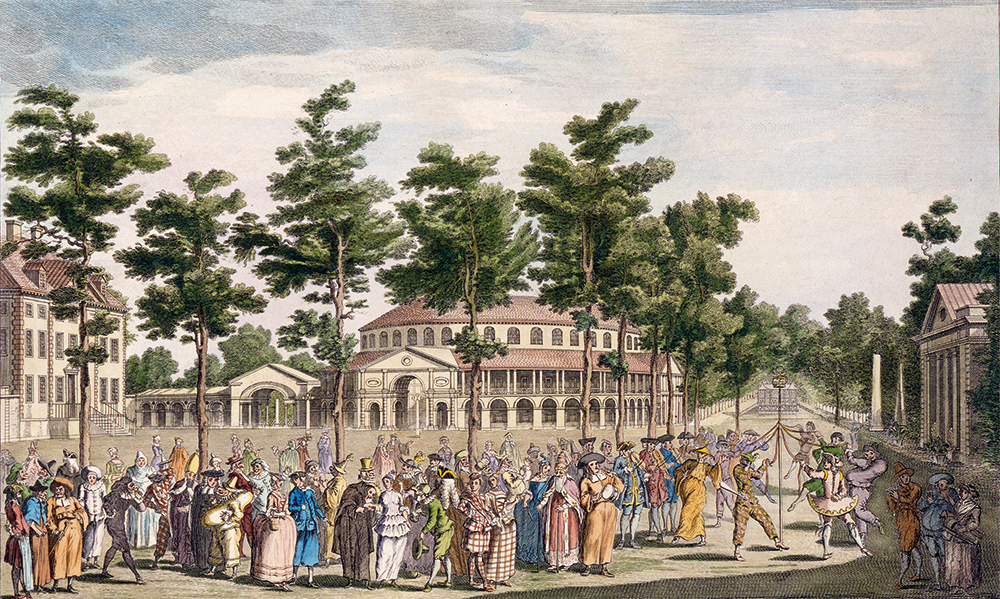
In the satirical print ‘Remarkable Characters at Mrs Cornely’s Masquerade’ from February 1771, the Georgian craze for dressing up as fantastical characters is shown in all its theatricality and wild invention. The harlequin was always popular, as was the domino, but here we also have a ‘Savoyard’ (supposedly from Savoy) playing a hurdy-gurdy with his dancing bear in tow, a nun in full habit, ‘Mad Tom’ with wild hair and ragged clothes, and, perhaps weirdest of all, a coffin, decorated with a skull and crossbones. Peeping out from beneath its sombre frame are the two ridiculously dainty feet of the masquerader.
At that time, masquerades (or ‘a diversion in which the company is masked’, to give Dr Johnson’s definition in his 1755 Dictionary) were regular events in London at Ranelagh Gardens, Vauxhall, the King’s Theatre and, most extravagant of all, Carlisle House in Soho Square, presided over by the ebullient Teresa Cornelys. A Venetian opera singer and former lover of Casanova (by whom she had a child), Cornelys had imagination and daring but not much financial acumen. A year after that print was circulated, she found herself in the King’s Bench prison after being declared bankrupt. Not that this quenched her spirit, or the enthusiasm for the masquerade that she had in large part engendered. As Meghan Kobza’s colourful new study describes, the masquerade survived into the 19th century, after which it fell victim to a different sensibility.

Kobza deploys a multitude of sources to draw out the gossip and scandal that fed off these spectacular parties, which could attract up to 2,000 guests and cost 1,500 guineas to stage (or about £500,000 in today’s money). We meet characters such as Johann Jakob Heidegger, the son of a Zurich theologian, who, desperate for money in 1713, transformed the King’s Theatre on the Hay-market into an elaborate party venue. Heidegger (who is mentioned by Alexander Pope in ‘The Dunciad’) was satirised in one of Hogarth’s earliest engravings from 1723, leaning out of a window of the King’s Theatre in a fearsome two-pronged wig. He is encouraging a motley crowd of costumed masqueraders to enter, led by the devil and a fool. The caption reads that Shakespeare and Ben Jonson would ‘blush for shame to see the English stage/ Debauch’d by fool’ries at so great a cost’. Heidegger’s tickets sold at one and a half guineas (about £350 in today’s money), which meant they were only available to the indolent rich.
How much intrigue and skulduggery actually went on at these evening affairs is debatable. Kobza argues that the masks, which were the tokens of admission, were perfunctory and often taken off almost at once, too sweaty and uncomfortable to be worn for long. In any case, the concealment and duplicity for which these events became notorious were perhaps less than the newspapers – which soon ran competing columns entitled ‘Masquerade Intelligence’ – tried to make out.
Elizabeth Chudleigh certainly left nothing to the imagination when she turned up at Ranelagh Gardens in 1749 dressed as Iphigenia, the Greek heroine sacrificed by her father Agamemnon at the outset of the Trojan wars. Or perhaps one should say undressed, given that by all accounts her robe, of flesh-coloured gauzy muslin, was virtually transparent. The society hostess and noted bluestocking, Elizabeth Montagu, who was there attired as the queen mother, was appalled at such lack of decorum, remarking that Chudleigh’s outfit left her ‘so naked, the High Priest might easily inspect the entrails of the victim’. A few years later, Chudleigh was tried for bigamy at Westminster Hall.
Kobza’s study abounds with such catchy stories, if at the cost of thematic interpretation. It is suggested that the masquerade was ‘a liminal space that both reinforced and challenged the strict hierarchies of Georgian London’, but we learn little about those hierarchies or the numerous businesses that fed into the spectacles – the florists, caterers, dressmakers, milliners, musicians, confectioners and hairdressers. Nor are we taken beyond the confines of London or to the kind of masquerade frequented by Frances Burney, who attended her first masked ball with her elder sister Hetty in 1770, aged 17, held at a dancing academy in Leicester Fields. Masking and unmasking were key elements of the evening’s enjoyment. Burney writes of the reveal after supper:
Elizabeth Chudleigh appeared as Iphigenia in flesh-coloured muslin which was virtually transparent
Nothing could be more droll than to see the pleasure which appeared in some countenances, & the disappointment pictured in others… The old witch we found was a young officer… but what surprised me was the shepherd, whose own face was so stupid that we could scarcely tell whether he had taken off his mask or not.
At its best the masquerade must have been an extraordinary experience, especially those held at Carlisle House in the 1770s, when vast forests were imported into the ballroom along with ponds, fountains and gothic arches festooned with flowers. This was Bridgerton for real, but with all that means: rooms filled with the fragrance of hot, unwashed bodies and the frisson not of dangerous liaisons but the very real threat of flimsy costumes bursting into flames when caught by the draught and blown into the path of a flickering candle.





Comments