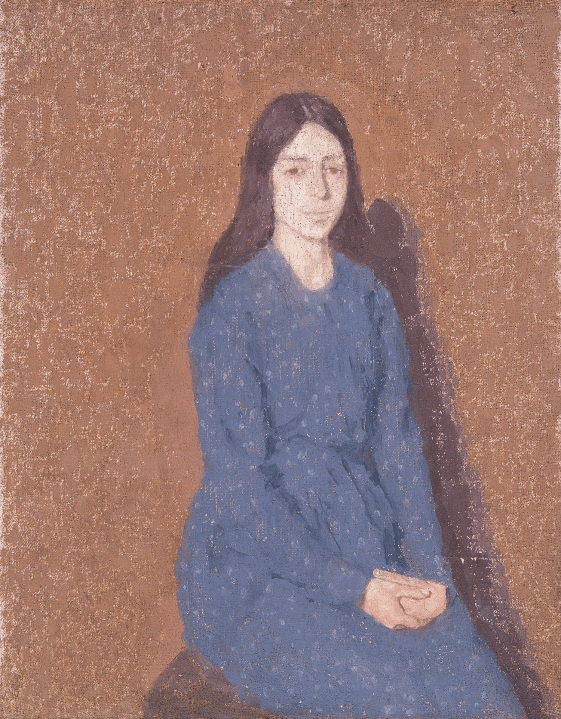
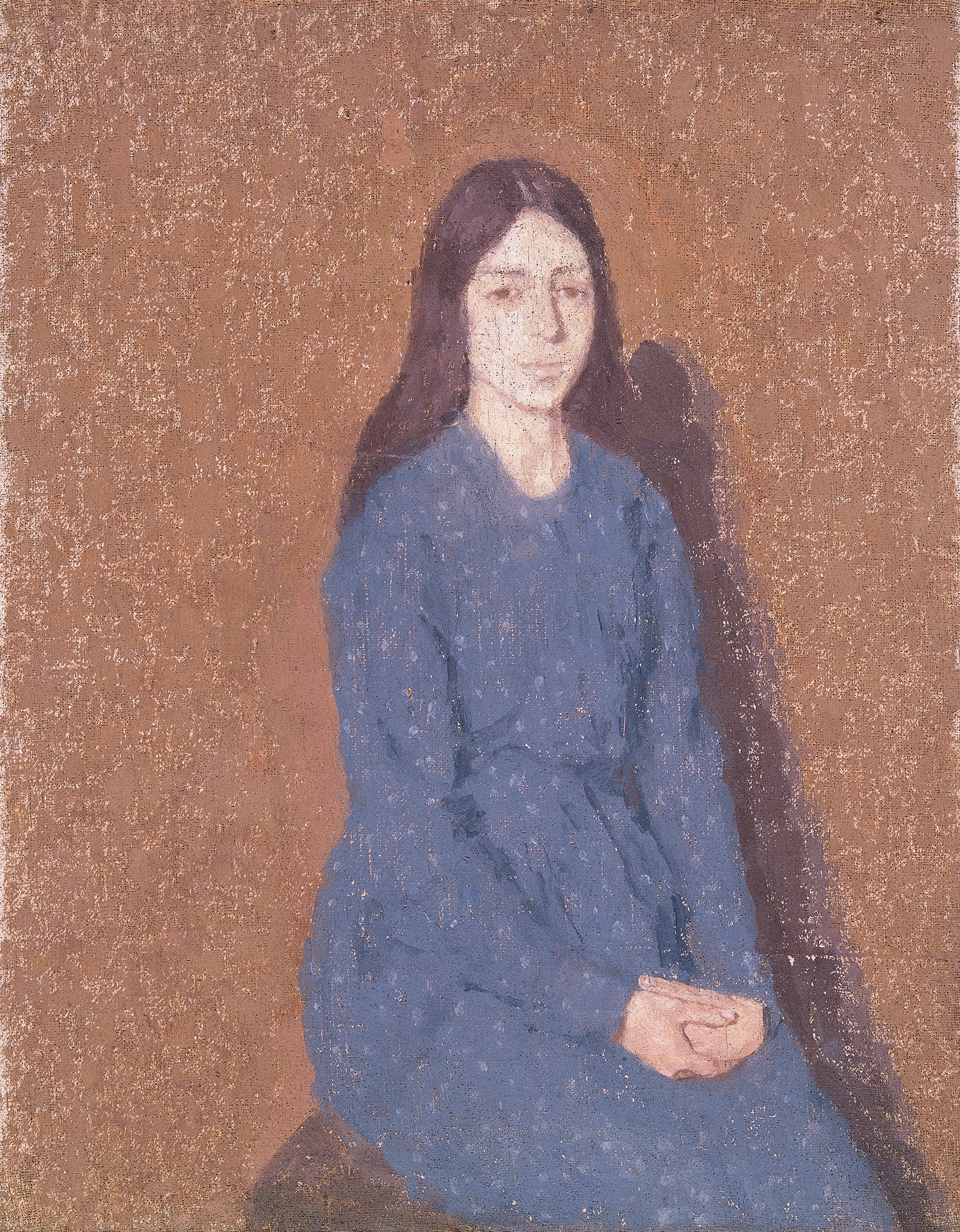
A pilgrimage to Cardiff Central, sorry, Caerdydd Canolog (according to the signage in the station, which also had my return train’s destination ‘Lundain Padd’ton’) to see the new Gwen John show. She is being lauded as Wales’s greatest artist, but she left Tenby at 18 in 1895, and never went back. After studying at the Slade she moved to Paris, fell in love with Rodin, and adopted the Catholic faith. She ended her days in Meudon in 1939, leaving a cache of work that her nephew Edwin John thankfully rescued before the Nazi invasion, and that the National Museum of Wales (now National Museum Cardiff) had the foresight to acquire in 1976 – 900 drawings, notebooks and paintings that form the backbone of this marvelous show, so big you start to see the world with her discriminating delicacy.
She tempered her paints with gasoline, which evaporated, leaving ground showing through
The Museum also acquired her work during her lifetime, and the first thing that greets the visitor to the exhibition is a note written by the artist thanking it for purchasing ‘one of my little paintings’. It’s lovely to see her handwriting (and errant spelling – ‘critisism’, ‘devellopment’) across the show, in notebooks and letters, including a draft to her friend Rilke. The self-diminution of ‘little’ recurs. In the early 1920s, she calls herself ‘God’s little artist, a seer of strange beauties, a teller of harmonies, a diligent worker.’

The humility is disconcerting – a traditionally feminine virtue, now considered a shackle to be thrown off. But even in her lifetime, the humility didn’t seem to match her single-mindedness as a painter. Augustus John – now known as the brother of the more famous Gwen – described her as ‘proud’ with ‘a haughty independence which people mistook for humility’. The paradox rings true. We all know those people. She held herself to the highest standards. She wasn’t careerist, often failing to enter work for high-profile shows that wanted her, or to deliver paintings to her patron John Quinn – because she was working towards a higher goal than worldly ambition: artistic success according to her own lights.
Whatever perfect pitch is for color, she had it. Whistler, who got to know her when he taught her in Paris, prized her sense of tone. Such harmonies she tells! Her colors are always subtle, natural and eloquent. ‘I must enter a world of form and color,’ she wrote in a notebook. She tempered her paints with chalk and even, according to her great-niece, with gasoline, so that they would evaporate faster and she could use the brush lightly (‘blobbing’, as she called it) leaving some ground showing through, as if the canvas is breathing. She rejected the varnishing and layering of paint taught at the Slade and perfected her own techniques.
But she painted the same painting again and again. Artists do; seriality was à la mode – think of Monet and Cézanne, where repetition was evolution. I love the way she returned to repaint the same view of her attic rooms, capturing changes of light and subtly different arrangements of curtain, flowers etc. But there is something about John’s later iterations that is, to me, stifling. The show has gathered here six examples out of the 11 she painted of ‘The Convalescent’ (a woman in blue, reading), four out of her six portraits of Mère Poussepin (who was long-deceased, but whom she painted from a likeness on a prayer card) and two Pilgrims – a caped girl in grey with a rosary. It should be fascinating to compare them. Each individual canvas is so serene, so assured. But the repetition does not feel creative, so much as striving, perfectionist, neurotic, compulsive – insisting and rigid. Small details change between the canvases, but not in an uplifting way – more like a drab spot the difference. Nothing progresses. Sorry.
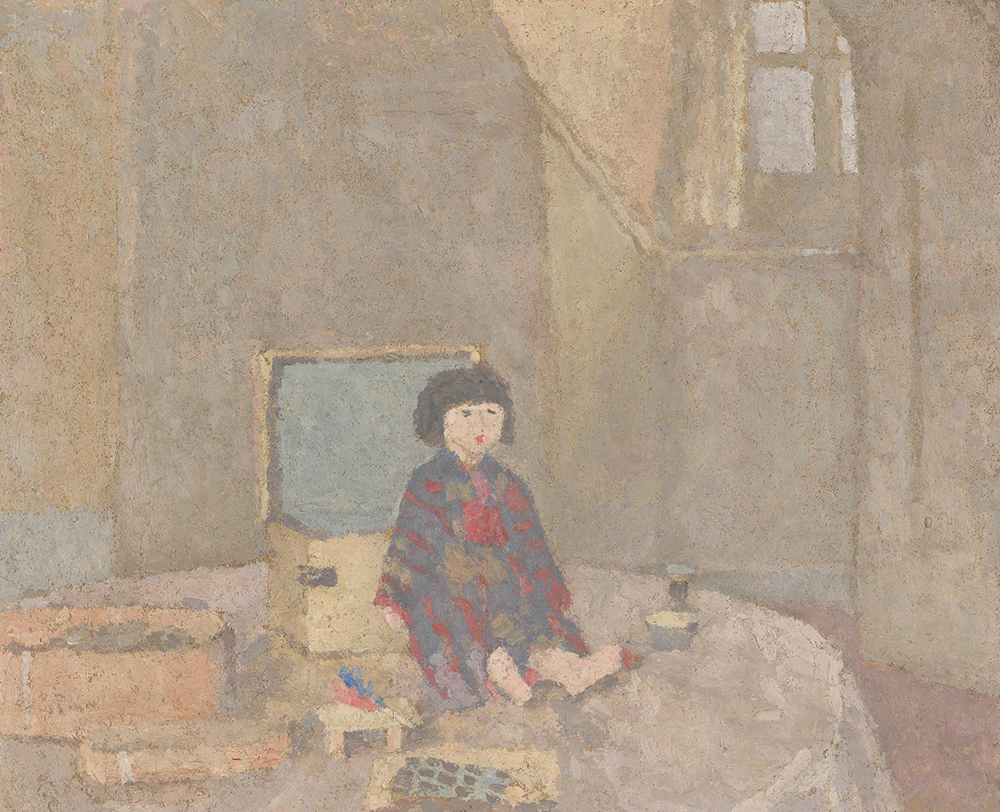
The show dispatches her biography lightly. There’s one sketch of Rodin, which she copied from a photograph, as well as his sculpture of her head in bronze. The focus is always on her work, as it should be. The balance is just right. It’s a privilege to see her rough drafts, her watercolors done surreptitiously in church, where she made her fellow congregants her unwitting life models. The repetitious preparatory studies of her later years, when she drew and redrew ad inifinitum a photograph of St Thérèse of Lisieux, are tucked away, at the end of the show, as if in recognition of her will to keep them private. The spiritual dimension of these exercises – her attempt to follow St Thérèse’s teachings, her ‘Little Way’ – is explained well, too.
When I look at Gwen John’s famous 1902 self-portrait (purchased by her former tutor at the Slade, and on loan here from the Tate), I feel I know her. Her personality vibrates through time. In every one of her works she is present – it all carries her DNA. She is a sensitive person in a world of brutes, but stronger, in the end, than all of them.


Comments