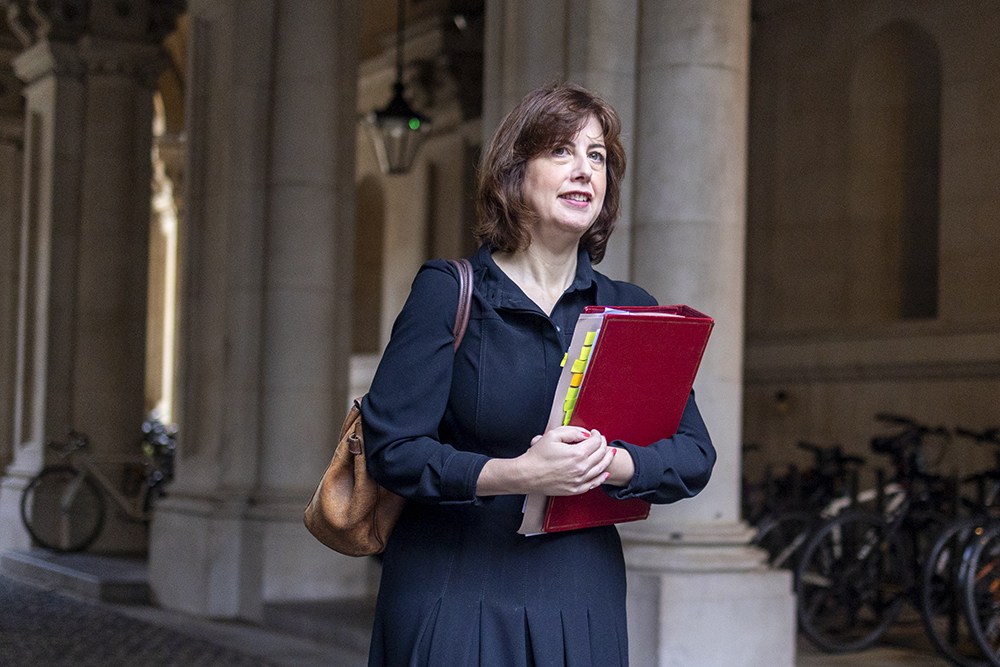


Whenever a government minister cites the advent of artificial intelligence as the justification for a policy, you can be certain that there has been an absence of actual intelligence in the reasoning behind it. Nowhere is that clearer than in the Education Secretary’s embrace of ‘oracy’ as the new priority for our schools. ‘With AI on the rise,’ Lucy Powell asserted, ‘we need to go harder on the skills that make us human, like oracy.’
Ms Powell refrained from explaining what it is about large language models that requires a different approach to language teaching in our schools. But that is because the vaunting of oracy is neither a carefully thought-through response to the rise of computer power in the hands of the Altmans or Amodeis, nor is it yet a quest to rediscover the art of oratory as practised by Cicero or Demosthenes. Would that it were so. It is yet another modish 1960s concept beloved of educational progressives who oppose rigour in the classroom – and which, like all such approaches, has already been tried and found wanting.
Sitting at the back and chatting to your friends was no longer a diversion; it was educational practice
Oracy has nothing to do with oratory, per se. In truth, the neologism was dreamed up by an educationist in Birmingham in 1965. Andrew Wilkinson was a guru of the progressive education movement. He believed that traditional English teaching placed too much emphasis on literature and grammar. A great critic of direct instruction (or teaching as it used to be known), Wilkinson invented the word ‘oracy’. In his book Spoken English he argued that oracy would be to speaking and listening as numeracy is to mathematics.
Influenced by sociologist Basil Bernstein, Wilkinson thought working-class children suffered from inadequate linguistic environments. He shared Bernstein’s belief that poorer households ‘may be authoritarian because the parents have not the words in which to explain or persuade’. He claimed that these children then go on to develop a ‘culturally induced backwardness’ which must be addressed in the classroom via liberal education practices like ‘discussion, experiment and discovery, group, team and project work’.
Team and project work have always been the preferred approach of progressives. It set back English education for decades before reforms introduced by the last government brought back rigour. Wilkinson believed the quiet classroom, with a teacher at the front, was authoritarian. ‘Had [children] been encouraged to speak’ in school, he claimed, the elite feared ‘they might have answered back’. He disliked teachers’ reliance on the ‘safe classics’ and far from embracing the idea of oratory, he thought that public speaking was ‘old-fashioned’ and less useful than teaching children to talk to each other.
He, of course, opposed the practice of learning poetry by heart. Banter, not Byron, was the route to enlightenment.
Oracy has always been at odds with two fundamental teaching traditions: teacher instruction and a focus on propositional facts. But it became fashionable in the 1970s and 1980s and drove the teaching of proper communication to the margins. ‘The teaching of traditional analytic grammar’ was deemed not to ‘improve performance in writing’, while learning via ‘discovery’ was ushered in over instruction.
Once the National Curriculum was introduced in 1987, speaking and listening had secured equal status with reading and writing. Between 1987 and 1993, the government-funded National Oracy Project encouraged thousands of teachers to experiment with group work, storytelling, classroom discussion and other forms of spoken communication. Sitting at the back and chatting to your friends was no longer a diversion for learning; it was advanced educational practice.
The only problem was that none of these reforms seemed to work. In 1991 the National Foundation for Educational Research found that reading standards among seven-year-olds had fallen sharply in the latter half of the 1980s. That year, eight-year-olds were six months behind their 1987 peers.
A report commissioned by Kenneth Clarke in 1992 finally proved that the ‘highly questionable dogmas’ ushered in by the educational progressives of the 1960s had ‘hampered’ the progress of primary pupils. Learning was now ‘fragmentary and superficial’.
What followed was a two-decade-long debate between the ‘questionable dogmas’ and a focus on academic content, grammar and vocabulary. No one was objecting to the principle that speaking and listening were valuable skills. But Wilkinson’s proposition that teacher instruction hampered a child’s communication skills, which could only be developed through relentless group work, seemed finally to have been disproven.
Speaking and listening was removed from English GCSE in 2014. The irony was that this once left-wing idea had quickly become a way for private schools to bank 20 per cent of their students’ grades. A child’s ability to deliver a presentation and participate in a group discussion was now teacher-assessed. Moderators observed a handful of candidates in around a third of schools and the grades awarded were so subjective as to be meaningless. Independent schools, with league tables to consider, were unsurprisingly awarding their own students the highest grades.
Since then, speaking and listening has existed as a stand-alone qualification, with universities and employers paying little attention to the grade awarded. The great oracy debate seemed to be over. Children would be given the knowledge to formulate an argument. They would read the classics in the hopes of emulating them. But the art of conversation would not dominate teaching time as though it were a stand-alone skill.
Now, under Lucy Powell’s stewardship, we have forgotten six decades of history. The modern oracy lobby is embedded deep in the Labour party. Voice 21, the UK’s oracy education charity, was founded by Peter Hyman, one of Keir Starmer’s closest advisers. So without ever really defining what oracy is, the government wants to bring it back. As Kipling once wrote, ‘the burnt fool’s bandaged finger goes wobbling back to the fire…’ But then in the classrooms, Powell wants there to be no place for memorising any poetry, let alone Kipling. Instead it will be, like her speeches, just a meaningless cacophony.




Comments