Before the cocoon I had never met a hotel I didn’t like. I thought all hotels were interesting. There was the hostel in the walls of old Jerusalem, so dirty I had to sleep in my clothes but riveting; the pale box in Oświęcim, Poland (Auschwitz in German) by the haunted square; the best hotel in Batumi, Georgia, pleased with itself because it was nearly an Ibis; the vampire-themed hotel which felt weirdly normal in the Carpathians; the lovely Narnian winter of Claridge’s. Then I stayed at the Zedwell Hotel near Piccadilly and I didn’t like it because there is nothing to like. It’s inside the Trocadero, the old Victorian pleasure palace, so it will have known a world of pain. This is a ‘cocoon’ hotel, and it has nothing so interesting.

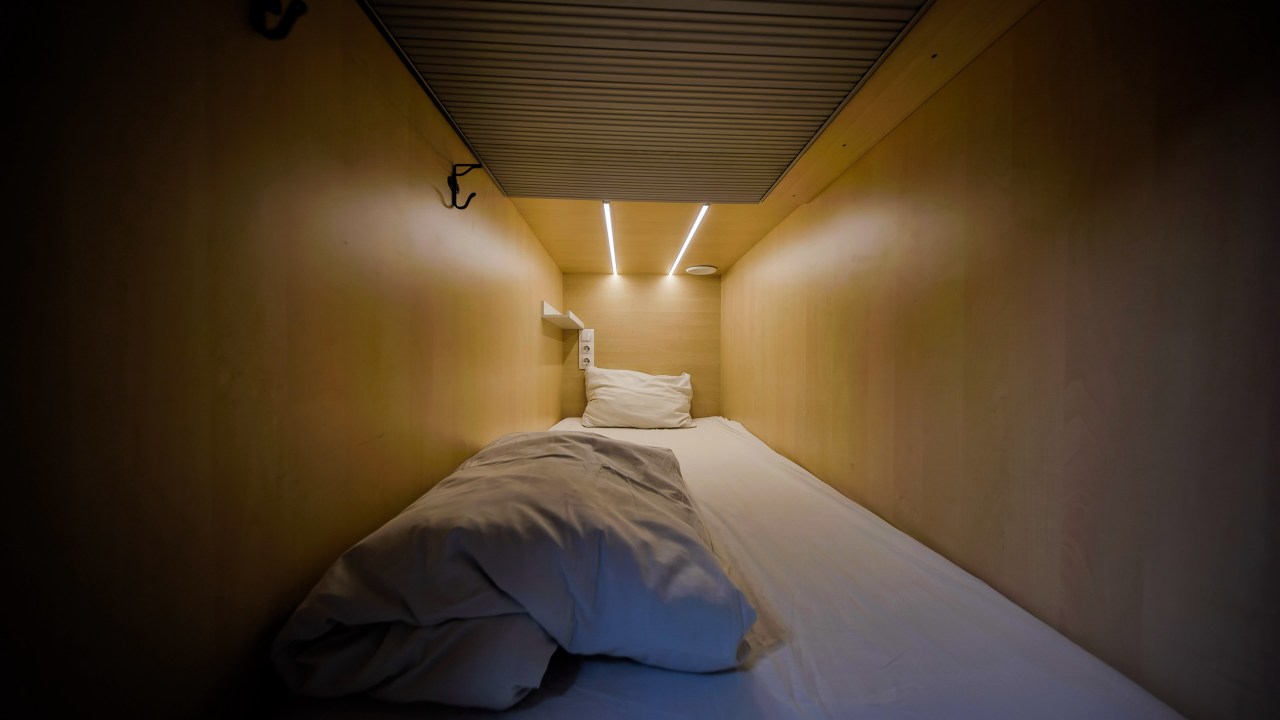
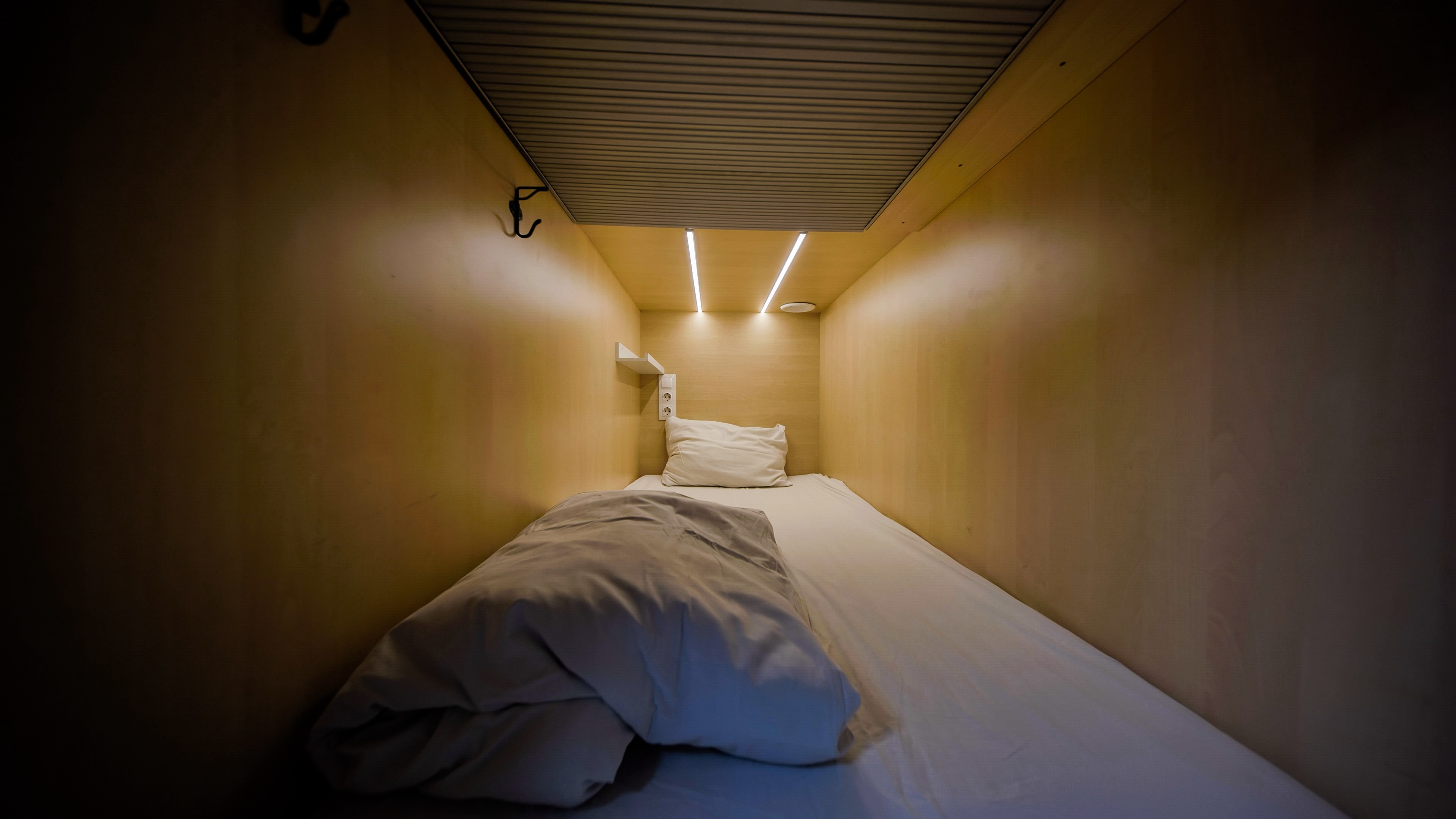
Zedwell also operates a ‘capsule’ hotel nearby: the capsule is the size of a single bed. This is interesting because it allows you to imagine your own death: not the journey, but the destination itself. In a capsule hotel you are stacked like a corpse in a drawer. That’s what the Polish capsule hotel I examined online looked like: but then I saw one in Tokyo that looked like more like an oven.
I wouldn’t stay in a capsule myself: my days of trying to make myself as small as possible are gone. Still, is it cheaper than my cocoon, which could sleep two: the capsule is £49 on a spring Friday (if booked that day) or, for the female version on the female floor, £59. (Apparently not getting raped is a tenner). The two-person cocoon is £187, rising to £1,150 for a party cocoon for 12, though the party cocoon seems to have a drawing room.
The lobby is expansive and glossy: it must be, considering what lies ahead. You check in on a screen, which greets you and prints your key card. Only if the ‘Clanker’ – the Generation Alpha slur for robot or algorithm – fails you, do you get a human. I need one, and he looks like the manager of a respectable nightclub, which is probably what he wants to be. The corridors are predictably terrifying, but hotel corridors have never recovered from The Shining. I know the Zedwell isn’t a fire hazard. They will have spent millions on compliance, and they must, because it feels so much like a fire hazard.
The room is designed to be hosed down in haste. Please forgive the constant death metaphors, but if I had more I’d give it to you. It is pale oak and dark tile. There is a low bed in a box, and a shower room. The lighting is better than most British people have in their homes. There is nothing else: no chair; no television; no window because ‘sunrise is when you decide’ apparently. Why no television? No one comes to central London to be alone with their thoughts. And it’s too big: the floor space – at least as large as the bed – yawns horribly. As a cocoon, which is something that envelopes you, it fails: patrons with Oedipus complexes will be disappointed. Nor did I metamorphose. I woke up angry, but I always do.
The corridors are predictably terrifying but hotel corridors have never recovered from The Shining
Never have I wanted ornamentation more: a John Constable print perhaps, or a ceramic owl that promises to change colour with the weather but never does. (When thinking of what cocoons lack, it seems I think of my grandmother). For some reason I also think of Jonathan Littell’s repulsive but riveting 2006 novel The Kindly Ones, the secret diary of an SS officer who sounds weirdly like Jonathan Littell. I’m not suggesting you read it, but one of his fever dreams conceives the whole world as a concentration camp, and this would be its hotel. To be boring in central London is unforgivable, but this is. Hotels offer shelter and warmth. I’d love to see their version of the stable of Bethlehem.
And so here it is, a hotel to mirror what London is fast becoming: an entirely generic city. I only thought of death at the Zedwell, but I always thought Heartbreak Hotel was a morgue.





Comments