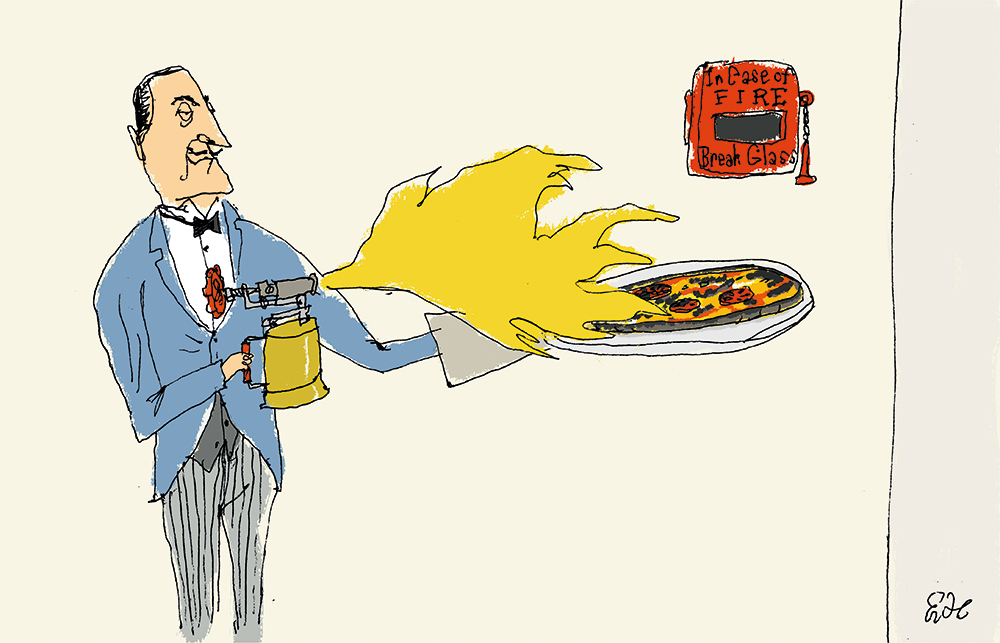


“London-style pizza.” People think there is such a thing. Somewhere over the past three years, the pizza hype in Britain’s capital city has gotten out of control. Our economy is struggling and chefs have turned to the food that literally nobody dislikes. Loads of new places have opened: we’ve had Vincenzo’s, Carmy’s, Breadstall, Gracy’s, Lenny’s, Dough Hands, etc. Can’t you tell they’re all incredibly different? All of them really (although they would quibble) have been putting out the exact same style of pizza. The problem is: what do you call it?
It’s hard to describe. Critics say it’s “burnt.” There’s some truth to that. The base will be pretty thin and usually positively crunchy (I’ve been reminded of burnt toast – no bad thing – on occasion, but chefs prefer to call it “charred”). Apparently this is due to a combination of a relatively high-hydration dough, as well as the use of strong flours and also olive oil being put in the dough itself. The second element is an electric oven, as opposed to a wood-fired one, which results in a slower but crispier bake. This style of pizza was first unveiled by Crisp Pizza, run by Carl McCluskey at the Chancellors pub in Hammersmith, west London.
I’ve been reminded of burnt toast on occasion – no bad thing – but chefs prefer to call it ‘charred’
Funnily enough, it took an American to alert London to how good McCluskey’s pizza was. Dave Portnoy, the sports presenter and insanely influential pizza reviewer, went to the Chancellors in early 2023 and gave it an 8.1 out of ten: a rare, very high score for him. After that, you had England soccer captain Harry Kane swinging by for a takeaway. Eventually, Crisp moved into an enormous site just off Oxford Street. It is thanks to Crisp that London’s pizza chefs now all seem to agree that the worst thing a slice of pizza can possibly do is flop.
Unsurprisingly, a backlash has begun. There’s a sense that “London pizza” is a bit fake, curated, planted. Chefs privately moan about the term, probably because they don’t want to be accused of riding the hype (“Mine’s actually a different style of pizza, because…”).

So there’s something refreshing about a restaurateur importing a self-described American style of pizza, which is what’s going on at Bar Etna in northeast London. I met up with Ed McIlroy, a kind of capo for northeast London restaurants. He’s the man behind Etna and runs two other impossibly scene-y places: a pub called the Plimsoll which is known for its Dexter cheeseburger, and Tollington’s, an old fish and chip shop converted into a pintxos bar.
That is: it’s good, still quite crispy, but doesn’t worry too much about whether it’s “London-style” or not. It’s not worth fretting about what style a pizza is, McIlroy tells me. “What I was bringing to London was Joe and his style of making pizza. It’s not burnt, it’s just what I consider to be a good pizza: a well-cooked, quite solid pizza that stands up against its toppings.” The secret (again, apparently) is all in the dough: you need to get a nice “rise” in the bread.
Bar Etna is a collaboration with Joe Beddia, the Philadelphia chef and restaurateur. His restaurant Pizzeria Beddia was named as having the best pizza in America in 2015 by Bon Appetit, and last year he got a Michelin Bib Gourmand (no pizza place in London has this). The idea for this US/UK collaboration came from Mike Stampler, Bar Etna’s designer (and he’s done a great job, evoking postwar, post-Bauhaus Milan). It’s a proper high-end pizza restaurant, of a type that London doesn’t really have; most artisanal pizzas are sold in pubs these days. McIlroy hadn’t even been to Bar Beddia, but could tell from the photos that it was the type of pizza he liked.
At the moment, the menu at Etna is small: some starters and just four pizzas, all 14-inch. On the night I went, a friend and I shared the “Number One” (a stridently cheesy pizza, featuring mozzarella and the Irish cheese Coolea) and the “Number Three,” a curry pizza that could only really be done, without being cringe, in London. It’s basically a saag paneer minus the paneer – all spices, spinach and mozzarella. They haven’t dialed down the heat: it builds slowly. McIlroy took Beddia to north London’s Taste of Goa when he came over, and he felt inspired. “Every single bite of that pizza,” Ed says, “is like when you have a bit of naan bread and you’re mopping up at the end of the meal.”
The transatlantic synergy works because of a marriage of roots and produce
The transatlantic synergy works because of a marriage of roots and produce: what Beddia brings is unfailingly brilliant dough and a cooking technique of a type the Americans excel in, while Britain, being closer to mainland Europe, offers more vivid produce. McIlroy was most excited about the ready access to Italian tinned tomatoes – in the US, they contain a lot more salt and sugar.
London is trying to assert itself, trying to convince everyone that it’s just as good a pizza-making city as Naples, or Rome, or New York. But in doing so, there have been some oversteps: a bad London pizza I had recently was little more than a burnt cracker with terrible cheese and (the ubiquitous, awful) hot honey. So thank goodness for the concession to America at Bar Etna, which has the humility to know what it doesn’t know.





Comments