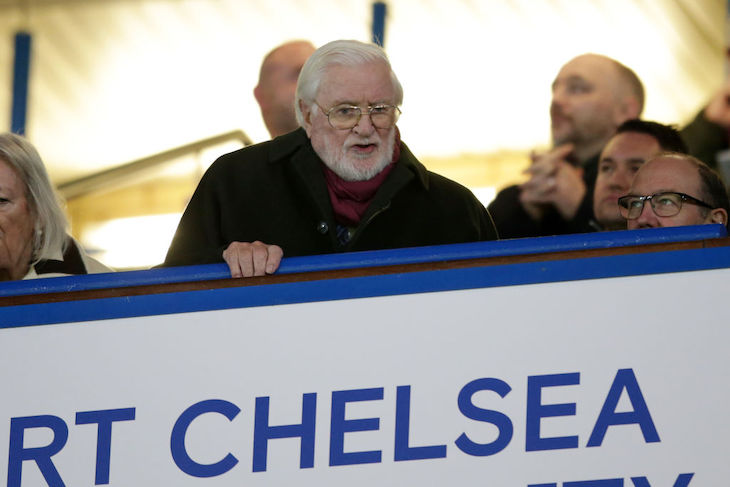
The timing of the death this weekend of Ken Bates, the former owner of Chelsea and Leeds United, will have struck many older football fans as significant, incongruous or – as football commentators are apt to say – ironic.
On the same morning in which millions of Englanders of all backgrounds were preparing to cheer on a conspicuously multi-ethnic England team, the announcement of his passing, aged 94, will have undoubtedly evoked memories of time when the sport in this country was in a very different state, and when some of its fans were of a very different disposition.
Hooliganism was rampant and racism on the terraces endemic. In the eyes of many, the club whose supporters epitomised this malaise was Chelsea
In contrast to the good-natured scenes we’ve witnessed at home and in North America in recent weeks, football in the 1980s was, one is obliged to repeat, ‘a slum sport played in slum stadiums and increasingly watched by slum people’, as a famous Sunday Times 1985 editorial put it.
It was dying: in the 1985-86 season the aggregate attendance at games in the top tier of English football slumped to their lowest ever postwar levels. Hooliganism was rampant and racism on the terraces endemic. And in the eyes of many, the club whose supporters epitomised this malaise was Chelsea.
Chelsea’s dwindling fortunes on the pitch – they were relegated from the original first division in 1979 – was matched by the club’s brush with bankruptcy and the growing racism and violence of its supporters. The clash at White Hart Lane in April 1975, when Tottenham and Chelsea fans fought on the pitch, made the national news and set the tone for a decade to come. Football hooliganism had arrived in earnest, and those who followed the west London side seemed to be its most keen enthusiasts. The hooligan crew, ‘the Chelsea Headhunters’, became the stuff of legend.
Ken Bates bought the troubled club for £1 in 1982, taking on its debts of £1.5m, and turned its fortunes around. The team returned to the top flight three years later, and since 1989 have enjoyed an unbroken spell there, eventually becoming title winners and an outfit of international renown.
Reversing the club’s decline necessitated dealing with the malign elements who came to watch the team every fortnight, and who caused mayhem throughout the land every other. The year Bates took control, at a game at Crystal Palace, Chelsea gave their first ever debut to a black player, Paul Canoville. As the substitute made his way on to the pitch he was booed by a section of his own supporters.
Then there was a home game against Sunderland in March 1985, when, as the next day’s Daily Mirror put it, ‘soccer reached sickening depths of savagery’. Bates, who called the home fans responsible for the riot ‘animals’ and ‘scum’, proceeded that year to erect electrified 12ft high perimeter fences around the stands – because ‘they work with farm animals.’ Only the intervention of the Greater London Council ensured that they were never turned on.
As someone who used to go to Chelsea games, home and away, regularly from 1987 to 1993, I remember well those perimeter fences, that crumbling stadium, the air of decay, that prevalent and vocal nasty element. I remember one fan, a regular at my local pub, who used to boast his part in the trashing of a Leeds ‘football special’ supporters train back in the early 1970s, and then setting it on fire.
Of course, most Chelsea fans weren’t like that. But there was an unquestionable air of menace attached to the club. Indeed, in retrospect, that was the initial allure for this shy and bespectacled teenager, whose real motive for following the team was to impress my peers, to show that I could mix it effortlessly with the ruffians who stood at the notorious Shed end.
One memory which particularly stuck was at a game in 1989 against Bradford City. This was just after the controversy surrounding The Satanic Affairs had erupted, and when Muslims in that place in West Yorkshire had voiced support for the Ayatollah Khomeini’s fatwah. The response by the bad boys at the back of the Shed was to start chanting ‘there’s only one Salman Rushdie’, followed by ‘Bradford’s full of Pakis’.
The explicit racism voiced in concert that day, seemingly challenged by nobody, was indicative of the times. Unsurprisingly, I can’t recall ever seeing a black or Asian face on the stands at Stamford Bridge in the 1980s.
That reality has changed markedly there and at all English football grounds, as the mentality of the game’s supporters has evolved in step with that of the populace in general. In the past forty years, this country has become more tolerant and accepting than some of us could have ever foreseen. Ken Bates sought to address that particular problem at Chelsea, but in truth, things were starting to change for the better everywhere anyway.





Comments