
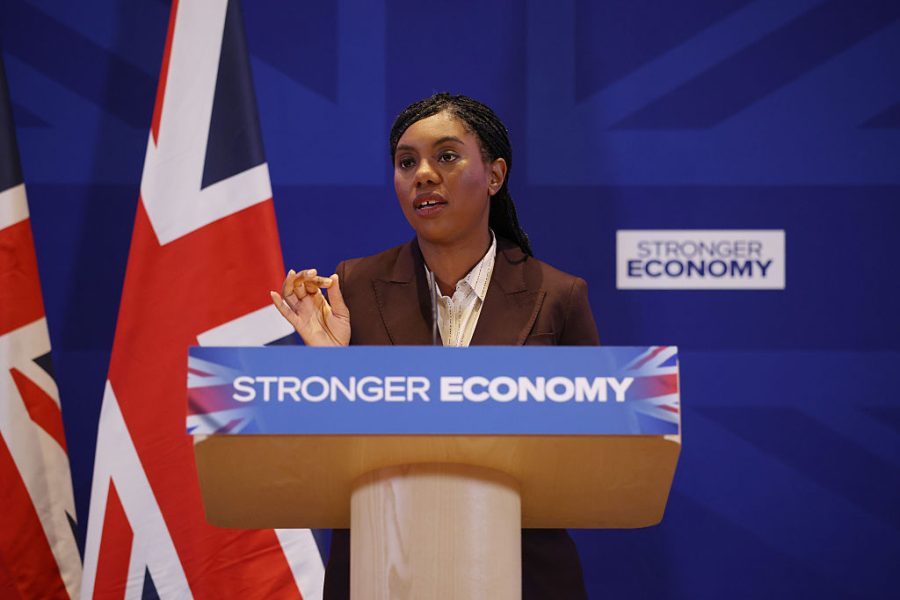
Kemi Badenoch has announced a series of commitments on defence spending that she would implement if she were to become prime minister. This is an important and sensitive issue as the war in Ukraine continues and there are repeated warnings about the heightened threats to the UK. The Conservatives would reallocate £17 billion of public expenditure to the Ministry of Defence (MoD), Badenoch said yesterday, because the ‘defence of the realm must be the first priority of any government’.
The most politically sharp-edged measure the Tories have announced is repurposing the National Wealth Fund (NWF), which Labour established to ‘increase investment… to accelerate delivery of the government’s growth and clean energy missions’. The NWF is not a sovereign wealth fund – despite its name – but a means of catalysing private-sector investment; in March, the Chancellor, Rachel Reeves, widened the NWF’s strategic priorities to include ‘investments in dual-use technologies… which better support the UK’s defence and security’.
The NWF remains predominantly directed towards what the Conservatives call ‘costly eco-projects’. It amounts to £28 billion, of which £7.5 billion has been committed already. Under the Tories, it would become the National Defence and Resilience Bank, with £11 billion of the balance transferred to the MoD and the rest spent on supporting wider national resilience. Cutting unrealistic climate targets in favour of the hard edge of the armed forces is straightforward sensible politics.
Badenoch is saying the right things, and acknowledging the hard choices
A Conservative government would also divert £6 billion to defence from UK Research and Innovation and create a sovereign defence fund. This, combining the extra £17 billion and investment from the private sector, would contribute to a £50 billion ‘war chest’ for new equipment and technology, backing defence-related start-ups and reducing the UK’s reliance on hostile states in supply chains.
These add up to significant numbers, but they need to. The government’s only firm commitment is to raise defence spending to 2.5 per cent of GDP in 2027. It trumpets loudly: ‘With Labour, the UK armed forces will see a record £270 billion investment in this Parliament through our historic defence spending uplift.’ But context matters: we already spend 2.4 per cent on defence, so proportionally the increase is extremely modest, and will hardly address the £17 billion shortfall in the MoD’s equipment plan identified by the National Audit Office.

Much less will it fund the aspirations of the Strategic Defence Review (SDR) – a failure the House of Commons defence committee highlighted last month:
Hard choices were not in the published SDR… [the government] must implement SDR recommendations aimed at ensuring that the UK is a better ally. Witnesses have highlighted a lack of mass, delays in developing promised capabilities… and a failure by the UK to meet its article 3 commitments.
Meanwhile, key documents like the defence investment plan, the home defence programme and the defence readiness bill have still not emerged.
Badenoch is right to urge the government to increase spending more quickly, to 3 per cent of GDP by 2030. She has argued that ‘in the face of growing threats we should be investing more in defence, yet all we see from this Labour government is heel dragging and vague promises.’
It is not a baseless accusation. In the Conservative government’s last financial year, defence received around 2.3 per cent of GDP; Labour increased that to closer to 2.4 per cent and has promised it will reach 2.5 per cent in 2027. The Nato target adopted earlier this year is 3.5 per cent on core defence capabilities with an additional 1.5 per cent on wider security and resilience by 2035. That target feels agonisingly distant.
Are the Conservative plans plausible? The government has dismissed them as ‘fantasy figures’, but the £17 billion mentioned is already there: £11 billion would come from the NWF, while UKRI has just been granted £38.6 billion over the next four years. A new government could reuse £6 billion of that if it wished. These are choices – but they do not come without cost. The posited private sector investment of £33 billion is much more speculative, and the Conservatives must beware of following Labour into the rosy world of ideal scenarios.
Even to have the chance to make these changes, though, the Conservative party needs to be believed by the electorate. When David Cameron took office in 2010, defence spending was 2.6 per cent of GDP, declining to a low of 1.9 per cent in 2018. Tony Blair likewise inherited a level of 2.6 per cent in 1997, and although under Labour it never fell below 2.4 per cent, during those years the UK was overstretched by its operational deployments in Afghanistan and Iraq.
The armed forces have been under-resourced for decades, and we are seeing the results now in the staggering capability gaps and inability to fulfil commitments. Neither party has clean hands, but the Conservatives were at the helm more recently, and that will count with voters.
Kemi Badenoch is right ‘to back our military to accelerate their war readiness’, in her words. She seems to accept that at least some additional spending will have to come from reordering priorities within government, and ‘Ed Miliband’s vanity net zero projects’ are an obvious target. Absolute precision cannot be expected of any opposition, because it lacks access to the details of government income, borrowing and expenditure.
The leader of the opposition is saying the right things and acknowledging the hard choices. Labour’s response will need to be better than ‘fantasy figures’ and ‘look at their record’. The threats are here now, and the expenditure is not currently there to match them: that is down to Sir Keir Starmer’s government, and no one else.




Comments