
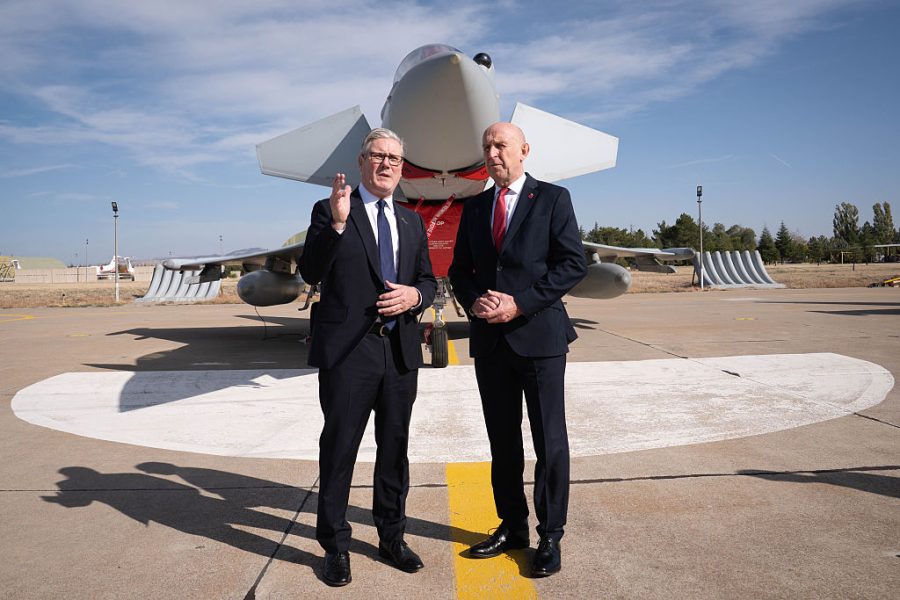
Today marks a year since the government published its Strategic Defence Review (SDR). From the outset, it was clear that the review was hampered by its terms of reference, and the government’s heavy and shameless leaking of its contents to generate positive publicity was disgraceful. But it was a useful statement of intent, a framework on which to build Britain’s future defence capabilities. None of it, however, was going to have much impact without considering expenditure.
The Defence Secretary, John Healey, in his foreword to the review stated that ‘we will develop a new defence investment plan (DIP) to deliver the SDR’s vision’. That was critical: the DIP would contain the facts and figures, the calculations of hard cash, and was to be completed ‘in Autumn 2025’.
A year on from the SDR, the DIP has still not been published. Pat McFadden, the Work and Pensions Secretary, has admitted it will be ‘more like weeks than months’ until the document appears. A hard deadline of 7 July has supposedly been set within Whitehall, the first day of the annual Nato Summit in Ankara, but I cannot count the number of ‘hard deadlines’ set by the Ministry of Defence (MoD) which have rushed past, unmet, over the years. The House of Commons is due to adjourn for the summer on 16 July – I would put the chances of the DIP having appeared by then as no more than 50/50.
Our allies are increasingly unwilling to pretend that the UK is really pulling its weight
This is not a minor bureaucratic niggle or broken promise by ministers. Until the plan is published and the resources available are made known, the armed forces are in stasis: equipment programmes cannot be signed off, orders cannot be placed, and deadlines slip further and further.
The delay means increased chances of critical capability gaps in the armed forces. These are already serious enough: the Royal Air Force has no medium helicopters, its Puma fleet having been retired before the contract for its successor was even awarded to Leonardo UK (the only bidder). The Royal Artillery, meanwhile, has a total of 14 self-propelled howitzers until the recently ordered RCH-155 begins to arrive. There are no amphibious landing ships from which the Royal Marines can operate since HMS Albion and HMS Bulwark were retired in March last yaer, and the first of their replacements, the Multi-Role Strike Ship, will not be delivered until at least 2033.
These delays are potentially hugely damaging for the armed forces, threatening severe limitations on what they will be able to do and perhaps the loss of some capabilities altogether. The DIP is reported to contain between £15 and £18 billion of expenditure – in itself woefully short of the £28 billion the MoD needs to fund the armed forces fully. Despite the woeful inadequacy of the Royal Navy’s surface fleet – brutally exposed in March when there was a desperate scramble to find a single Type 45 air defence destroyer to deploy to Cyprus – the current government has yet to place a single order for a new vessel, and rumour suggests shipbuilding programmes may be pushed back by several years to save money.
This is not simply a domestic problem. Our allies have been aware for years that we are making promises of commitments and capabilities which we simply cannot fulfil. Last year, Luke Pollard, then armed forces minister, was forced to admit to the House of Commons defence committee that the UK was not meeting its Nati commitments: ‘Article 3 has not been upheld in the way that we would like it to be.’ Article 3 of the North Atlantic Treaty requires all Nato members to ‘maintain and develop their individual and collective capacity to resist armed attack’.
Our allies are no longer staying silent on this issue. Recently a Nato planning official told The i Paper that:
Britain is now seen as suffering from its ‘say-do’ gap. It says a lot about supporting, and even leading, Nato and allied peace missions. And does very little.
This should be humiliating to any British government, and it rests on ministers’ fundamental dishonesty. It sometimes feels as if the Prime Minister in particular genuinely does not understand the difference between announcing an intention and taking an action. Sir Keir Starmer is overflowing with bravado about defence being the government’s first priority, and he and John Healey repeat ad nauseam the irrelevant metric that the government is making ‘the biggest sustained increase in defence spending since the Cold War’.
Our allies are increasingly unwilling to pretend that the UK is really pulling its weight, as opposed to saying that it will do so. The government boasts that it will spend 2.5 per cent of GDP on defence by next year: this will still leave us behind the United States, Poland, Latvia, Lithuania, Norway, Denmark, Greece and Finland. And still we have the senior officials in the MoD poring over equipment programmes to see what can least damagingly be cut.
A year since the SDR and soon two years in office: if we judge Starmer’s government by its deeds rather than its windy, highfalutin rhetoric, the conclusion is that it is just not serious about defence. Our allies can see it, voters will see it, and there is no question that our enemies already see it.






Comments