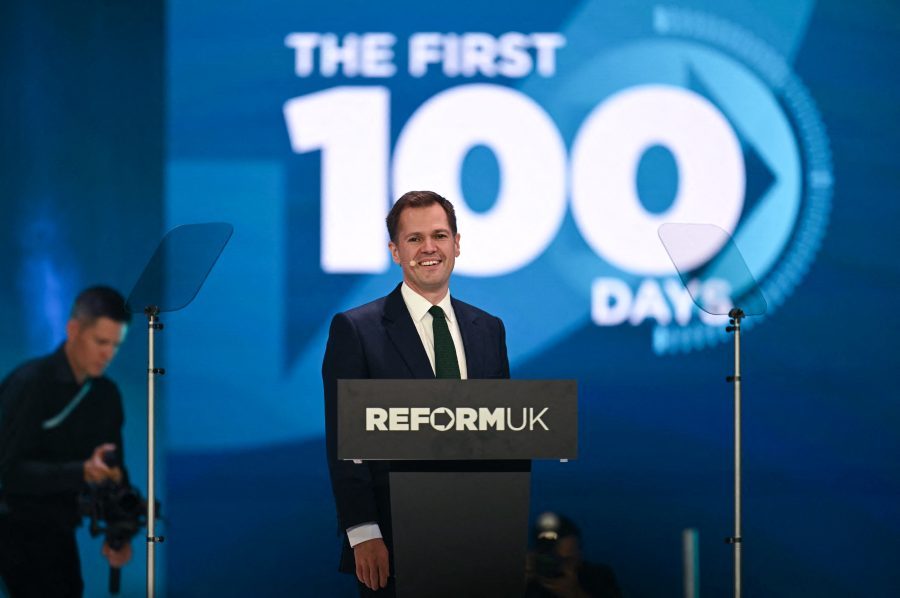
Reform has said at its conference that it will increase the tax-free personal allowance to £15,000 in its first budget. This would amount to a £500 tax cut for the average worker, or £1,000 for a working couple. ‘The biggest rise in the personal allowance in its history,’ as Jenrick put it.
But average workers are already paying the lowest proportion of their earnings in tax for almost 50 years. The figure is also low by international standards: it is 2.7 percentage points below the OECD average, putting the UK in the bottom third. The average UK single worker pays less tax than their American and Canadian counterparts and, as research by the Tax Policy Foundation shows, ‘the average UK worker paid less wage tax than at any time since the 1940s’.
On the other hand, the OBR forecasts that the total tax burden, as a share of GDP, will reach 38.3 per cent by 2030-31: the highest since records began in 1948. There is a clear gap here: the country’s tax bill is going to reach a post-war high at the end of this parliament, but the tax paid by the average worker is at its lowest level for half a century. Who is paying the bill? The middle class and the rich.
The folly at the heart of Reform’s thinking is a class struggle
Former White House chief economist Tyler Goodspeed showed that a worker in the United States must earn 8.5 times the average wage before triggering the highest marginal income tax rate, which sits at 37 per cent federally. In stark contrast, a worker in the United Kingdom hits the top marginal tax rate when earning just 3.5 times the average wage. And this isn’t only income tax. On dividends, the UK’s top combined rate is about 39.35 per cent, well above the OECD average of roughly 24.7 per cent, while our top capital gains rate of 24 per cent is also above the OECD average of about 20 per cent. No surprise, then, that the top 10 per cent are paying 60 per cent of the tax bill.
Isn’t our ultra-progressive tax system something to be proud of? Not exactly. It creates a political economy problem: average workers do not pay the tax bill directly, which makes them more likely to vote for policies promising higher public spending, creating a vicious cycle. Those who earn the average wage or below rationally vote for policies that expand public spending because they aren’t paying the tax increase directly themselves. The spending balloons, but top earners are rational as well. They leave the country in record numbers or, like Henrys (high earners who are not yet rich) sacrifice income to avoid falling into the top rate and losing their benefits. If anyone needs to pay more tax for a fairer tax system, it’s the working class, not the rich.
Reform’s policy is what I call a populist Keynesian policy. It is populist because it seeks to win the votes of those in that income bracket; it is Keynesian because it rests on the idea that putting more money into the hands of people with a higher propensity to consume will, magically and by itself, generate more growth. If that were true, we would have the highest growth with our current tax and benefit system. But the folly at the heart of Reform’s thinking is a class struggle.
In his conference speech, Jenrick said: ‘You have had 40 years of politicians promising everything and delivering nothing.’ It’s surprising that the party which wanted to portray itself as the true heir to Thatcher now uses the term ‘40 years of decline’. Was reducing the top marginal income tax rate from 83 per cent to 60 per cent and then 40 per cent a decline? Was Thatcher’s increasing GDP by 29.4 per cent during her premiership a decline? Reform wants economic policy to serve British workers. But the way it wants to pursue that goal is the same failed uniparty consensus it says it is against: take money from one group and give it to another, rather than cut the spending bill.
Reform’s pledge to cut welfare spending is courageous, but if the spending cuts it promises are spent on increasing the personal allowance, that money will be wasted. When we face low defence spending, millionaires leaving the country in numbers never seen before, and stamp duty stopping the country from moving, the priority for tax cuts should be the worst taxes. Taxes that are broad-based and create the least amount of distortion shouldn’t be the priority. The UK’s tax competitiveness is 32nd out of 38 OECD countries, and corporation tax is above the OECD average. Start cutting the taxes that are shrinking the middle class, stopping foreign investors from moving their capital to Britain and punishing wealth creators again and again.
Raising the personal allowance is helpful for small businesses, but let’s be honest: it’s big business that creates life-changing innovations. Large businesses (those with more than 250 employees) make up 0.15 per cent of firms in this country but employ 40 per cent of the workforce. If any group needs to pay less tax, it’s the rich and the top one per cent, who pay close to 30 per cent of all tax.






Comments