
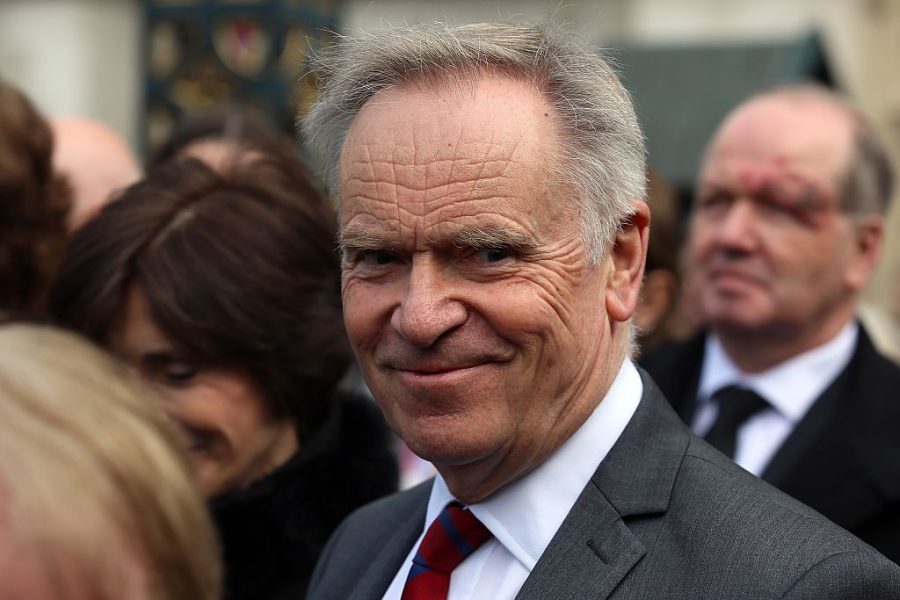
Michael Gove interviewed Jeffrey Archer in late September, several weeks before the novelist and politician died at the age of 86. This is the transcript from their interview.
Michael Gove: Jeffrey, this is your last novel. You say it will be a disappointment to many people across the globe that this is your final exercise of your authorial voice. Can you tell us what was it that inspired Adam and Eve?
Jeffrey Archer: Yes. And one of the things I would say immediately, Michael, is that when I finished it, I didn’t think I could do that again. I think it is the best thing I’ve ever done. And I thought, you’re 86 years old. Don’t knock out another novel. This is it. The inspiration was strange. Six years ago, I was reading a book by Leo McKinstry about Operation Sea Lough. And Hitler’s preparing very, very professionally to invade Britain. And on September the 15th, 1940, he changed his mind three times.
And that was six years ago. And I went home and thought, what if he changed his mind twice and invaded Britain? Would the war have been over in a few days? Would we have been defeated? Would he have still gone on to Russia? How would the world have changed? And don’t let’s kid ourselves. He had the boats lined up. He had the planes lined up. He had 120,000 troops lined up. This wasn’t casual.
So there I am, stuck with this: what would he have done? What would have happened to the world if he changed his mind twice and not three times? Then six months later, I got the idea of an earl desperate to have a son in order that he could inherit the title and the estate. A shepherd on the estate, desperate to have a daughter so she never goes to war. Adam and Eve. Because he gets a daughter. And the shepherd gets a son. Now they’re born on the same estate. But they could not be further apart. How do I bring them together? One. Two. How do I make them change Hitler’s mind without you saying or the reader saying, ‘Plonk Jeffrey. Too obvious. Boring. Didn’t enjoy that’? You had to make it seamless so that at the end of the book you say it’s just possible and that’s enough.
Michael Gove: And it’s an historical novel. It’s also a spy thriller, but it’s a meditation on class, as you point out, The heroine is the daughter of an earl, the hero the son of a shepherd. And in it you look at the question of succession to titles and also social mobility through the lens of grammar schools and the type of education that we had during the 20th century which facilitated social mobility. How much has class been a preoccupation in your writing?
Jeffrey Archer: Well, I was born in 1940, so I’m about 25, 30 years older than you. So I actually remember men on crutches with one leg, with one arm blind because they’d been to war. And the first five years of my life, Britain was still at war with Germany. So that is in the mind, also very conscious. I mean, you may not be able to believe it, youngster. You may not be able to take this, but we actually talked about upper class, upper middle class, middle class, lower middle class, lower class, working class. And it drove me mad because I’ve always been a believer in achievement being more important than class. And so that was consciously in the mind.
So when I’m writing the book, I thought there must have been people who were way ahead thinking about this. So I make the Countess way ahead and Victoria way, way ahead in thinking about this. And that’s possibly because I’m married to a woman who, if she’d been born 50 years ago, would probably have been a housewife. That is how much Britain. And to be fair, Europe has changed in 50 years. Mary became my wife. Mary became chairman of the Science Museum. It’s now 15 years ago. She was the first woman ever to chair a national gallery or museum. She should have been the 20th. So yes, to your question, there in the mind, I had an extremely able mother who was a local councillor at Weston-super-Mare when it wasn’t fashionable. An extremely clever wife and the honour of serving Margaret Thatcher for 11 years. I’m used to and like able, competent women and so they get into the books.
Michael Gove: And the fact that you have a love affair between an earl’s daughter and a shepherd or a shepherd’s son, I should say, is not uncommon in 20th century fiction. The idea of a cross-class romance. But you do bring out the sense that there are some of your characters who have a profound sense of entitlement. And there’s, if not a scorn, certainly a distaste on your part for snobbery. Did you encounter snobbery during your career? Do you think snobbery is still a factor holding Britain back?
Jeffrey Archer: I was very aware of snobbery in my youth. Very aware of it when I first entered the House of Commons at the age of 29. Very aware of it when I first entered the House of Lords in my 50s. But I was equally aware, Michael, of people who had not only faced up to it but moved way beyond. For example, when I first met Alec Douglas-Home as foreign secretary, I was shaking. And I went to the Foreign Office and sat down to see him on a private matter concerning a constituent. And he treated me – I know this makes one laugh now – he treated me, this 29-year-old child has an equal and it was no bluffing and it was no cleverness. He treated me as an equal. So you saw that side, and then you often saw other, less intelligent people who had achieved far less, saying, ‘I am a Lord. You can’t…’ And I thought, ‘Oh, God, stuff this.’ I’m a total believer in equality. And I think what I’ve lived to see in this country, we’ve damn nearly removed entitlement and snobbery, but not altogether.
Michael Gove: And you manage to convey establishment or elite institutions with the view of someone who is looking inside with a sceptical eye. So you portray life in the Earl of Brancaster’s house, you portray life in clubland, in Brooks’s, with a weary, appreciative, but also slightly cynical eye of the establishment institutions that you’ve witnessed. Which do you think deserve to survive, and which do you think embody either snobbery or elitism or even the arrogance of power?
Jeffrey Archer: I would be a hypocrite to say, you know, the Lords, Eton and go through the list because I sit in the Lords and my son went to Eton, so I couldn’t get away with that. It’s individuals, Michael, rather than institutions. You can go to Whites and you can sit and look at the room and they really do think they’re entitled to be there – but half the room doesn’t. Half the room, it’s their club and that’s their way of life. And that’s fine. I have a particularly dear friend who’s a member of Whites, and he couldn’t be less of a snob. So you’ve got to kind of live with both.
What you’re touching is what should be abolished and whether the Lord should go. The hereditaries have now gone, and I accept that. I remember when I was in the House, when we voted on how many hereditary peers we would have, because there were a thousand. And I think we voted for 93, and that survived. And then we had this even stranger thing where you had an election when a hereditary peer died, an election to get a new hereditary. I thought that was farcical. I suggested to the man who was leading this campaign. I said to him, look, let all thousand stay and say none of their children can ever inherit a place in the House of Lords. They can inherit the title but not a place in the House of Lords. And that way we’ll get rid of them in 50 years. And in my opinion, a very British way of doing it. So by now there’d probably be three alive and we wouldn’t have had to go through that. And the earl looked at me and said, mind your own business.
So, and I have to say to you, because we’re a couple who fought from the bottom, I have to say to you, there are one or two of the hereditary peers I admire as much as any cabinet minister. The Earl Howe, who none of your, other than your erudite, readers and listeners will even know who he is because he’s such a modest man, being one of the finest ministers I have ever known, and served his country in a way either of us would be proud to have done because he believed in service. And there’s a group of people in the Lords, among the hereditaries who have now all gone. Who believed in service.
When I first entered the House, I sat next to Admiral Sir Hugh Munro Lucas-Tooth. And can you believe it, Michael? So when I got to know the Admiral a little better and stopped calling him ‘Sir’, I said, ‘Forgive me for asking. What are you doing here?’ ‘I am serving,’ he said. ‘I served my country as a sailor. I am now serving my country as a member of parliament.’ And I said, ‘Do you want to be a minister?’ ‘Certainly not. I’ve come here to serve.’ Those days are gone. Almost everybody who enters the House wants to hold office or get higher. Those days are gone, and as a child I sat among this group of people who’d come out of the war and intended to continue giving service. And I admired them greatly.
Michael Gove: One institution that, of course, embodies privilege is the royal family. We’re talking at a time when there’s been intense interest once more in Princess Diana, how she changed the royal family, how it changed her. And of course, her brother has written a memoir, Swansong, in which he makes a number of allegations about the King and, in his view, also attempts to champion Diana’s memory. You knew Diana very well. What are your memories of her and your reflections on the current dispute between the Spencers and the Windsors?
Jeffrey Archer: I’ll take the second thing first. She was stunningly beautiful and we were all madly in love with her, and she knew it. And she played us like violins, we just did as we were told. I had the privilege of being her auctioneer – because I do charity auctions – and we got to know each other quite well then. Though I must say, Michael, I was very touched. You will understand this. I was travelling towards the House of Lords in my mini and the phone goes and it’s Robin Butler: ‘The Prime Minister would like to see you, Jeffrey.’ So I continued on round.
Now here’s the first thing that will shock any of your younger listeners. I drove into No. 10, into Downing Street, and parked the mini outside No. 10. Gone are the days. Literally no gates, no police. Popped up to see the prime minister, as one does. No one there to stop me. And he said – What’s he want to see me for? Of course, I wondered. We’ve both been through that many times.
Robin did most of the speaking, and the prime minister sat there and Robin said: ‘Tomorrow it will be announced that Prince Charles and Princess Diana will be divorced. The speech has been written and she’s going to a particular charity event at the Hilton and I don’t want anything to go wrong. So I’m still looking a bit puzzled and she’s asked if you would spend the day with her.’
Now, I was very, very touched. And the prime minister said, ‘Jeffrey, I hope you’ll report back to me immediately anything that goes wrong or report back to me at the end of the day. And Jeffrey, you are not to touch one word of the speech.’ So I went to pick Diana up and I read the speech and she said, ‘What do you feel about the speech, Jeffrey?’ And ‘Ah wonderful ma’am’, didn’t get into that one. Took her to the function. And I don’t know if you ever met him, but the deputy ambassador in America was the guest of honour that day – Diana was, of course, the guest of honour, but the former head of Nato, Ed Streeter. And I told Ed the truth, the others I didn’t. To the others I said, ‘Please just carry on as normal. There will only be one speech. And then she will leave.’
Ed got it immediately. Of course he did. Bright, brilliant ambassador. He got it immediately. I didn’t have to tell him. We got her through without her crying because I think everyone else who talked to her just talked to her about normal things. She made her speech, which was very moving, and she left. I made one big mistake. I put her in the car, stood to attention and let her go. She told me years later that she’d gone home and had supper on a tray watching television. I should have gone with her. I should have spent that evening with her. And I’ve regretted it ever since, because I could see what state she was in. But she told me that years later.
And now we moved to the present day. I hate everything that’s going on. I’m basically a royalist. I put through the House of Lords, first reading, second reading, the primogeniture Bill, believing that if a woman came first, she should be our Queen without the men aside. And so I have a strong feeling about it. Now, if I was to answer your question totally honestly – and no one seems to have been saying it – wouldn’t it have been better if he’d married Camilla in the first place and none of this had arisen?
Michael Gove: The owner of what was the Caprice, what is now Arlington restaurant, Jeremy King, said that the most prominent table that he had there was known either as ‘Jeffrey’s table’ or ‘Diana’s table’, because whichever one of you was there, it was dedicated to either one of you. So your lives were linked in intimate ways. You were there at a moment of history. You were joint celebrities as well as friends. When you think back on her life, what do you think is the legacy she leaves?
Jeffrey Archer: You know, I had absolutely no doubt about her sincerity, about the charities she worked for. I had absolutely no doubt about her genuine love of children, and she was a bloody sight better politician than most of the people in the House of Commons. She would go up to a crowd and talk to them. She would treat them as if they were the only person in the room. It’s a great gift, that, and she had it in spades. And I used to stand there and admire the way she could do it.
Her legacy is you can give service in different ways. And she gave it through charity. The bomb problem. Of course, she felt very strongly about that. She felt very strongly about children. And she was brilliant in a room when they were raising money. She could make them give double by just standing up and saying so. It’s a tricky question, and I’m trying to get my brain to think around your words, because ‘legacy’ is such a strong word. Michael. We know very well what Margaret Thatcher’s legacy was. We know very well what the Queen’s legacy was, and that is not the same for Diana, because she had to step in and do the job. And frankly, the job she did on her own was truly remarkable.
Michael Gove: Talking about legacy, of course, one way in which she’s still very much in our minds is in the person of her sons, the Prince of Wales and Prince Harry. When you look at the way in which Harry and Meghan are being treated by the media at the moment, what advice would you give to them?
Jeffrey Archer: Gosh, could you give them any advice? One doesn’t know what to say. Certainly with two prime ministers, one would say ‘This is one to ignore until this afternoon; it will go away.’ For them, it never goes away. I don’t think Harry knows what he really wants long-term.
But I will tell you one story. I do the annual auction for the Royal Marines. And when he went, and we’re talking, I don’t know how many years ago it was, he first left ten years ago. They missed him. When I went, they said, we don’t have our commanding officer here. And they were really sorry that he’d gone. And I thought he bet he loved it as much as they loved him. And I remember saying to Mary that I just can’t believe he’ll like California. I mean, I can last about five days in California. A week is a long time. And I’m happy to head for Los Angeles airport. And I said to her, ‘How long will he last?’ So I had that sympathy with him.
And she has one thing in common which I’ve never seen the press admit to. She has one thing in common with Diana. It’s damned hard to take a bad photograph of her. She looks sensational all the time, which was, of course, Diana’s secret. You couldn’t take a bad photograph of her. She looks sensational all the time. Now what they will do in their future? Heaven knows. And when you say, would you give them advice? No, I’d shut up and pray.
Michael Gove: Charles, you say, should have married Camilla. Meghan, you point out, like Diana is an icon of glamour. Do you think that Harry would have been happier if he hadn’t met Meghan and stayed in Britain?
Jeffrey Archer: That’s a wicked question. And you’re a wicked man. You fall in love with who you fall in love with, Michael. I met Mary when I was at Oxford. I’ve been very lucky. Sixty years we’ve been together and it’s been a privilege. You can’t do much about that. I read and remember reading at the time a sentence that I’ve never forgotten that Harry said when he first saw Megan. Do you remember that sentence? No. ‘I’ll have to raise my game if I hope to get this girl.’ And I thought, ‘Wow, you have fallen.’ That sentence for me, and I’ve remembered it all these years later, ‘I’ll have to raise my game.’ I thought, ‘Wow, you’re besotted.’
Michael Gove: You worked with ministers both during Margaret Thatcher and John Major’s premiership, and as you pointed out, you met Alec Douglas-Home when you first entered the House of Commons. Of all the ministers that you’ve seen who impressed you most in the Thatcher and Major years?
Jeffrey Archer: Can I ask you a question? Do you mean as a minister or as an orator?
Michael Gove: As a minister first and then as an orator.
Jeffrey Archer: Some ministers work behind the scenes. You all know those. John MacGregor, who was number two in the Treasury, I admired tremendously. I admired Leon Britton’s brain. It was a privilege to have something explained to you by him, and I was very sorry about the end of his career, because we were dear friends. But I think Margaret remains the giant in my lifetime, and I consider it a very great privilege to have served her and that we became friends afterwards.
There’s a double friendship there that you will know, Michael, but not everybody knows. Of course, Margaret read chemistry. So did Mary. Margaret was at Somerville. So was Mary. But here’s one you’ll never believe. The chemistry teacher at Margaret’s school taught Mary at her school. When they came down to Cambridge to stay with us she had much longer talks with Mary than she did with me, and if the phone went it was often, ‘Can I talk to Mary?’
But what I saw in her – and I realised she divided people. I realised that and accept it – there was never a moment I doubted that she loved her country, and that was the first and foremost in her mind. And what I saw in John Major and in Margaret. They weren’t interested in money. That was not why they were in politics and in America. We can already see it literally being an interest. Margaret and John, and I’m sure Tony Blair, and I’m sure others, because I had the privilege of knowing Harold Wilson, who was my first prime minister.
And I hate to say it, I liked him more than Ted Heath because he loved sport. He loved his sport, did Harold. And because I’d run, he would chat to me and I thought ‘You can’t chat to me. I’m a Conservative member of parliament and you’re the Labour prime Minister. You can’t chat to me.’ But of course he could. And he’d say, ‘I had a bad week, Jeffrey. I should have won that match, you know.’ And I didn’t know because I didn’t follow Huddersfield. My God, he did. And he loved his sport and I grew to like him and his dear wife, Mary, very much indeed.
And I don’t know about what you would say on what I’m about to say now, Michael, because you’re three generations, certainly two behind me. Margaret asked me to do a tour of Scotland when we could go from Glasgow to Edinburgh and stay on Tory land, and during the trip – I was heading towards Edinburgh – I got a call to hear John Smith had gone into hospital and John and I had entered the house at roughly the same time. So I rang matron and said, ‘I’d like to visit him, please. But I understand fully if that’s not right.’ Ten minutes later I get a call from matron saying ‘He’d love to see you. Can you pop in this afternoon?’ So I popped in and sat on the end of the bed and we chatted politics.
I’d like to believe that’s still possible, but wonder if it is. And the thing I reported back to Margaret Thatcher that night. He was then, at that time he first went into hospital, he was shadow business secretary, and he said, ‘I’ve just appointed my number twos. My two number twos, Jeffrey. Keep your eye on them.’ ‘Yes, John,’ I said, ‘what are their names?’ ‘Tony Blair and Gordon Brown.’ I reported back to the prime minister that evening. ‘Watch these two.’
Michael Gove: When you’re thinking about Margaret Thatcher, it’s almost impossible not to think about Michael Heseltine, the challenge that he mounted against her. How do you think people will remember Michael Heseltine? His career, to an extent, has paralleled yours, in that both of you have been in the thick of politics. Both of you now have the opportunity to reflect back on your careers over the last more than 80 years. What are your own reflections on him, traitor or hero?
Jeffrey Archer: Human. I think he’d have made a great prime minister. He was a natural leader. He was engrossed in politics in a way very few people are. His views on Europe made it awkward for him within the parliamentary party, so to have captured 50 per cent of the vote within the Tory party would have been difficult at any time. He was one of our most able ministers and one of our most respected ministers and although we were never friends, partly because of Margaret, I was a huge admirer and remain a huge admirer.
I think he, I think, funnily enough, when John stood for prime minister against Douglas Hurd and Michael Heseltine – three giants! – I think either Douglas Hurd or Michael would have made outstanding prime ministers in a different way. Michael was a leader, a doer, make things happen. Douglas had, with no snobbery at all, an air about him of a patrician. I remember he once said to me, he said, ‘Jeffrey, people don’t realise that it’s not since the Second World War we’ve been going downhill. It’s since the First World War,’ he said. And I said, ‘What’s your job then?’ He said, ‘My job is to box above my weight.’ And as Foreign Secretary, he boxed above his weight. A remarkable man.
And then John was the up-and-coming man. It was a thrilling election. A week before, there was an article in the Daily Mail saying ‘we can’t decide who will win, Heseltine or Hurd’. They didn’t mention John. And I rang the editor, David English, who you may have known. I rang and said, ‘You haven’t mentioned my man.’ ‘Jeffrey, he hasn’t got a chance.’ ‘But he deserves a mention. He’s not even on the front page. He’s on page two.’ And he said, ‘Jeffrey, forget it. This is between Heseltine and Hurd.’ And a week later, John Major was Prime Minister.
Michael Gove: That story proves that you must never attempt to predict with absolute certainty what will happen in politics, because chance plays such an important role.
Jeffrey Archer: Oh, I can give you much better. I apologise for interrupting.
Michael Gove: No, please.
Jeffrey Archer: Party conference. Margaret always had a few people to dinner at Chequers to celebrate her birthday, which came a couple of weeks after the party conference, and she called John Wakeham, Cecil Parkinson, Kenneth Baker, Alistair McAlpine, myself, and there was one other – and I’m feeling guilty not remembering. The six of us to dinner. And we were given our jobs for the election. The purpose of the dinner was to tell us what we would be doing. I was to be in charge of the marginal seats, 40, and that was fine. If any one of us had stood up – in reference to what you just said – if any one of us had stood up at that table and said, ‘Prime Minister, you won’t be Prime Minister in six weeks’ time.’ The other five would have laughed out loud. She went that quickly. It was all over in six weeks and none of us spotted it.
Michael Gove: Given how so much in politics depends on chance and contingency. Will you nevertheless offer some predictions? What do you think the next few weeks, months and years hold for Andy Burnham, Kemi Badenoch and Nigel Farage?
Jeffrey Archer: Wow. Bound to get that wrong. Assuming the £72 million can be spent. That is a lot of money. And there are amazing things he can do with it. You’re talking to a man who raised £100,000 at one meeting, and the Prime Minister called for me to congratulate me. So this man got £72 million. I mean, he can put people into constituencies. He can arrange television, he can take advertisements, he can spend money. And by the way, I don’t think it’s £72 million. I think, in all terms, it’s probably £100 million. And the Labour party are in a weak position in the sense that they’ve given £50 million over the last, whatever it is, they’ve given £50 million to the Labour party. So they’re not exactly in a position to say they should be returned.
But it’s an impossible question to answer. So I’ll give you two alternatives. I’ve watched Kemi Badenoch, not with admiration, climb quietly up so that she’s on 19 per cent, though I haven’t seen a poll after the £72 million. She’s on 19 per cent. Farage is on 24 and Andy Burnham’s on 26. I did say to Kemi Badenoch at the time, ‘Three years is a very long time in politics’ – if one week is a long time in politics, three years is a very long time – ‘And what will matter at the next election is which of the two of you gets the most seats.’ And what will matter, I didn’t have the courage to say this to her, is if some arrangement can be made so that you don’t fight each other and let Labour in certain seats, that’s a discussion for the future, of course, for both of them. Where it’s going to go? I haven’t got a clue. I mean, what a silly question, Michael. You don’t know and I don’t know. It was you who said it can change overnight.
But third, Andy Burnham, I think he’s had a good start. I think people like him. I don’t think Keir Starmer ever liked politics, so people didn’t like him. Andy Burnham clearly likes politics and is enjoying it. But I am told that it will have nothing to do with Andy Burnham. It will have nothing to do with Nigel Farage. It will have nothing to do with Kemi Badenoch. It will be the bond market in America that will decide the bond market in England. And I was reminded in The Spectator quite recently that when we borrowed money in the year 2020, and that’s not long ago, we borrowed it at 1 per cent. We’re now borrowing it at 5 per cent. So we and the French and the Germans and the Italians are bankrupt.
Second thing I read in the Times weeks ago, which I’ve been repeating this sentence to everybody, talk about a problem: 40 per cent of the British people are over the age of 67. Oh, I’m glad to see your eyebrows rise. Forty per cent of the British people are over the age of 67. Now, when I was a child, you retired at 65, you got a gold watch, and you conveniently died – for the government – at the age of 70. Peter Lilly, an outstanding minister in Margaret Thatcher’s time, wrote a paper for the Prime Minister warning her insurance and pensions were going to be the biggest problem in the future. He wrote it 40 years ago and he’s turned out to be right.
Michael Gove: Given the fraught nature of the budgetary situation that we face, you quite rightly point out Andy Burnham is likely to run into difficulties. And I infer from what you said earlier that in an ideal world, you’d like Reform and the Conservatives to reach some sort of tacit accommodation. Not a deal, but an understanding that allows the Conservatives to concentrate on their areas of strength, Reform on theirs, in the hope that if a general election comes, that we can have a right-wing or centre-right government.
Jeffrey Archer: I’m a middle-of-the-road man, although I once told Margaret Thatcher I was a middle-of-the-road man and she said ‘That’s where you get run over.’ I think both Farage and Kemi Badenoch hate each other so much, that may not be easy. They don’t like each other, they don’t get on and they don’t agree with each other’s views. And indeed, the deputy leader, Tice, said very clearly to the whole nation that his aim was to destroy the Conservative party. And there are still members of the Conservative party who believe we’re going to have a very bad election.
The more fascinating question, Michael, is when that election will be. Because there are those, as you well know, who are saying, if Farage and the Conservatives are roughly equal and he’s been in power, Burnham’s been in power for, say, up to next May, he might spring an election because that would be his best chance, because we’re fighting each other. So I think that’s a possibility.
Of course, there was no reform, but Gordon Brown avoided going early when he was in the lead. And it may have been a political mistake. Burnham will have the terrible decision. Now, I understand any human being saying ‘I don’t want to be prime minister for six months. The only thing I’m remembered for is that I was prime minister for six months.’ I understand that, of course I do. But it may be his one chance of a win because I think in three years’ time it’ll be much harder for him to win. Of course, we don’t know what will happen to Reform and the Conservatives during that period. So going back and telling you off very firmly, Michael, a week is, as Harold Wilson said, a long time in politics.
Michael Gove: It’s the Conservative party conference shortly. You mentioned that Gordon Brown was derailed from his plans to have an early election because the Conservatives unveiled a proposed tax cut which dominated the agenda. If you were to offer Kemi Badenoch any advice about the policy or policies to announce at the Conservative party conference to blow people’s socks off, what would that policy be?
Jeffrey Archer: Well, first, I’d try to answer that. First, I would say that Margaret Thatcher always said, ‘Never do that,’ and she didn’t do it in opposition. She avoided it in opposition. And I think the way Kemi Badenoch is behaving and conducting herself is very clever. She lets out the occasional announcement which she clearly has given a lot of thought to. You can’t miss that. So I would say, dare I answer the question pathetically and feebly, go on the way you’re going on because you’re improving inch by inch.
I don’t know if you get this, but I get people saying, ‘Well, I’m sick of your lot and I’ll be voting Reform. But she’s doing better than I expected.’ And I think that could change in three years. We have a March election. May election, it’ll be very different. But if it goes for three years, she won’t necessarily command the stage because we come to the second thing that’s happened in my lifetime. As a child, 40 per cent voted Labour, 40 per cent voted Conservative, 20 per cent voted Liberal and other parties. I think we’re now in a five-party situation and – I’m not saying I like it – but politicians will have to consider that and react to it. It’s no longer two parties. Today it’s 20 per cent Labour, 20 per cent Conservative, 60 per cent who may ‘Haven’t decided where I’m going yet, Jeffrey.; And so that can change as well. We live in a totally different age.
Michael Gove: What are you most proud of?
Jeffrey Archer: Are you talking politics or are you talking generally?
Michael Gove: Generally.
Jeffrey Archer: Very proud of having run for my country, even though it was pathetic. Three vests, as we called them in those days. I remember when I was at Oxford and I’d fallen in love with Mary, and the phone went and they said, ‘Can you come to Birmingham and run for England against Ireland, Scotland and Wales?’ And I said, ‘Yes, yes, of course,’ It was my first. And I got on a train and went up and ‘I bet Mary would be very impressed that I’m going to run for England.’ And I came back with the program to show her. And it said ‘Radford, Frith, Davis and A.N. Other.’ We’ve kept that program. So I’m proud of that. I’m proud of the primogeniture Bill. I was praying that William, Prince William’s first child, would be a girl. That I might even see – no, I would never see her take the throne – but I would see the Bill become reality. And if I’m to answer your question totally, honestly, 31 number ones on The Times and seven number ones on The New York Times.
Michael Gove: What is your biggest regret?
Jeffrey Archer: I went into the house too young. I went into the house at 29 and thought I was a god. I’m going to be prime minister. Who’s going to stop me? Oh, look at me. I’m here with Harold Wilson and Ted Heath. I’m on my way. I’m the one. I wasn’t the one, I blew it. Made a complete fool of myself. And I said to people like Sajid Javid and Kwasi Kwarteng and that group who served so honourably with me when I stood for mayor of London. ‘For God’s sake, don’t go in the House until you’re 40, and don’t go in the House until you’ve achieved something. So when you get there and speak, people will go, “Yes, well, he has the right to speak on that subject. He knows something about it”.’ I knew nothing, I was a complete moron, and I was living under the illusion because I’d won a by-election with a record number, I was a god; I wasn’t, I was a pleb.
Michael Gove: You mention Sajid and Kwasi. One of the things that was conspicuous about your time in the Conservative party, both at central office and also when you ran for mayor, was the way in which you deliberately set out to recruit people from ethnic minority backgrounds to the Conservative party. When we look at Britain now, multi-ethnic, multicultural Britain, there are tensions, but also signs of hope. If you were to advise any prime minister on how to bring Britain together at this time, what would they do?
Jeffrey Archer: Well, I can’t because for me it was natural. You’re not 100 per cent right, Michael. When I looked at the people who were in my London team.
Michael Gove: So Kwasi Sajid, Nadhim Zahawi and.
Jeffrey Archer: Toby Ellwood and Priti Patel.
Michael Gove: Oh yes, of course.
Jeffrey Archer: They were sitting around here, not even members of parliament. But they were there because I thought they were able and perhaps the most able of all. Who would be among those names? I think Stephan Shakespeare was the most able of the lot who went on to invent and found YouGov. I saw him as a future Chancellor of the Exchequer, an extremely able man. But he made the decision very interesting when I discussed it with him at the time. ‘I’m not going into the house, Jeffrey.’ He’d thought about it. He’d even applied for seats. But he withdrew.
Michael Gove: Of all your books, which is your favourite?
Jeffrey Archer: I’m sentimental about Not a penny more, not a penny less. And I want to tell young readers, writers, in particular young writers, listening to this. It was a triumph. Forteen publishers turned it down. The 15th managed 3,000 copies and gave me £3,000. And I’ll tell you with great pride, Michael, I heard just before you walked in in its 50th year; it’s never been out of print. It’s number 73 on the bestsellers list this morning. Fifty years later. So I would say to people, don’t give in. If you want to write a book, don’t let anyone stop you. So I’m proud of that. The public have decided Cain and Abel, now on its 139th reprint after 47 years. I don’t know what the numbers are. I keep reading them in the papers, I don’t know. But I do know it’s had 139 reprints. But I’m more proud of Adam and Eve than any book I’ve ever written. And it is the reason I will never write another novel.
Michael Gove: What advice would you give to aspirant writers about the writers from whom they should draw inspiration?
Jeffrey Archer: My heroes, the great storyteller writers. It’s a weird combination: great storyteller writer. And it’s very rare. It’s much rarer. The storytelling side. Dickens is the classic example of both. Stefan Zweig is a classic example of both. Both is pretty rare, obviously. Jane Austen is an example of being able to. And there’s an example because she’s wonderful. She’s sitting in her bedroom writing without her parents knowing. But she had a natural gift. Genius.
She wrote a story about four young women who wanted to find a husband. And that did quite well. So she wrote a book about three young women who wanted to fight her husband. So she wrote a book about two young women who wanted to write, and she wrote a book about one young woman. Why did you turn the page? Because she was a genius.
So if you combine that with an ability to write well, that’s when you get the best. And who inspires me the most? Huge admirer of Scott Fitzgerald. Though one forgets that his most famous book, the book that is The Great Gatsby, stuck in everyone’s mind. Hold your breath, Michael. It sold 142 copies in the year he died. But it’s gone on and on and on. And films have been made with Robert Redford, and it’s grown. And his reputation is there. People forget that he died in poverty. Most authors do. Most great artists do die in poverty, but he died in poverty. And so he’s one of my heroes. And a writer you might not have heard of. From India, R K Narayan, of whom Graham Greene said he should have won the Nobel prize. And ho am I to disagree with Mr. Graham Greene?
Michael Gove: And can you describe a perfect day for Jeffrey Archer?
Jeffrey Archer: I’m Prime Minister. I’m glad to see you laugh. I’m Prime Minister. I’m sitting in No. 10 Downing Street and Somerset have won the county championship. They’ve been second five times in my lifetime. And where are they at the moment, Michael? They’re second. The final match starts this week. We play Surrey and Warwick, who are likely to win, play Leicestershire and we will be second again. I am going to live to see Somerset win the County Championship.
Michael Gove: Jeffrey Archer, 86 not out. Thank you so much.
Jeffrey Archer: Thank you very much.




Comments