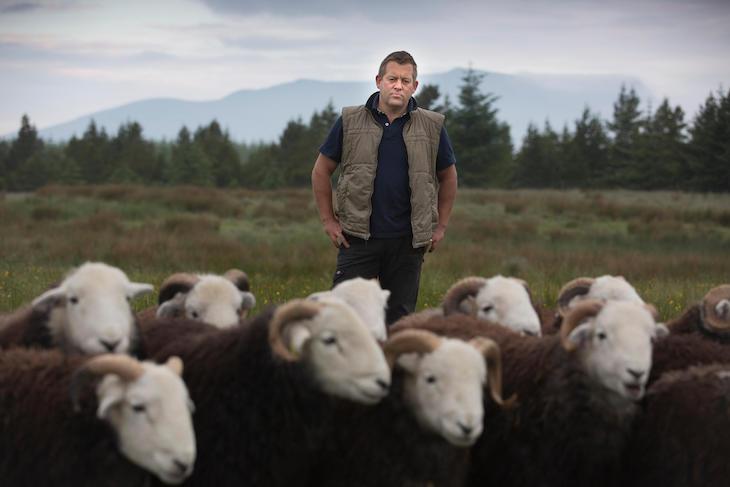
Next time you’re in the British uplands, perhaps in one of our national parks, Dartmoor, say, or the Lake District, stop a while to watch a flock of sheep, and count how many of them are limping. You’ll find it’s a lot. Because keeping sheep year-round in our bleak uplands is an animal welfare issue on a huge scale, hidden in plain sight.
A popular piece of dark farming humour says that sheep “spend all their lives finding ways to die”
I’ve been in trouble with the sheep lobby on X for saying this. Especially boisterous in his criticism has been legendary upland farmer James Rebanks, author of The Shepherd’s Life and English Pastoral, a truly wonderful book, after I stated (perhaps a little thoughtlessly) in a reply to someone or other that “there are no shepherds anymore! That’s the problem. The sheep are dumped on the hills all year round unsupervised, unprotected, and a good number of them consequently die of natural causes each year. A return to shepherding might be a good thing.”
The fact is, British sheep farming today is more akin to ranching than shepherding. “Rebanks’ own book, The Shepherd’s Life, is candid about this. Of his Herdwick flock on the Lake District fells, he writes: “In the eight weeks since I brought them here, I have not seen many of them… Our shepherding culture includes periods when the sheep graze the fells away from our supervision… so I am anxious to see them again, keen to check that they are alive and well.”
He explains why: “Because there are no large predators, the sheep are left to graze alone, but are brought down several times a year for lambing, clipping and other key activities.” Eight weeks! Certainly, from a rewilding perspective, he’s right: if sheep were still shepherded in the real sense, unrealistic as that may be in modern Britain, there’d be far less fuss over the restoration of vital predators such as eagles, lynx and wolves to our uplands.

I’ve long argued that tens of millions of sheep have been an ecological catastrophe for our fabled uplands, and that the modern-era monoculture of sheep is not working out for farming communities either. The best and only pathway to economic, social and ecological renewal in some of our remotest and most precious landscapes is a shift of emphasis away from sheep towards ambitious nature recovery. Key to this will be a return to extensive grazing by the kinds of native cattle, pigs and ponies that were once predominant in our uplands, and the development of additional sources of farm income in nature capital and nature tourism. Given the barrage of fury I’ve received for suggesting that upland sheep farming is also an animal welfare nightmare, I’ve delved into the issue further. And, while I regret that some sheep farmers may feel denigrated by my comments, which wasn’t my intention, what I said is true.
The National Animal Disease Information Service estimates that around three million sheep in the United Kingdom are lame at any one time. That’s three million animals in chronic pain, in a country that prides itself on world-leading animal welfare standards.
And lameness is just the symptom that’s easiest to spot. Sheep suffer from more than one hundred documented diseases, including respiratory illnesses, parasitic infestations and mineral deficiencies, most of them a direct consequence of keeping an animal that evolved in the arid mountains of the Middle East in the cold, wet and windy hills of Britain.
Sheep are domesticated mouflon. Their pointed hooves, shaped over aeons for rocky, dry terrain, are simply not built for boggy British hillsides. “It’s like wearing stilettos at a festival”, someone once quipped. Many of our native upland grasses are rich in silica and abrasive, and as sheep walk through them, the coarse blades lacerate the skin between their splayed hooves. The wounds get infected. The results are a cluster of conditions, footrot, contagious digital dermatitis, toe abscesses, all painful, all extremely common, lumped together under the bland word lameness, which undersells quite how agonising they are. The standard preventative treatment is a footbath of formaldehyde derivatives, a substance corrosive enough to carry three separate hazard warnings on the drum, which then washes off the open hill to poison our rivers and streams. Moreover, the antiparasitic drugs routinely administered to sheep is a major contributor to the insect apocalypse with effects that ripple through the food web, depleting the birds and small mammals that depend on them.
Millions of sheep limping across our barren hillsides are not an inevitable feature of rural Britain
A popular piece of dark farming humour says that sheep “spend all their lives finding ways to die”. The death toll among lambs is particularly appalling. About 16 million are born in the UK each year. The Agriculture and Horticulture Development Board considers it normal for between 10 per cent and 12 per cent of those detected while ewes are pregnant to die before they are reared, with losses of over 20 per cent before a farm is advised to review its performance. Even at the lower end of that range, that’s 1.6 million dead lambs a year. Across much of the Lake District, the Pennines and the uplands of Wales and Scotland, sheep turned out onto the fell are routinely left without any ‘shepherd’ for days or even weeks at a time. The Welfare of Farmed Animals Regulations require that animals be inspected at intervals sufficient to avoid any suffering. It’s hard to see how that can be met when a sheep hasn’t been seen for a week. The industry even has a term for it, “black loss”, the sheep that simply vanish from the hill without trace. A 2024 peer-reviewed study of Highland and Island flocks found black loss of up to 17.5 per cent of lambs between marking and weaning, on top of the losses that occur around lambing time, meaning total lamb losses on some upland farms exceed 30 per cent in a year.
This isn’t the fault of individual farmers. Most upland sheep farmers are good, hardworking people who don’t want their animals to suffer, and who are themselves trapped in a system shaped by decades of bad policy. A combination of the EU’s Common Agricultural Policy (CAP) and a food market that has structurally disadvantaged farmers for years has pushed them towards ever greater intensity and locked in practices that have proved catastrophic for nature, for people and for tens of millions of sheep.
Sheep are not ecologically harmful everywhere. On chalk downlands in the south, grazed since the Bronze Age, centuries of sheep grazing have helped create some of our most wildflower-rich habitats. But in most habitats in Britain the picture is entirely different. The untold damage all these sheep have done especially to our upland landscapes is increasingly understood by the British public. Our hills were once a great mosaic of mysterious blanket bog – vast natural water sponges – plus wildflower meadows, scrub and woodland pasture, sinewed with meandering streams and rivers, alive with birdsong and wildlife. Drainage of all that to make way for sheep, and centuries of overgrazing, processes which accelerated dramatically during the twentieth century, have stripped nearly much of the nature away. Studies consistently show that many of our national parks are in poor ecological condition, in some cases faring worse than areas outside their boundaries.
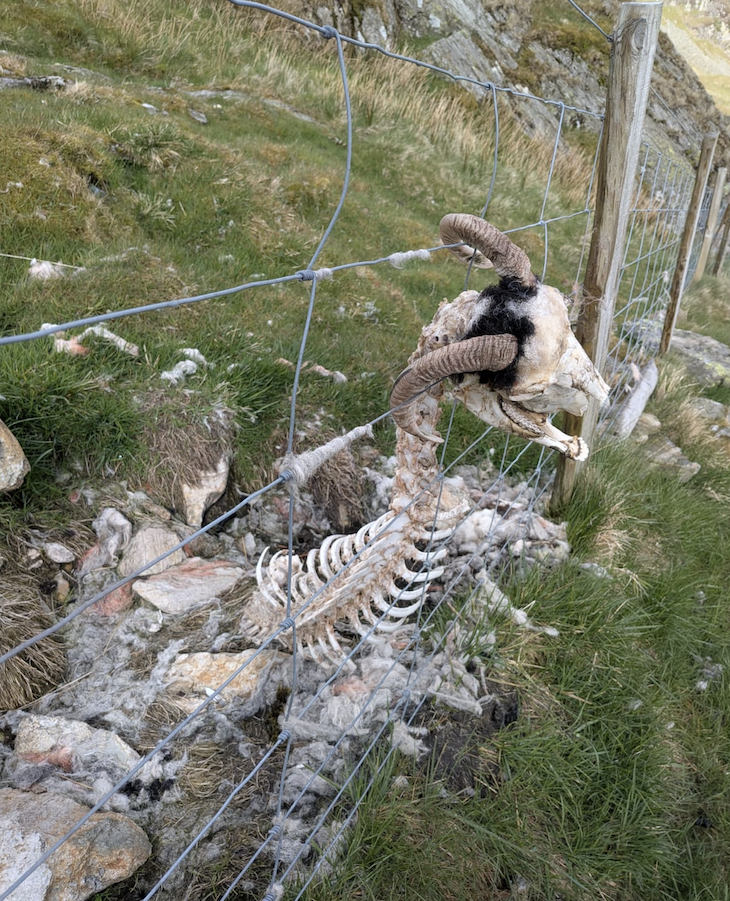
Sheep have small mouths and are good at removing the plants and tree seedlings they prefer, leaving behind just the coarse grasses and rushes that little else can use. Soils compacted by sheep can’t absorb rainfall as easily, turning hillsides into sluices that send floodwater cascading through towns downstream. Following a switch from sheep to mixed cattle grazing at Hawes Water in the Lake District, staggering increases in breeding birds, butterflies, wildflowers and wildlife of all kinds have been recorded. A long-term study at Ingleborough in the Yorkshire Dales, published this year in the journal Ecological Solutions and Evidence, found that replacing sheep with native cattle increased butterfly abundance five-fold.
Assertions that all these sheep are vital for our food security are of course nonsense. Henry Dimbleby’s National Food Strategy found that England’s uplands, representing roughly 20 per cent of our farmland, contribute less than 3 per cent of the food we produce. Take into account imported feed grown on better land elsewhere and the figure is even lower still. Meanwhile the economics for sheep farmers in these areas are bleak. Lamb consumption has been falling since 1980, when it matched chicken in popularity, although the rapidly growing Muslim population in Britain has somewhat slowed the decline in recent years. Wool, long ago the main earner, has collapsed in value due to oversupply and dwindling demand, sadly, because wool is an amazing product. Sheep farming businesses have been kept afloat solely by subsidies. This one-track system simply isn’t working for anyone.
But change is afoot. England’s Environmental Land Management scheme, which replaces the CAP post Brexit, rewards farmers explicitly for the public goods they deliver: cleaner and more reliable water, natural flood protection, regeneration of soil, the return of birds and wildlife, carbon sequestration and so on. Clusters of farmers are coming together to roll out whole Landscape Recovery projects, with shared, long-term plans for big areas of land. There are dozens of these now, a number of which are beginning to show what our uplands could look like in the future, the return of nature, more resilient landscapes, new jobs, and continued livestock farming. Ongoing research for Rewilding Britain has found that managing marginal land for nature increases rural employment by 124 per cent.
Making this work requires people who know these landscapes intimately, who can manage livestock across vast and demanding terrain, and who have the grit to do so. James Rebanks himself has in recent years brought Belted Galloway cattle onto his farm. He uses them, as he puts it, as a proxy for the wild cattle that once roamed these landscapes. His farm now supports over 200 species of plants and flowers, barn owls have returned, and he has planted over 25,000 trees. Rebanks’ farm is now less intensively managed and far richer in wildlife, and has a more diverse set of income streams than the sheep alone could provide. And he still loves and cherishes his prized herd of Herdwick sheep. We don’t need thirty or more million sheep for the rich culture of raising and showing sheep to go on as it always has.
Millions of sheep limping across our barren hillsides are not an inevitable feature of rural Britain. Poll after poll shows that the public wants its nature back, and it will get its way. The question is whether farmers choose to lead the charge or not. These are the people who have known and loved these landscapes for generations; who are the soul and the backbone of their communities, of Britain itself even; and it is they who are best placed, given the right incentives and enough time, to restore the wilder, wetter, more vibrant, more resilient uplands that we so want and need.



Comments