
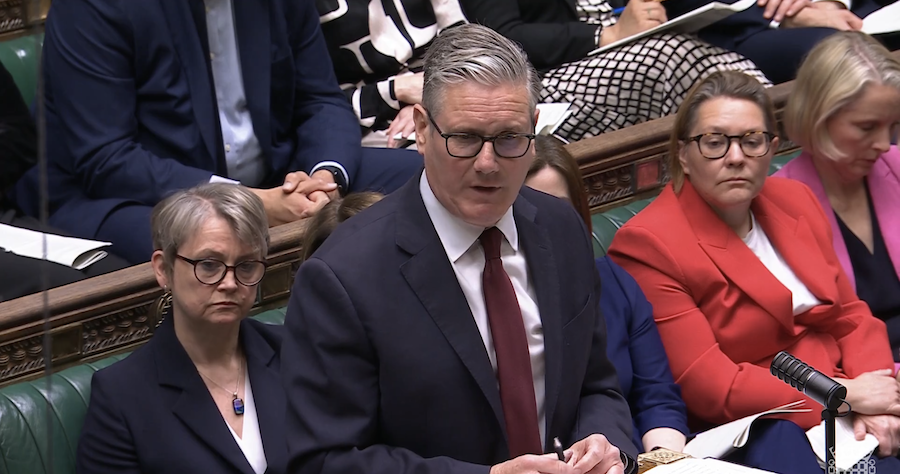
Keir Starmer probably found it vaguely comforting that today’s Prime Minister’s Questions at least gave the impression that he is still making decisions in Downing Street – rather than focusing entirely on when he will leave the job. The Prime Minister still has the demeanour of a duck with mobility problems but found himself answering questions about sanctions on Russia when he faced Kemi Badenoch.
The Tory leader used her six questions to accuse Starmer of favouring Russian oil over granting new licences for drilling British oil in the North Sea, as well as accusing him once again of taking a ‘pompous’ and ‘patronising’ tone with her. She also tried to set up a narrative that the problem is not Starmer specifically but Labour, and that changing leader will only mean a new salesman, not new policies.
Starmer opened the session with a sweetener for the electorate and Labour MPs: he announced that the government would be giving hauliers a 12-month road tax holiday and extending the freeze in fuel duty for the rest of the year. Badenoch immediately described it as a ‘U-turn’ and joked that ‘it would make more sense if they just did what we were going to do because they get there in the end anyway’. She then turned in her next question to the sanctions decision, asking the Prime Minister to tell the Chamber ‘why oil from Russia is acceptable, but oil from Aberdeen is not?’
Starmer’s tone really is very grating
The pompous tone came back in Starmer’s reply: ‘We have been united across the House on these issues since the beginning of the conflict,’ he said, loftily suggesting that scrutiny of decisions was in some way beneath a parliamentarian. He then claimed that this was:
Standard practice: this government has phased in sanctions in this way before and the last government used exactly the same technique when they used sanctions, and when they did so Mr Speaker, we supported them because we could see the sanctions were the right thing to do.
He insisted that ‘this is not a question of lifting existing sanctions in any way whatsoever’.
Badenoch mocked the ‘very weak set of cheers from the MPs who are trying to get rid of him’, and then said, in her customarily blunt fashion that ‘he doesn’t know what he is talking about’. She accused him of ‘processology’ and pointed out that Ukraine’s own sanctions chief had disagreed with the Prime Minister’s approach.
Starmer continued to take his lofty tone, saying he thought that ‘on an issue of this importance’, it was really important that the position was not misrepresented. He repeated his assertion that ‘none of the existing sanctions are being lifted in any way’. ‘I think if she’d done her homework, she’d actually support us on this,’ he added, in a nod to old briefings that Badenoch was ‘lazy’.
Mind you, Starmer has more recently been accused of being quite incurious about policy. Badenoch gave her own nod to that when she replied that:
Being patronising is not a substitute for understanding policy. And I’ve heard this tone before. This is the same tone he used during the Mandelson scandal. They were all cheering and then it turned out that he was wrong, wrong, wrong.
She asked if Starmer was ‘ashamed’ that he was ‘choosing to buy dirty Russian oil’ and that the money would fund the killing of Ukrainian soldiers. Once again, Starmer claimed that she was misrepresenting what was happening and that ‘these are new bans, they are new sanctions’.
Back came Badenoch with another line about Starmer taking a ‘pompous tone’ that ‘does not cover for the fact that he has got his policy all wrong’. She then shifted the debate from the sanctions to new licences for drilling in the North Sea, predicting that Starmer’s policies would lead to further job losses, particularly in cities such as Aberdeen.
Starmer made a – slightly weird – joke that Badenoch would have to refer herself to the Privileges Committee because there is drilling in the North Sea. He then said that the way to take control of energy bills was through renewables. This prompted Badenoch to use her final question to accuse him of not understanding the policy, and of being ‘ so deep in the bunker’, and that his policies on oil, steel and so on meant it was ‘like the Soviets won’. She then mocked the Labour backbenches, saying:
They aren’t getting rid of him over his terrible agenda – no, they actually like it! They just want a better salesman! So isn’t it the case that it doesn’t matter who replaces him? The real problem is the Labour party.’
Starmer replied that the UK economy was the fastest growing in the G7, and said he’d take that along with falling inflation and Arsenal becoming Premier League champions any day.
Starmer’s tone really is very grating and is one of the things that does seem to particularly annoy voters. But in these exchanges he did manage one thing: he stuck to the line that there was no weakening of sanctions, and Badenoch was not able to offer any detailed argument about how he had got his policy wrong to contradict him. It does beg the question of how the government managed to get its communications so badly wrong on this. If Starmer is right, he has had to spend a lot of time trying to correct a story that has also enraged the public quite quickly.




Comments