
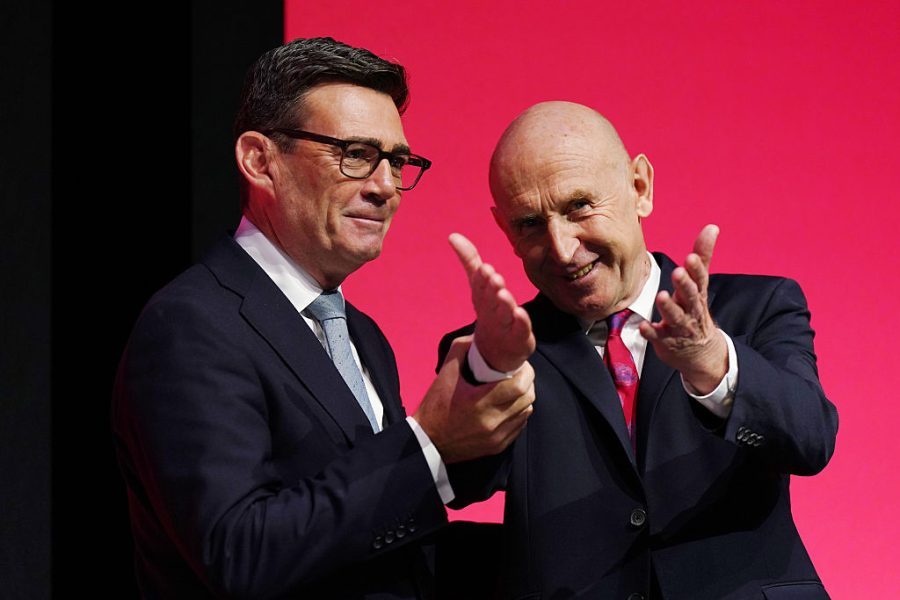
There was a grim inevitability about this. ‘Whitehall sources’, which is almost always code for the government rolling the pitch with the media to prepare for bad news, have suggested that a decision about when to increase defence expenditure will probably not be made for another year. The announcement will be part of the government’s Spending Review, which some had anticipated would be published in the spring. Now, though, the mood music from Andy Burnham’s administration is that it will take place in autumn 2027 so that it can sit alongside that year’s Budget.
To be charitable, the government’s case is as follows: there was no announcement on the timing of the Spending Review, so it is inaccurate to describe it as delayed if it is published next autumn; to suggest otherwise is ‘pure rumour and speculation’, as the date has yet to be determined; and the only formal commitment the government has made is to the Nato-wide target of spending 3.5 per cent of GDP on defence and another 1.5 per cent on wider security and resilience by 2035.
Delays are particularly corrosive in the Ministry of Defence
That target was agreed at the Nato summit at the Hague in June last year. Not only would member states reach the agreed total expenditure of 5 per cent of GDP, but they would ensure they played their part in fulfilling the alliance’s capability targets. Then prime minister Sir Keir Starmer signed up to the spending target and announced that the UK would buy 12 Lockheed Martin F-35A strike aircraft. This variant of the F-35B already operated by the Royal Air Force is capable of delivering tactical nuclear weapons and would allow the UK to join the United States, Belgium, Germany, Italy, the Netherlands and Turkey in supporting Nato’s nuclear-enabled Dual Capable Aircraft mission.
There has been a pattern of delay and ‘clarification’ of policy since then. At the end of June this year, the government published its Defence Investment Plan. This was supposed to be the financial ‘how?’ to the ‘what?’ of last year’s Strategic Defence Review, so was in effect a year late and a year lost. Moreover, it did not provide the funding for elements of the SDR for which many had hoped. Shortly before it was formally published, then defence secretary John Healey resigned because he regarded its financial foundations as insufficient given the threats faced by the UK.
The acquisition of the F-35As seems to have been paused. In July, the Minister for Defence Readiness and Industry, Luke Pollard, confirmed in answer to a written parliamentary question that no more F-35s of any kind were expected to be received until ‘the early 2030s’.
It is no secret that Sir Keir Starmer, then in the death throes of his premiership, met with some raised eyebrows at this year’s Nato summit in Ankara. With Poland, the Baltic states, Germany and the Netherlands having made considerable strides towards the 2035 spending target already, the British assertions that it ‘has always met its spending commitments’ and that ‘the Prime Minister will be focused on building a stronger and more European Nato than ever before’ cut little ice. Instead, allies – especially the United States – noticed that the UK’s defence expenditure was only planned to increase to 2.7 per cent by 2027/28.
The government, both under Starmer and Burnham, has reiterated its commitment to the 2035 target but at every point has declined to anything which might instil confidence in its willingness to do so. At the moment we must take on trust consistent progress towards an ambitious target which falls just beyond not the next general election but the one after that. And Labour’s track record on defence has been pock-marked by delays, deferrals, obfuscation and blind, unwarranted optimism.
This makes the news that potentially nothing will be decided until next autumn more than just alarming. Remember this does not mean defence expenditure will rise significantly next autumn; it means the government will only tell us then when it plans that increase it. Realistically, therefore, new funds are unlikely to appear in the Ministry of Defence’s bank account until 2028 at least. It is also worth noting that the absolutely latest date on which the next general election can be held according to law is 15 August 2029, and it will inevitably be before that (no general election has intruded into August since 1895).
Delays are not just frustrating and disappointing. They are particularly corrosive in the Ministry of Defence, where major acquisition projects are regularly scheduled over several years (and almost always fall badly behind schedule). The contract for the troubled Ajax armoured fighting vehicle was awarded in 2010, for a capability requirement identified in 1996. It is not expected to be fully in service until 2028 or 2029 at the earliest.
There is also the reputational issue of intent and will. A good rule of thumb is that if something appears in the newspapers, then Moscow and Beijing are already aware of it and have a good sense of its accuracy. So our current most pressing adversary, Russia, sees us yet again falling behind in terms of our allies, our commitments and our capacity. The British armed forces are not currently capable of carrying out the tasks and meeting the threats that face us. That situation is worsening, and those who present those threats are fully aware of the fact.
When John Healey made his resignation statement to the House of Commons on 16 June, he remarked with uncharacteristic acidity, ‘Our adversaries do not follow timetables set by the Treasury.’ Chancellor of the Exchequer John Healey now sets those timetables. The government is running out of road and running out of excuses. Andy Burnham says he will be a different kind of prime minister, so let’s see him prove it. Tell us the truth, and do your duty.






Comments