
Half of America’s deployable air power sits within striking distance of Iran, and yet Washington is negotiating. Gaza is promised a gleaming future, and yet Hamas still refuses to disarm.
Is this strategic patience, or proof that the US President has been dangerously misled, indulging adversaries who are buying time?
By placing comprehensive proposals on the table, publicly, the administration creates a test for Iran
Two US carrier strike groups sit in the eastern Mediterranean and the Gulf. Land-based fighters rotate through Jordan and the Gulf states. Long-range bombers have been repositioned. Analysts calculate that somewhere between 40 and 50 percent of America’s deployable air power is now concentrated in the Middle East, a level comparable to the build-up before the 1991 Gulf war and the 2003 invasion of Iraq. This feels similar in scale, even if ground forces are absent
At sea, the USS Gerald R. Ford and the USS Abraham Lincoln anchor two full strike groups. This is a posture designed for rapid transition from deterrence to strike. And yet Washington is negotiating with the Islamic Republic regime even as it has slaughtered tens of thousands of its citizens and rushes to create more ballistic missiles and resume its nuclear activity.
In Oman, sources indicate that Ali Larijani, secretary of Iran’s Supreme National Security Council, is expected in Muscat to deliver Tehran’s response to an American proposal. Back-channel diplomacy continues. Yesterday, India advised its citizens to leave Iran immediately. Videos circulated from Tehran showing explosions near power infrastructure. Iranian opposition outlets report that a cellular network was hacked and mass messages were sent out declaring: “To the Iranian people subjected to oppression – the US president is a man of action.” The world is waiting to see whether this is choreography before compromise or the prelude to war.
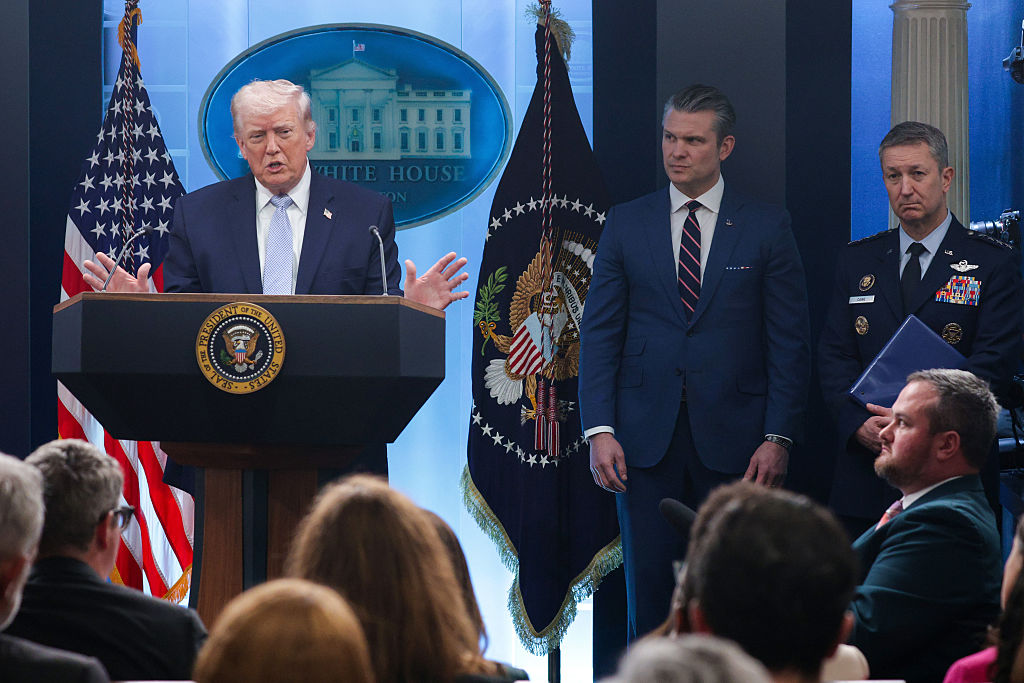
Simultaneously, in Gaza, another drama unfolds. The President staged another Board of Peace extravaganza last week, once again presenting a vision of Gaza rebuilt into a gleaming coastal hub, towers rising where rubble now lies, investment and infrastructure replacing tunnels and Islamic terrorist rule. The premise is simple. Hamas must demilitarize. Weapons surrendered, command structures dismantled, Gaza transformed from terror hub to city. But Hamas continues to refuse.
These are the two dilemmas. Iran’s nuclear and missile program on one front; Hamas’s refusal to disarm on the other. In both cases, critics question whether the administration is being strung along, lured into elaborate diplomatic processes while America’s adversaries buy time. In both cases, some suggest that the White House is indulging fantasies: Tehran voluntarily relinquishing decades of nuclear investment, Hamas dissolving itself in exchange for urban redevelopment. But that reading may miss what is really happening.
Donald Trump recently posted a clip of Mark Levin delivering a blistering monologue on Fox News. Levin mocked the idea of a transformative Iranian conversion: nuclear surrender, missile dismantlement, ideological moderation. He recited Iran’s record of phased uranium enrichment increases, stockpile breaches, advanced centrifuge deployment, monitoring restrictions, formal announcements of termination. His conclusion was stark but on point: a regime that defines itself through resistance and apocalyptic theological mission will not be tamed by negotiation. By amplifying that argument with a repost online, the world’s most social media savvy leader indicated that he understands the risk of illusion, and how to communicate that to everyone else. At least, I hope so.
Any optimism surrounding the latest American diplomatic initiatives rests on a structural tension. It is a collision between two conceptions of time and power. From Washington’s vantage point, nuclear weapons invite sanctions, isolation and the risk of overwhelming retaliation. Relinquishing them offers economic stabilization and reintegration. This is rational, transactional logic. Incentives and penalties shape behavior.
Tehran’s calculus is layered differently. Ali Khamenei, in power since 1989 and now in his eighties, presides over a system that elevates endurance. The regime has survived war, sanctions, protests, internal dissent. It crushed mass demonstrations and absorbed the reputational cost. A struggling economy does not threaten its ideological core. Nuclear capability is its symbol and shield. It embodies permanence, defiance, a claim to regional primacy. Sacrifice is framed as virtue. Delay is strategy.
The same asymmetry shapes Hamas. Western democracies operate on electoral clocks and public tolerance. Military campaigns are scrutinized, casualties debated, fiscal costs tallied. Hamas speaks in generational terms. Struggle is not an episode but a vocation. Demilitarization would dissolve its identity.
Authoritarian systems, whether dynastic dictatorships or theocratic regimes, calculate differently from elected governments. Leaders such as North Korea’s Kim Jong-un do not face voters or midterm losses. They think ideologically. They think in decades and centuries. Their primary imperative is regime survival, and the survival of the ruling structure often justifies extraordinary deprivation at home. Risk is absorbed differently. Economic punishment that would cripple a democratic government can be endured, reframed, even weaponized. Concessions are tactical, time is elastic, and agreements are instruments rather than endpoints. Trump’s high-profile summits with Pyongyang show how personal diplomacy and spectacle can fail to produce structural change.
Massive military deployments cannot sit indefinitely without consequence. Assets are drawn from other theaters, and readiness elsewhere. At some point, either forces are withdrawn, visibly, or they are used. Tehran understands this. Stalling negotiations, offering partial concessions that keep talks alive, can buy time and potentially force gradual American de-escalation. A protracted diplomatic process dilutes immediate leverage. Washington understands that dynamic as well.
By placing comprehensive proposals on the table, publicly, the administration creates a test. If Iran offers a serious pathway on enrichment and missiles, diplomacy acquires substance. If it refuses, as it almost certainly will, the refusal is documented. If Hamas declines demilitarization even in exchange for Gaza’s reconstruction, responsibility is exposed.
This, then, could be summed up as the Trump doctrine. Force without prior offer can be framed as aggression. Force after rejected offer carries a different narrative weight. None of this guarantees restraint. Khamenei may judge that limited American or Israeli strikes will be survivable, that regime endurance will translate into declared victory. He may believe that some compromise will act as a diversion, or that merely remaining in power even after US bombardment constitutes triumph. Hamas may calculate that survival amid ruins reinforces its legitimacy. They may both be right.



Comments