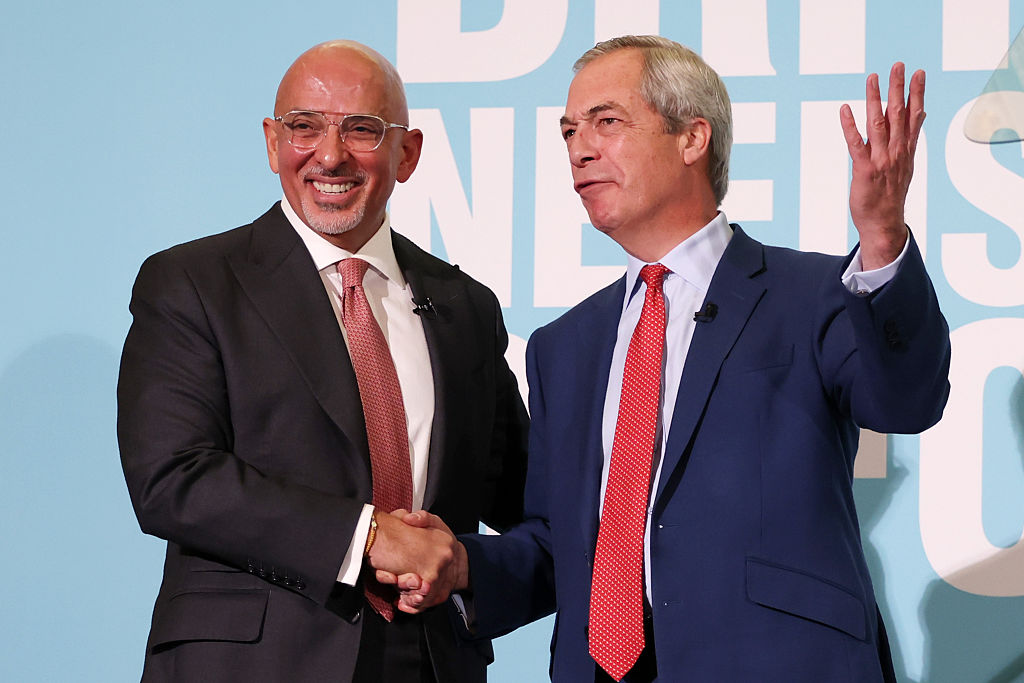
Nadhim Zahawi, the one-time Tory chancellor and former vaccines minister, has joined Reform UK. But is that a good thing? For some, his defection is yet another coup for the populist upstarts at the expense of the sinking Conservatives. For others, the arrival of the smooth-talking Tory grandee raises the hackles, suggesting Reform is slowly becoming just another wing of the dreaded ‘uniparty’.
Baghdad-born Zahawi is a ‘walking rejoinder’ to tedious media witch-hunts about Reform’s alleged racism
My brief survey of Reform’s grassroots shows feelings are mixed. One member is concerned about Zahawi’s views on immigration, but says putting the boot into the Tories with such a high-profile catch is no bad thing. Another complains it undermines Reform’s credentials as an ‘alternative’ to the mainstream. ‘Why can’t they say no?’, asks a third. For the party itself, though, mainstream credentials are part of Zahawi’s appeal. Among his virtues are ‘delivery’, ‘competence’ and business credibility, one source says – he will likely be involved in fundraising – adding that it doesn’t hurt that he’s ‘comfortable in modern Britain’. As James Heale notes, Baghdad-born Zahawi is a ‘walking rejoinder’ to tedious media witch-hunts about Reform’s alleged racism.
One sting in the tail, though, has been largely overlooked. At Monday’s press conference announcing the move, there was much focus on Zahawi’s role in the vaccine rollout during the pandemic, touted as evidence that he can operate the levers of state while working with business. That’s as may be, but one of Reform’s great strengths compared with the rest of the political establishment is precisely that it was not involved in any of the draconian Covid measures, which the Conservatives blithely foisted on us and which Labour wanted to be even harsher. As well as procuring the vaccines, Zahawi was responsible for the hated Covid passports too, with healthy British citizens coerced to have a jab in order ‘protect’ them from a virus with a miniscule death rate for young people. Reform’s non-complicity in the greatest policy failure of our postwar history is an asset it would do well to jealously guard. ‘A pro Covid-passport guy?’, an unimpressed member says about Zahawi. ‘I don’t care what his justification was, this isn’t a man of principle.’
Most popular
Spectator Editorial
The Iran war has exacerbated the failure of European energy policies

For those on the right, the biggest question mark is over Zahawi’s record on immigration. To migration sceptics, the picture isn’t exactly pretty. In 2013, Zahawi called for an amnesty for illegal migrants. The following year, he spoke at the Oxford Union in favour of the motion that ‘Immigration is good for Britain’. The year after that, he said that Farage’s calls as Ukip leader to scrap race discrimination laws were ‘racist’ and something that ‘Goebbels would be proud of’, and apparently also tweeted that he would be ‘frightened’ to live in a country run by Farage. During the upheavals of 2020, he voiced his support for the far-left race activists of Black Lives Matter. Most egregiously, he was in cabinet during the Boriswave. Though not quite on a level of Alaa Abd El-Fattah, this arguably speaks to a lack of rigour in vetting. It would certainly have saved Reform some embarrassment if their new man had gone more carefully through his X profile excising some of his woker moments.
As such, Zahawi’s arrival has gone down like a lead balloon with right-wingers online, something Reform will have to keep one eye on. This is the same constituency which, among other things, propelled the rape gangs scandal back into the political conversation last year and coined the term ‘Boriswave’, which Reform love to use to pinpoint the utter betrayal of the Tories’ post-Brexit immigration surge.
Still, is it really true that Reform are going soft and becoming the ‘Tory party 2.0’? After all, we saw a similar cycle of online outrage last year, after former Conservative councillor Sarah Pochin became the Reform candidate for Runcorn and Helsby. That Pochin attended a ‘Refugees Welcome’ event in 2022 was soon dragged up and went viral as supposed proof Reform was losing its nerve and tacking toward the centre. Yet the May by-election proved the wisdom of the strategy, with the doughty, inoffensive Pochin successfully overturning a 34 per cent Labour majority to win the seat. Reform netted its fifth MP, and an outspoken one at that – and the policy red meat kept on coming. Her win was followed by a blitz on crime over the summer, before Millbank Tower unveiled plans for ‘mass deportations’ of illegal migrants in August, and then a robust policy on indefinite leave to remain – which Labour stroppily denounced as ‘racist’.
More recently, a similar debate has raged over the choice of Laila Cunningham as Reform’s candidate for London mayor, largely due to her being a Muslim – as if in a future Reform government, migration policy would be set from City Hall. The reality is the mother-of-seven talks tough on ‘Islamic extremism’ and is photogenic enough to be able to communicate Reform’s message to a wider audience.
With Reform riding so high and Tory prospects so dismal, there are doubtless many more would-be defectors Reform have turned away. With Zahawi, the basic calculation would appear to be the following: Reform is currently long on its anti-immigration and dissident credentials; but it is short on its roster of talent, its fundraising, and the public perception that it will know what to do when it gets into government. In footie terms, then, it needs more strength in depth, and the former Conservative chairman fits the bill. Farage is canny enough to know that sometimes it’s worth tempering ideological purity with a dose of pragmatism. After all, what is politics but winning people over to your point of view?



Comments