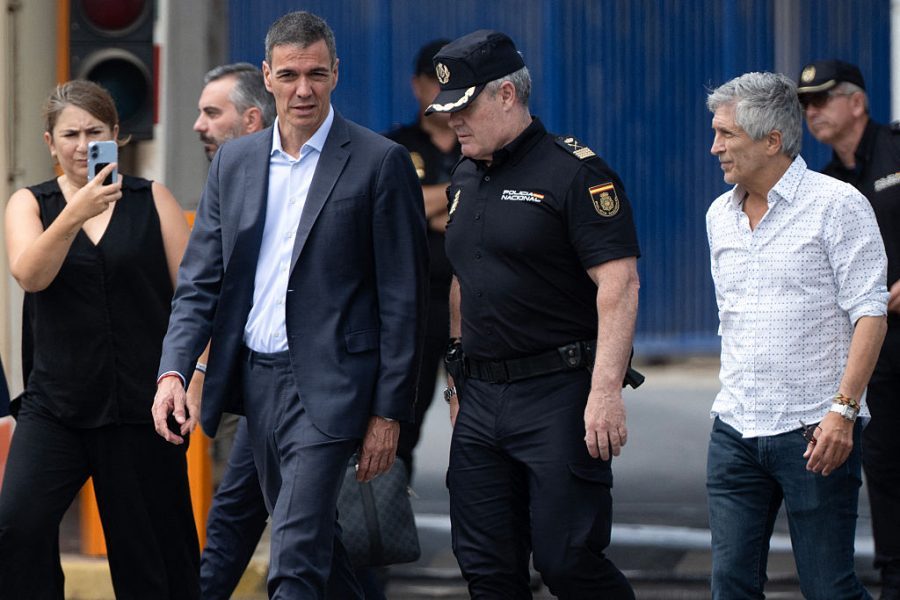
Spain’s socialist Prime Minister, Pedro Sánchez, has accused social media networks linked to Israel and Russia of spreading misinformation that helped fuel the crisis culminating in the sudden mass arrival of approximately 80,000 mostly Moroccan and sub-Saharan African migrants in the Spanish exclave of Ceuta (population 83,000) on 30 and 31 July. Madrid says some 5,000 remain in the city on the North African coast, although other estimates put the number considerably higher.
Like other EU leaders, Sánchez has consistently opposed Russia’s war in Ukraine. But he has gone much further than most in his criticism of Israel, repeatedly describing its actions in Gaza as “genocide.” Israel’s foreign minister, Gideon Sa’ar, described Sánchez’s latest accusation as a “brazen lie.” He added: “Continuing to spread defamatory lies will not distract from Sánchez’s disgraceful failure to manage his country’s affairs.”
Sánchez has meanwhile dismissed claims that Morocco played a part in organizing the massive influx at the end of July. Ceuta borders Morocco, which disputes Spanish sovereignty over the territory. Sánchez insists that cooperation with Rabat has been positive.
Ceuta has now added another charge to the opposition’s indictment: incompetence
The Spanish Prime Minister is coming under intense criticism for his government’s failures in Ceuta. Silvia Rojas, Ceuta’s chief prosecutor, says the city is experiencing “almost one sexual assault a day,” adding that the influx has caused the collapse of the child protection system and severe pressure on health and education: “Ceuta is on the brink of collapse.” Referring to the spike in sexual assaults and violent robberies, Rojas says the crisis has restricted children’s freedom to use parks and other public spaces normally. Asked about the danger of a social explosion, she said Ceuta’s population feels it has endured “a month of inaction”. She appealed for calm.

Migrants are sleeping on beaches, streets, wasteland and in abandoned buildings. Two people-smuggling gangs broken up by police were charging as much as €9,000 ($10,400) a head to reach mainland Spain in small boats. Last Thursday, a group of as many as 40 migrants surrounded and stoned a military vehicle, injuring four soldiers. On Sunday, three Moroccans were arrested after bottles containing corrosive liquid, described by a local newspaper as being thrown “in the manner of Molotov cocktails,” were hurled at soldiers.
Yesterday police charged migrants at the Loma Colmenar camp and fired rubber bullets into the air. Hundreds who had spent several days outside, crowded together in the sun waiting for places, had tried to force their way into the tents.
For Sánchez, the Ceuta crisis could hardly have come at a worse time. His fragile minority coalition was already struggling under the weight of corruption scandals. His former transport minister has been sentenced to more than 24 years for corruption offenses. Other senior officials are under investigation over alleged kickbacks connected with public contracts. Sánchez’s wife remains embroiled in judicial proceedings. In July, his brother was convicted of administrative prevarication and sentenced to nine years’ disqualification from public employment.
Ceuta has now added another charge to the opposition’s indictment: incompetence. The government initially resisted demands for a unified command, only to establish one almost a month after the crisis began.
Defense Minister Margarita Robles has publicly apologized, acknowledging that the government “arrived late.” She said the intelligence service had issued warnings about the growing danger of a mass crossing. Interior Minister Fernando Grande-Marlaska contradicted her, insisting there had been no warning of anything resembling what happened on July 30. Seven ministers have since spent hours explaining the crisis to congress without establishing with certainty how many migrants entered, how many remain or even how many unaccompanied minors are in the city.
Sánchez himself made only a flying visit to Ceuta before departing for the government’s holiday residence at La Mareta in Lanzarote. While the crisis continued, videos appeared on his social-media accounts recommending music and books. Asked about his holiday, he said: “I have worked and I have rested; those are my rights.”
The electoral signs are ominous. A SocioMétrica poll taken immediately after the mass crossing found that 80 percent of Spaniards wanted unaccompanied Moroccan minors returned to Morocco, even if legal changes were required. Remarkably, that included 77.6 percent of Socialist voters. Another found that 77.4 percent believed Sánchez had failed to reinforce the border because he did not want to upset Morocco.
The same pollster subsequently put the center-right Partido Popular (PP) on 149 seats and Vox, further to the right, on 57 seats – a combined 206, comfortably beyond the 176 needed for an absolute majority. Other polls also put the right well ahead.
A general election must be held by next summer. Sánchez once wrote a book called Manual de Resistencia (Resistance Manual), but if the polls are even approximately right, Spain’s next government is likely to depend on the PP and Vox, which promise to take a far harder line on immigration.





Comments