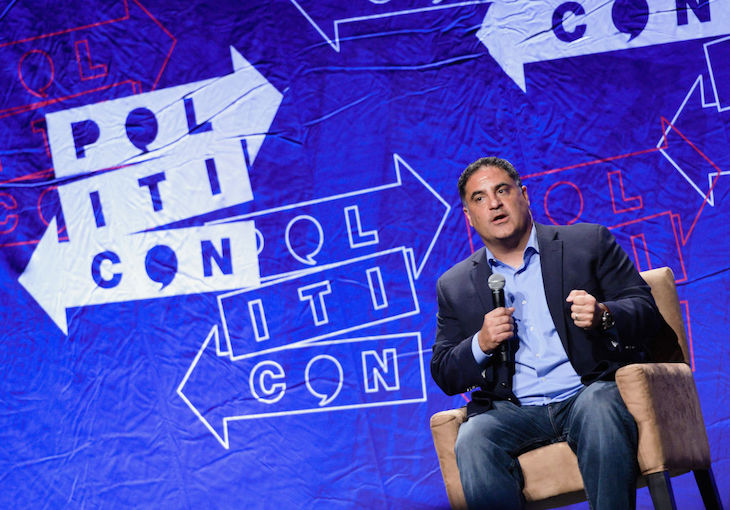
I was invited back on to Piers Morgan’s show next week to debate Cenk Uygur, in studio, while he was due in the UK to speak at SXSW festival in London. I politely declined. Uygur is, to put it mildly, not a man whose public manner suggests calm forensic exchange. Morgan himself proudly features a compilation video on his YouTube channel entitled: “Cenk Uygur’s Biggest Piers Morgan Uncensored MELTDOWNS!”, complete with a thumbnail showing no fewer than three images of Uygur snarling and yelling in fury.
The hypocrisy might also embarrass the Labour government, if they are still capable of that emotion
It is therefore with some amusement that I now learn that he has been barred from entering the United Kingdom by the Home Secretary.
Uygur was an odd fit for SXSW London, whose own website describes the festival as “the global festival for the convergence of business, technology and creativity,” which, it says, is “grounded in practical optimism.” Whatever else may be said for Uygur, practical optimism is not the first phrase that springs to mind.
I wrote in these pages about my appearance on Piers Morgan’s YouTube show a month ago, bemoaning the conspiracy theories aired on the programme and Morgan’s apparent nonchalance about them, alongside his more energetic attempt to portray me as insufficiently critical of Israel. He also asked me to continue critiquing his show in my writing (happy to oblige), but when I did – in what I can only assume was a case of age-related skin thinning – he reacted with a tantrum on X. He proudly boasted that he had counted all my Spectator articles – 186 apparently – and found only one not to be about Israel. Perhaps he should learn to count better, and also to read past the headlines, since he admitted he had not actually read the columns. (Piers, have you got this far?)
Israel is an area of specialisation in my work, but I have also written on Islam, Jew-hatred, Iran, Yemen, Kanye West, Nigel Farage, Piers Morgan, the Oxford Union, Sudan, Saudi Arabia, the UAE, and the BBC just to list a few other topics. None of this prevented Morgan from declaring me a ‘slavishly biased Israeli shill’. His chief complaint seems to be that I am not sufficiently reflexively negative about Israel to satisfy the change of mind he underwent on the country shortly after he visited Qatar.
Without official confirmation, one cannot state definitively why Shabana Mahmood has apparently decided to exclude one of Piers’ most frequent guests from entry to the UK. One might presume the decision was made on the grounds that his presence would not be conducive to the public good. This is a power she has enjoyed wielding over numerous others recently.
The SXSW appearance would have been in Shoreditch, very close to the Nova exhibition, where survivors of the Palestinian massacre of 7th October 2023 are present, and where enhanced security reflects the obvious risks to Jewish people.
The Community Security Trust recorded 3,700 anti Jewish incidents in 2025, the second-highest annual total ever logged, following 3,556 in 2024. Britain has seen not merely an ugly rise in rhetoric, but arson, stabbings, intimidation, assaults, and the deadly terrorist attack at Heaton Park Synagogue in Manchester. Jewish schools, synagogues and community premises require permanent vigilance. This is the country into which Uygur was proposing to arrive.
The case against him is not that he has criticised Israel. Plenty do. It is that he has repeatedly trafficked in language and claims that sit dangerously close to the conspiratorial fever now animating anti-Jewish hatred. He regularly describes Israel’s actions as “genocide”, “barbaric” and “savage” and has claimed that Israel uses Jews as “human shields”. Then there’s his claims that the global war on terror was a “global war against Israel’s enemies”, that America was “occupied” if Israel was “paying 94% of Congress”; and that Jeffrey Epstein was “almost certainly Mossad”.
Israel aside, there is his past Armenian genocide denial, which he has since recanted; his continued ownership of a network named The Young Turks, a name critics associate with the perpetrators of that genocide; and his public handling of UK Pakistani Muslim paedophilia gangs, where he has dismissed concern over organised abuse as Islamophobic rather than engaging properly with the findings of official inquiries. Taken together, perhaps Mahmood saw not merely a record of controversy, but of provocation at the exact fault lines where British public order is already under strain, expressed aggressively and often at high volume.
Sovereign nations have the right to decide who may enter. Britain sometimes appears to have mislaid that right when it comes to violent illegal immigrants, but at least it retains the principle when dealing with foreign extremists likely to inflame disorder. Historically, these powers were often used, quite rightly, to keep Islamist preachers out. More recently they have also been used against an American rapper who sold Nazi-themed merchandise and released a song in which he repeatedly chanted “Heil Hitler”, after years of public anti-Jewish outbursts. And now it seems for Cenk Uygur, too.
Yet Mahmood has also strained this discretion badly. Ahead of the Unite the Kingdom rally, the Home Office barred a cluster of foreign critics of immigration policy and Islam, including Eva Vlaardingerbroek, Joey Mannarino, Ada Lluch, Filip Dewinter, Dominik Tarczyński, Don Keith, Ezra Levant and Avi Yemini. Some are elected politicians, including Dewinter in Belgium and Tarczyński in the European Parliament. Others, like Levant and Yemini, are journalists or commentators. Those cases look far harder to justify, and carry the unmistakable whiff of a government using border powers to prevent its critics from arriving here to criticise it.
Piers Morgan should feel some embarrassment as well. Uygur is not his first guest to be deemed persona non grata by the Home Secretary
The hypocrisy might also embarrass the Labour government, if they are still capable of that emotion. When Israel barred British Labour MPs Abtisam Mohamed and Yuan Yang, David Lammy denounced the decision as “unacceptable, counterproductive, and deeply concerning”, adding that it was “no way to treat British parliamentarians”. Yet the same government has excluded foreign elected representatives from allied democracies when their politics were inconvenient to Labour’s preferred orthodoxies on immigration, Islam, and integration. Sovereignty is apparently sacred when Britain exercises it, and scandalous when Israel does.
Piers Morgan should feel some embarrassment as well. Uygur is not his first guest to be deemed persona non grata by the Home Secretary. Morgan’s YouTube show repeatedly invites guests whose fury, conspiracism and theatrical excess can be harvested for clips, clicks and advertising revenue. The Uygur “meltdowns” compilation is part of a business model, not the by-product of journalism. Previous guests include others barred from entry to the UK, like Valentina Gomez who took a flame thrower to a Quran and regularly criticises Islam, and the Hitler praising Kanye West. It’s uncensored, alright, but Morgan might consider what kind of public conversation he is rewarding and capitalising on.
So yes, we can argue about free speech. We can argue about who should be allowed into the United Kingdom, and where the line between offensive opinion and public danger should fall. We can disagree on individual cases – personally I won’t miss some of their presence here – But there must be a distinction between protecting open argument and importing those whose public role is to turn conspiracy into cash. A country is not obliged to host every foreign provocateur who wishes to monetise its tensions. Let’s hope the Home Secretary can apply that principle with integrity, rather than merely with convenience.



Comments