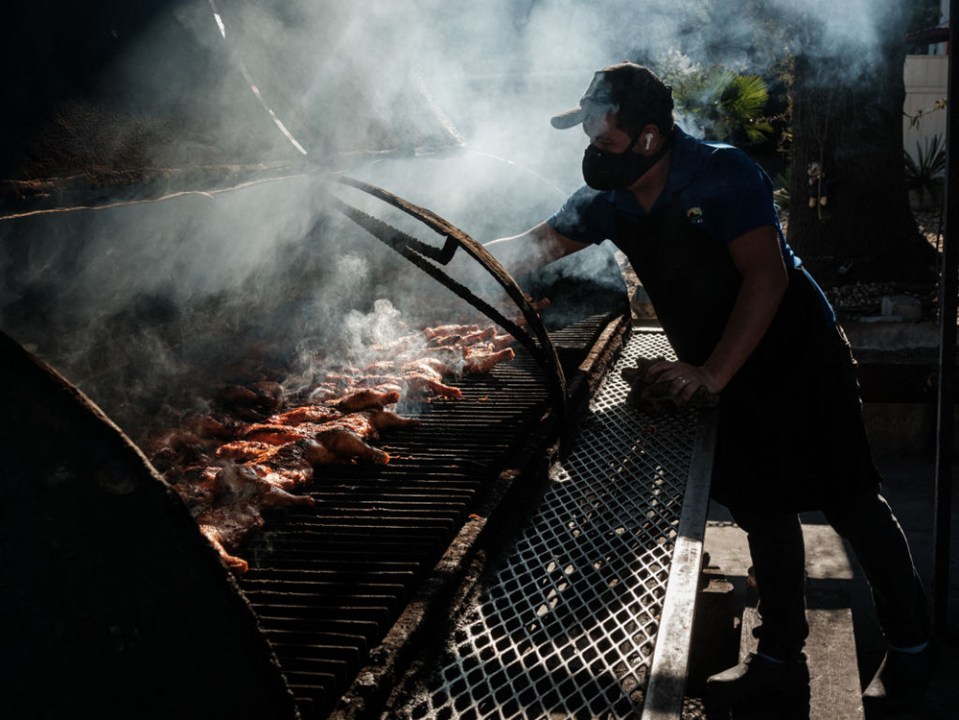

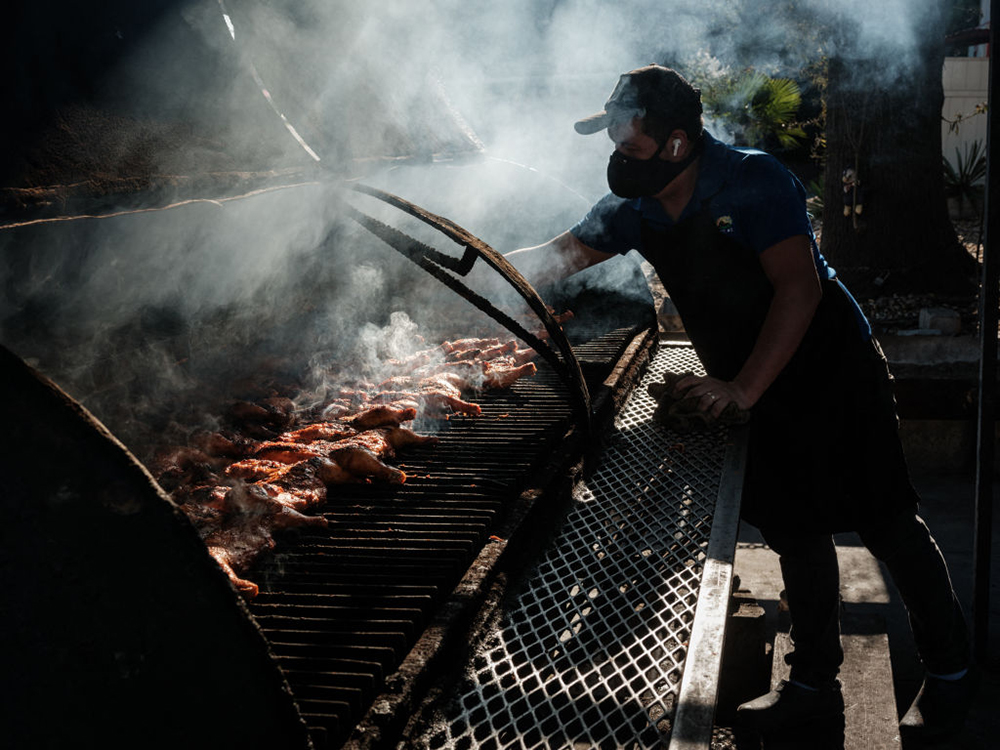
Memorial Day is approaching, the traditional kickoff for the American barbecue season – or for grilling season, depending on where you are in the country.
In some regions – say, New Jersey and northward – if someone asks you to come over for “a barbecue” during the holiday weekend, you’re likely to find a charcoal or gas grill loaded up with hot dogs, hamburgers, or, if the host is really putting on the dog, thick ribeye steaks.
Western-inspired parties took off in the 1930s – though digging a hole in the lawn was kind of a pain
For most folks in the South, calling such fare “barbecue” is painful. Here we call those events “cookouts,” and we would say the hosts are “grilling,” not “barbecuing.” Barbecue for us means slow-cooking large cuts of meat over a wood fire in a brick or metal pit, not grilling brats or chicken breasts.
Some ideologues will even insist that barbecue is a noun, not a verb, and that it refers to a very specific type of smoked meat. If you are at a gathering in upstate South Carolina, where I grew up, and ask the host, “can I have some barbecue?” there will be no question what you mean. You’ll get a plate loaded up with chopped pork dressed in a tangy vinegar and tomato sauce, even if chicken and ribs are also on the pit.
For some reason, pork that has been slow-roasted on a wood-fired pit is “barbecue,” while chicken cooked in the exact same manner is called “barbecued chicken.” I suppose one could say “barbecued pork,” but to a Carolinian, that’s unnecessary.
So how did we get into such a state of linguistic divergence? As different as the regional definitions of “barbecue” are today, they actually descend from a common 19th-century ancestor.
Back then, barbecue was cooked in long trenches dug in the ground – barbecue pits – and the animals were roasted whole and basted with a simple blend of vinegar, lard, salt and pepper. Long before there were barbecue restaurants or Memorial Day cookouts, these free outdoor events would draw hundreds or even thousands of guests for civic celebrations, political campaigning, and community fundraisers.
The cooking methods evolved in the 20th century, as elevated brick or cinderblock structures replaced the in-ground trenches, though they were still fired with hardwood coals and still called “pits.” Cooks started using individual cuts of meat – pork shoulder, beef brisket, a rack of ribs – instead of whole animals, but the basic principle remained the same: large pieces of meat cooked slowly over coals for hours on end. For many, that’s what barbecue means to this day.
Curiously, the use of the term to mean “burgers seared on a charcoal grill” evolved out of the same outdoor barbecue tradition. In the 1920s, glossy magazines began publishing articles describing outdoor gatherings that travel writers encountered out west. “An unusual way to entertain informally during the late summer or fall is to give a barbecue,” suggested a 1924 feature in Woman’s Home Companion. The author gave instructions for staging an event for up to 30 people, including how to dig a pit in the backyard as well as a recipe for “Cowboy Sauce,” which she had learned from a famed barbecue cook in Colorado.
Such western-inspired parties took off in the 1930s – though digging a hole in the lawn was kind of a pain. Soon a new type of cooking device, the barbecue grill, began appearing in hardware and sporting goods stores. Most models were small and simple in design – a metal tray for holding coals with a grate above it for the meat – though some featured adjustable grates or roasting spits. Sold alongside were bags of charcoal, a more convenient fuel than firewood.
Backyard barbecues boomed after World War Two, becoming an iconic part of the aspirational “good life” in the rapidly suburbanizing United States. Grilling equipment became larger and more sophisticated, with the Weber kettle grill being launched in the 1950s and the first gas grills coming the following decade. The types of food cooked on those grills broadened, too, encompassing not just hamburgers and sausages but steaks, chops, shish kebabs and much more.
Calling this new backyard pastime “barbecuing” did not sit well with everyone. “Many Georgia epicures insist that this is an insult to the honorable name of barbecue,” huffed Rufus Jarman in the Saturday Evening Post in 1954. “You cannot barbecue hamburgers, roasting ears, potatoes, onions, tomatoes, wieners, or salami, and it is a shame and disgrace to mention barbecuing in connection with such foolishness.” We’ve been arguing over the word ever since.
I will admit that as I grow older, I’ve become less dogmatic about definitions and regional preferences. I now don’t care whether your backyard barbecue features weenies grilled over a gas flame or a massive pork shoulder slow-smoked for 12 hours. Just make sure there’s plenty of cold beer – and don’t forget to send me an invitation.





Comments