
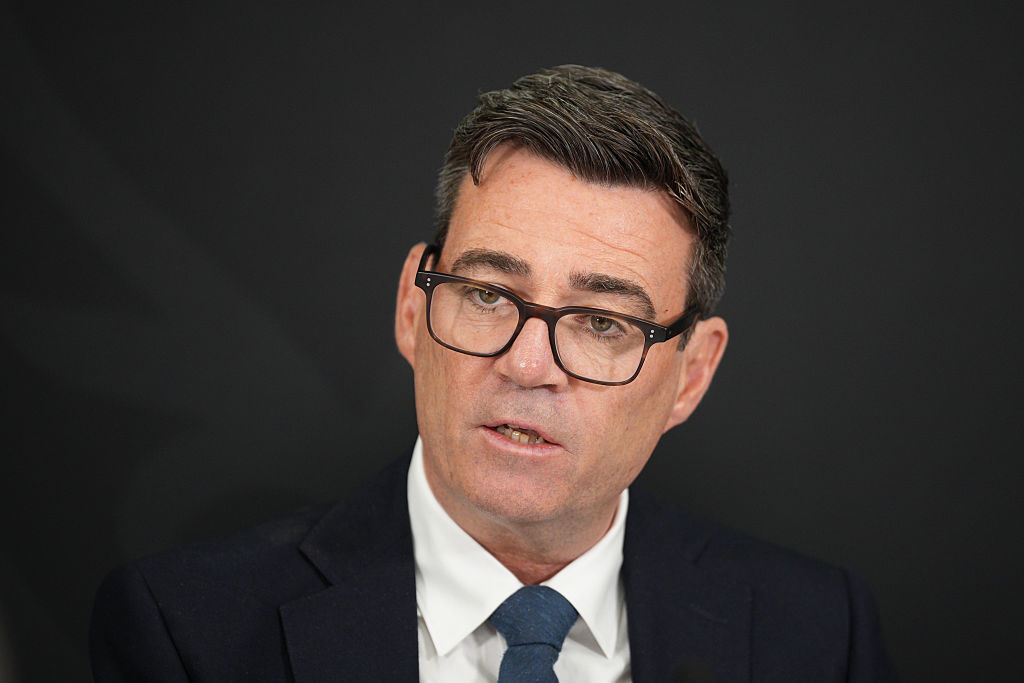
Keen to keep up the momentum on his big (or not so big) ideas, Andy Burnham will apparently announce on Friday that in future some revenue from income tax will be distributed directly to local government so that they, rather than Whitehall, can choose how to spend the money.
Will he really want to give up power and money to Reform-led councils who might be minded to do all they can to thwart Labour party policies? Or spend their money hanging the St George Cross from every lamp post?
In Britain, only around 5 per cent of total government revenue is collected by local government, which is markedly lower than many other countries. Councils will reportedly not be allowed to vary the rate of income tax, as the SNP has done disastrously in Scotland (its 3 per cent supplementary rate on income tax has cost it £20 million this year according to Dan Neidle, expert on fiscal policy). HMRC will simply give them a slice of existing revenues. What is not clear is whether this is extra money – and therefore yet one more unfunded spending commitment – or whether it is just a redistribution of revenues, in which case what is central government going to stop funding in future?
But there does seem to be something of an inconsistency in Burnham’s approach. At the same time as he is trying to devolve money and power to the regions and localities he is planning to create a National Care Service. That is a policy which pulls heavily in the opposite direction. In this financial year, £42 billion out of £139 billion budgeted to be spent on public services by local authorities will go on adult and children’s care. This is money which at present is spent on locally-commissioned services, in accordance with local decision-making, but in future it seems that Burnham wants a national-run agency to make these spending decisions instead. We don’t have many details about this National Care Service, but if the ‘National’ in it means anything it surely means a centralisation of decision making, a concentration of power in Whitehall.
So does Burnham really believe in devolution or not? I suspect it won’t take him long to go off the whole idea. It is very easy when you are not part of national government to decry the centralisation of power and to demand more devolution. It was natural that Andy Burnham, mayor of Greater Manchester, was keen on this. But Prime Minister Burnham may well be minded to see it differently when he is faced with devolving powers to councils of a different political colour.
Will he really want to give up power and money to Reform-led councils who might be minded to do all they can to thwart Labour party policies? Or spend their money hanging the St George Cross from every lamp post? David Cameron, it might be recalled, came into government with great enthusiasm for what he called ‘localism’. He went a lot cooler on it when it came to local authorities indulging their Nimby voters to block housing development, for example.
All this said, there is a good argument for hiving off children’s and adult care into a dedicated National Care Service and letting councils focus on roads, planning and other genuinely local stuff. At the moment there are bizarre consequences of localised care. A council might find its budget thrown off course by the birth of a single, high-needs child: the cost of care in such cases can run into hundreds of thousands of pounds a year. In order to stop councils trying to push responsibility onto a neighbouring council, the rules stipulate that care for a child born, say, in Birmingham, will always be paid for by Birmingham City Council, even if the child later goes to live in Newcastle. It’s hardly an efficient use of time for officials in Birmingham to have to assess the needs of a child who lives 200 miles away.
A National Care Service, therefore, is logical. It is just that it is not exactly consistent with a government which preaches devolution at every turn.




Comments