
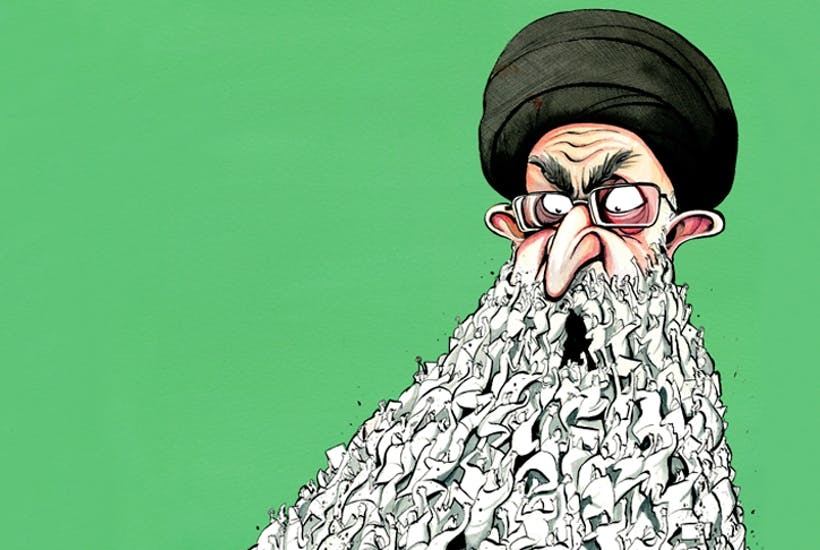
Liberal supporters of the US-Israeli killing of Ayatollah Ali Khamenei are straining to parry the charge that Operation Epic Fury is illegal. They say that Washington and Jerusalem are returning fire in a continuing war initiated by Iran, which has funded proxy terror organisations to target Americans and Israelis. It’s a good try but once you kill a country’s head of state in a targeted bombing, it’s hard to claim regime change wasn’t the object of the exercise.
If international law says Khamenei should still be in place, maybe international law deserves to be detonated along with him
Customary international law, as commonly understood, does not permit the violation of another state’s sovereignty to change its government by force. There is a body of opinion that finds the responsibility to protect insufficient and believes there must be licit grounds on which to remove tyrants who oppress their own people and pose a threat to other nations.
If ever there was an action that bolstered the case for a ‘right to regime change’ it is surely Iran. The Islamic republic is a total tyranny in which the structure of government makes regime change in a liberal or democratic direction almost impossible to achieve. Want to mount a serious electoral challenge to the regime? Good luck getting your candidates approved by the Guardian Council. Somehow manage to push reform legislation through the Consultative Assembly? The Guardian Council has a veto.
Technically, the directly elected Assembly of Experts could oust a Supreme Leader but it never has, nor murmured so much as a cough of dissent, probably because candidates to this body must be approved by, you guessed it, the Guardian Council. There is a Reformist faction, of course. At the last elections for the Assembly of Experts, the Reformists — or those who were permitted to stand as candidates — secured a whole two per cent of the vote. Toppling the Islamic regime without force is to all intents and purposes impossible.
To non-interventionists, this doesn’t change anything. There are dictatorships across the globe oppressing their own people right now. We can’t overthrow all of them and, even if we could, is it a matter for us? We can all agree, unless we had the misfortune to attend a British university anytime in the last quarter-century, that Islamism is barbaric and the regimes it produces are backwards and despotic, but does that create a moral duty to risk the lives of our military personnel and expend taxpayers’ money trying to bring democracy to the most politically unstable region on Earth? Not our fight. Leave well enough alone.
These considerations are not easily dismissed. Remove a cruel regime without a plan for the day after and you risk unleashing infinitely more cruelty on the long-suffering population. Make a particularly poor fist of it and significant numbers will flee and end up claiming refuge in the European Union or the UK. We certainly don’t need any more unaccompanied young men storming in from regressive cultures. Plus, create an exemption for regime change and rogue states will misuse it to destabilise rival states or as a means of settling disputes, such as Taiwan or Gaza. Indeed, Russia has asserted a right comparable to this in its invasion of Ukraine, which it originally premised on safeguarding the welfare of Russian-speaking people refused self-determination by Kyiv. In international law, every tool eventually becomes a cudgel.
Defenders of international law might make common cause with non-interventionists on the subject of regime change, but any alliance can only ever be temporary. Those who are philosophically opposed to intervention in any circumstances tend, for the most part, to be sceptical of international humanitarian law, seeing it as an encroachment on state sovereignty. International law and foreign policy realism will always be awkward bedfellows.
International legal theorists and practitioners need an answer to the regime change question. Either work to establish a consensus on the lawful removal of a despotic regime or double down on the status quo. The latter would be the easiest course of action, but not necessarily the wisest. All weekend, the general public has been bombarded with images of Iranians celebrating the death of their oppressor, waving Israeli and American flags in gratitude, and talking about their people’s suffering at the hands of the Islamic republic. The public has been bombarded too with activists, ideologues and academics repeating the same mantra: ‘This is a violation of international law.’
It might well be, and what does that say about international law? That it required these people dancing in the streets to be cowering still in fear? That it involved disapproving of the regime’s barbarity while blocking any action to stop it? That respecting international law means accepting the sovereignty and legitimacy of a country where beating women and publicly hanging gays are national pastimes? If international law says Khamenei should still be in place, maybe international law deserves to be detonated along with him.





Comments